

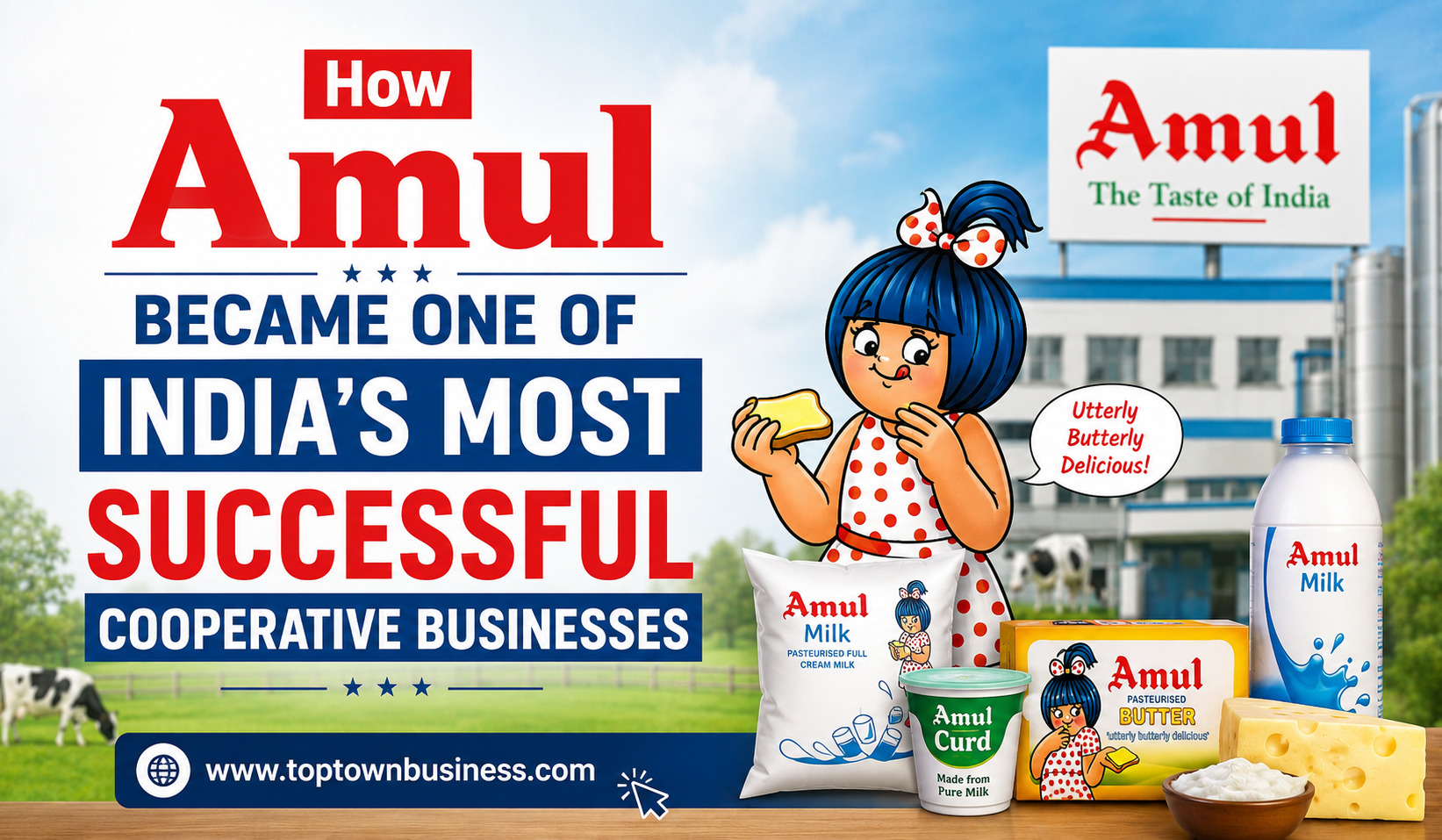
Amul is one of the most recognizable brands in India, but its story is very different from that of a conventional consumer company. It was not built around a single private owner or a traditional corporate structure. Instead, its foundation lies in the collective strength of dairy farmers who came together to create a cooperative that could give them greater control over their milk, income and future.
From a small cooperative started in Gujarat in 1946, Amul developed into a nationwide dairy movement and eventually became a powerful food brand. Its journey combined farmer ownership, professional management, large-scale processing, strong distribution and memorable marketing.
The success of Amul is therefore not simply a business story. It is also a story about how cooperation can turn thousands and eventually millions of small producers into a powerful economic force.
The Beginning of Amul
The roots of Amul can be traced to Anand in Gujarat’s Kheda district in the 1940s. At that time, dairy farmers faced problems with milk procurement and the role of middlemen. Farmers had limited control over pricing and often had to depend on intermediaries to sell their milk.
The situation eventually encouraged farmers to organize themselves.
In 1946, dairy farmers formed the Kaira District Co-operative Milk Producers’ Union Limited. The cooperative initially began with just two village societies and around 247 litres of milk per day. Its objective was straightforward: create a system in which milk producers could collectively control procurement and marketing instead of depending on middlemen.
This simple idea became the foundation for what would eventually become the Amul model.
The Role of Sardar Vallabhbhai Patel
The cooperative movement in Kaira was strongly influenced by Sardar Vallabhbhai Patel, who encouraged farmers to organize themselves rather than remain dependent on private milk traders.
Farmer leader Tribhuvandas Patel also played an important role in building the cooperative and providing leadership during its early years.
The idea was revolutionary for its time. Instead of competing individually, farmers would work together, pool their milk and create a collective organization capable of negotiating with buyers and investing in processing facilities.
This created the foundation for a business model in which farmers were not simply suppliers. They were members and owners of the cooperative system.
That distinction became one of Amul’s biggest strengths.
How the Amul Cooperative Model Works
The Amul model is based on a three-level cooperative structure.
At the village level, dairy farmers become members of village cooperative societies. These societies collect milk from farmers and send it to district-level milk unions.
The district unions handle processing and other dairy operations. At the state level, the Gujarat Cooperative Milk Marketing Federation, commonly known as GCMMF, brings the member unions together and manages marketing and distribution of products under the Amul brand.
This structure allows individual farmers to participate in a much larger business without having to build an entire processing, branding and distribution system on their own.
The model effectively connects farmers with consumers while reducing the dependence on unnecessary intermediaries.
Why Farmer Ownership Made Amul Different
One of the most important reasons behind Amul’s success is that the farmers remained at the center of the business.
In a conventional company, raw-material suppliers generally sell their products to the business and have limited involvement in how the final product is marketed.
The cooperative approach is different.
Amul’s farmers collectively own the cooperative institutions. This means the success of the business can directly benefit the people who supply its most important raw material: milk.
The model also creates a strong incentive for farmers to continue supplying quality milk because the cooperative’s success is connected to their own economic interests.
Amul has described its basic philosophy as creating a direct relationship between milk producers and consumers while ensuring remunerative returns for farmers.
The Importance of Dr. Verghese Kurien
Amul’s growth cannot be discussed without mentioning Dr. Verghese Kurien.
Kurien arrived in Anand in 1949 and became closely involved with the development of the Kaira cooperative. His professional management approach helped transform a small farmer organization into a sophisticated dairy business.
What made Kurien particularly important was his understanding that a cooperative could not succeed simply because farmers owned it. It also needed professional management, technology, efficient processing and strong marketing.
This combination became central to the Amul model.
Farmers provided ownership and direction, while professionals handled the technical and commercial aspects of the business.
That balance allowed Amul to remain farmer-focused while competing effectively in the organized food industry.
Turning Milk Into a Large-Scale Business
In its early years, Amul faced another major challenge: what to do with surplus milk.
Milk production could increase significantly during certain seasons, creating a surplus that the existing market could not absorb. Farmers could once again be forced to sell excess milk at unattractive prices.
The cooperative responded by investing in milk processing.
A major processing plant was established in Anand in the 1950s, allowing surplus milk to be converted into products such as milk powder and butter. The facility was inaugurated in 1955 and helped the cooperative expand its ability to process milk throughout the year.
This was a critical business decision.
Instead of simply selling fresh milk, Amul could create products with longer shelf lives and reach customers in different markets.
The cooperative was therefore moving from being a milk collection organization to becoming a diversified dairy business.
Building the Amul Brand
A strong cooperative alone would not have been enough to create a national consumer brand.
Amul needed a recognizable identity that consumers could trust.
The Amul brand became increasingly important as the cooperative expanded its product portfolio. Milk, butter, cheese, milk powder, ice cream and other dairy products allowed the company to reach consumers across different categories.
The brand name itself became closely associated with Indian dairy products and eventually developed a strong emotional connection with consumers.
This was a major achievement because Amul successfully combined the image of farmer ownership with the professionalism expected from a large consumer brand.
The Amul Girl and Memorable Advertising
Amul’s advertising strategy became another important reason for its popularity.
The Amul Girl, introduced in the 1960s, became one of India’s most recognizable advertising characters. The brand became famous for topical advertisements that responded to current events, popular culture and social conversations.
Rather than relying only on conventional product advertising, Amul developed a distinctive communication style.
The advertisements were usually simple, humorous and connected to what people were discussing at the time.
This helped Amul remain culturally relevant across generations.
Its advertising became so recognizable that the Amul brand itself became part of Indian popular culture.
Creating a Powerful Distribution Network
Producing good dairy products is only one part of building a successful food business. Those products also need to reach consumers efficiently.
Amul developed an extensive distribution system that allowed its products to reach markets across India.
The Gujarat Cooperative Milk Marketing Federation was established in 1973 as the apex marketing organization for Gujarat’s dairy cooperatives. Its role was to bring together the marketing efforts of different member unions and strengthen the overall Amul brand.
Instead of individual cooperatives competing against each other, the federation helped create a unified marketing and distribution strategy.
This provided Amul with the scale needed to compete with large private food companies.
Amul and India’s White Revolution
The influence of Amul extended far beyond its own business.
The success of the cooperative model inspired the broader dairy development movement in India. Dr. Verghese Kurien later became a central figure in the National Dairy Development Board, which was established in 1965 with the objective of replicating aspects of the Amul model across the country.
This became closely associated with Operation Flood, one of the world’s major dairy development programs.
The broader movement helped transform India’s dairy sector by organizing milk producers, improving milk procurement and connecting rural producers with growing urban markets.
Amul’s cooperative structure therefore became an example of how rural producers could participate in large-scale economic development.
Why Amul Has Remained Successful
Amul’s long-term success comes from several elements working together.
The first is farmer ownership. The people supplying milk are connected to the cooperative system rather than simply being outside suppliers.
The second is professional management. The business has consistently required expertise in dairy technology, processing, marketing, finance and distribution.
The third is scale. By bringing together large numbers of farmers, the cooperative can achieve efficiencies that individual small producers would struggle to achieve on their own.
The fourth is product diversification. Amul moved beyond fresh milk into butter, cheese, milk powder, ice cream, beverages and other dairy categories.
Finally, the company developed an unusually strong consumer brand. Its advertising and distribution strategy helped turn a farmer cooperative into a household name.
Amul’s Growth Into a Major Food Brand
The scale of the cooperative movement has increased enormously since Amul’s early years.
According to Amul’s own information, its wider cooperative model now involves millions of milk producers, village cooperative societies, district milk unions and state-level marketing federations.
GCMMF has also described itself as India’s largest food product marketing organization, with Amul becoming one of the country’s most significant food brands.
The significance of this growth lies in what it represents.
Amul did not grow by replacing farmers with large industrial suppliers. It grew by organizing farmers and connecting their production to a modern processing and marketing system.
What Other Businesses Can Learn From Amul
Amul’s story offers several important lessons for entrepreneurs and businesses.
One of the biggest lessons is that a strong business model begins with solving a real problem. Amul was created because farmers needed a better way to market their milk and receive fairer returns.
Another lesson is the importance of scale. Small producers can become commercially powerful when they work together and share infrastructure.
Amul also demonstrates that social objectives and commercial success do not necessarily have to conflict. A business can focus on improving the position of its producers while building a strong consumer brand.
Most importantly, Amul shows that ownership, professional management and innovation can work together.
The Future of the Amul Model
Amul has already survived several generations of changing consumer habits, competition and technological development.
The dairy market continues to evolve, with consumers looking for convenience, new product categories, healthier choices and greater variety.
Amul’s ability to respond to these changes while protecting the basic principles of its cooperative model will be important for its future.
The larger cooperative movement also remains significant for rural India because it provides a framework through which small producers can participate in organized markets.
As India’s food and dairy markets become more competitive, Amul’s biggest advantage may continue to be the combination of farmer ownership, scale, consumer trust and a powerful national brand.
Conclusion
Amul’s journey from a small cooperative in Anand to one of India’s most successful food brands is one of the country’s most remarkable business stories.
It began with farmers who wanted greater control over the sale of their milk. Through collective ownership, professional management, investment in processing, strong distribution and memorable marketing, that small movement developed into a major dairy business.
The real strength of Amul is that its success is connected to the success of its farmer members. The cooperative model gave small producers the ability to participate in a business much larger than any one farmer could have created alone.
That is why Amul remains more than a dairy brand. It is an example of how cooperation, entrepreneurship and professional management can come together to create a sustainable business model with a lasting economic and social impact.