

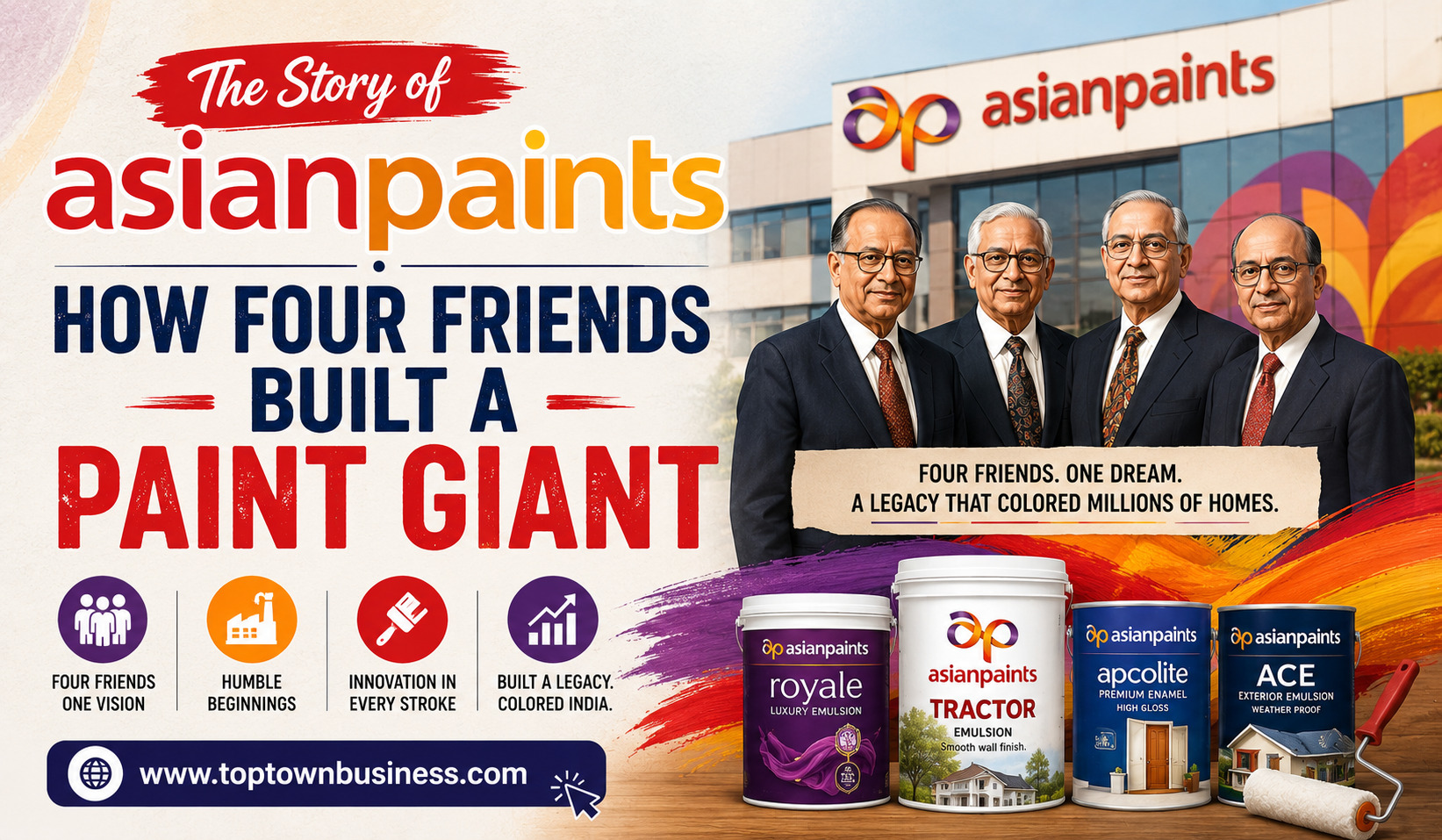
Asian Paints is one of the most successful business stories to emerge from India. What makes the company’s journey particularly interesting is that it did not begin with a large industrial group, wealthy investors or an established corporate network. It started in 1942 with four friends who decided to build a small paint business during a difficult period in India’s history.
Over the decades, that small venture grew into a major paints and home décor company with a presence across multiple countries. Asian Paints transformed itself from a manufacturer of paints into a consumer-focused brand associated with colours, homes, design and renovation.
The story of Asian Paints shows how a business can grow by understanding customers, building distribution, investing in technology and continuously adapting to changes in the market.
How Asian Paints Started
Asian Paints was founded in 1942 by four friends: Champaklal Choksey, Chimanlal Choksi, Suryakant Dani and Arvind Vakil.
The company began during a period when India was still under British rule. The founders started the business with limited resources and entered a market that already had established international paint companies.
Their initial ambition was relatively simple: create a successful Indian paint company.
The early years were challenging. The company had to compete with larger and better-established players while operating in a market where consumers were already familiar with foreign brands.
However, the founders believed there was an opportunity to build an Indian company that understood local customers and could provide products suited to the country’s growing market.
That approach eventually became one of Asian Paints’ biggest strengths.
Growing During a Difficult Period
The early 1940s were not an easy time to start a manufacturing business.
World War II created major disruptions in international trade and affected the availability of several imported products in India. For a young Indian paint company, these conditions created both challenges and opportunities.
With imports becoming more difficult, domestic manufacturing became increasingly important.
Asian Paints used this changing environment to establish itself in the Indian market. Instead of relying on imported products, the company developed its own manufacturing capabilities and gradually increased its presence.
This was an important early lesson in the company’s history: difficult market conditions can sometimes create opportunities for businesses that are willing to adapt.
From a Small Company to a Growing Manufacturer
In its early years, Asian Paints focused heavily on building a strong manufacturing base.
The company gradually expanded its production capabilities and distribution network. As demand for paints increased, Asian Paints invested in manufacturing facilities and improved its ability to serve customers across different parts of India.
But manufacturing alone was not enough.
Paint is a product that reaches consumers through a complicated chain involving manufacturers, distributors, dealers, contractors, painters and homeowners.
Asian Paints began developing a strong relationship with this entire ecosystem.
Its distribution network became one of the company’s most important competitive advantages.
Understanding the Indian Consumer
One of the reasons Asian Paints became successful was its understanding that paint was not simply an industrial product.
For homeowners, choosing paint is closely connected to emotions, lifestyle and personal taste.
A family painting its house is not simply buying litres of paint. It is making a decision about how its home should look and feel.
Asian Paints recognized this shift and increasingly positioned itself as a consumer brand rather than simply a paint manufacturer.
This change helped the company connect with ordinary households.
The Power of the Asian Paints Brand
Brand building became a major part of Asian Paints’ strategy.
The company developed advertising campaigns that focused on homes, family life, celebrations and the emotional importance of colour.
One of the most famous examples was the “Mera Wala Pink” campaign, which showed how paint could become a form of personal expression.
Another major part of Asian Paints’ brand identity was the idea that every customer could find a colour suited to their individual taste.
Instead of telling consumers simply to buy paint, the company encouraged them to think about colours and how those colours could transform their homes.
This helped Asian Paints establish a strong emotional connection with customers.
The Famous Gattu Character
Asian Paints also became famous for its advertising mascot, Gattu.
Created in the 1950s by cartoonist R. K. Laxman, Gattu became one of India’s most recognizable advertising characters.
The character helped make Asian Paints more approachable and memorable.
At a time when advertising was becoming increasingly important in consumer markets, Gattu gave the company a distinctive identity.
The mascot became associated with Asian Paints for decades and helped establish the company as a household brand rather than an unknown industrial manufacturer.
Building a Powerful Dealer Network
A major reason for Asian Paints’ success was its distribution strategy.
The company developed strong relationships with dealers and retailers across India. This allowed its products to reach consumers in both large cities and smaller towns.
The dealer network was particularly important because paint purchases often involve recommendations from retailers and professional painters.
Asian Paints worked to create an ecosystem around its products instead of treating dealers simply as sales outlets.
This approach made its distribution network difficult for competitors to replicate quickly.
The company also invested in technology to improve inventory management and supply-chain efficiency.
Technology Became a Competitive Advantage
Asian Paints understood that a large distribution network needed sophisticated technology behind it.
The company became known for using technology and data to improve forecasting, manufacturing and distribution.
One important objective was to make sure the right products were available at the right locations without creating unnecessary inventory.
The company also used technology to understand consumer demand and manage its extensive network more efficiently.
This combination of technology and distribution became a powerful advantage.
While customers saw the brand and its advertisements, a complex supply chain worked behind the scenes to ensure products reached stores efficiently.
Moving Beyond Paint
As the company grew, Asian Paints realized that homeowners needed much more than paint.
A person renovating a home might also require waterproofing solutions, wall coverings, adhesives, decorative finishes, kitchen products, bathroom solutions and other home improvement services.
Asian Paints gradually expanded into these categories.
This represented a major change in the company’s business model.
Instead of being only a paint manufacturer, Asian Paints increasingly positioned itself as a home décor and home improvement company.
This strategy gave the company more opportunities to interact with consumers and generate revenue from different stages of the home renovation process.
Expanding Internationally
Asian Paints eventually expanded beyond India and established operations in several international markets.
The company has built a presence across Asia, the Middle East and Africa through subsidiaries and businesses in different countries.
International expansion allowed Asian Paints to diversify its business and gain experience in markets with different consumer preferences.
However, entering international markets also required the company to understand local cultures, competition and economic conditions.
The experience helped Asian Paints develop into a more global organization while maintaining India as its most important market.
The Importance of Innovation
Innovation has remained an important part of Asian Paints’ development.
The company has invested in new products, colour technology and digital tools designed to make the painting process easier for consumers.
One example is the growing use of digital colour-selection and visualization tools that allow customers to explore how different shades might look in their homes.
This is particularly useful because choosing a paint colour can be difficult when customers cannot easily imagine the final result.
By using technology to make that decision easier, Asian Paints has extended its relationship with consumers beyond the traditional paint shop.
From Paint Manufacturer to Home Décor Brand
Perhaps the biggest transformation in Asian Paints’ history has been its move into the broader home décor market.
The company has expanded its offerings to cover different aspects of home improvement and decoration.
This strategy is based on a simple idea: customers do not think about their homes in separate product categories.
Someone renovating a living room may need paint, furniture, lighting, décor and other products at the same time.
By expanding its portfolio, Asian Paints can participate in more of these decisions.
This also reduces the company’s dependence on traditional decorative paints alone.
What Made Asian Paints Successful?
Several factors have contributed to Asian Paints’ long-term success.
The first is its strong understanding of Indian consumers. The company learned how to make an industrial product relevant to families and homeowners.
The second is its extensive distribution network. Making paint available across a large country requires strong logistics and relationships with thousands of retailers.
The third is branding. Asian Paints invested heavily in advertising and created memorable campaigns that made the brand part of everyday Indian life.
The fourth is technology. Data, automation and digital tools have helped the company improve its operations and customer experience.
Finally, the company has continued to evolve. It did not remain dependent on its original business model but expanded into new products, services and international markets.
Lessons Entrepreneurs Can Learn From Asian Paints
The Asian Paints story offers several valuable lessons for entrepreneurs.
A company does not necessarily need to begin with enormous resources to build a powerful business. Strong execution and a clear understanding of the market can be equally important.
The company also shows the importance of distribution. A great product cannot become a national brand if customers cannot easily find it.
Another lesson is the power of branding. Asian Paints turned an ordinary household product into something connected with emotions, lifestyle and personal identity.
Perhaps the most important lesson is adaptability. Markets change, consumer expectations evolve and new technologies emerge. Companies that continue to reinvent themselves have a better chance of remaining relevant.
The Future of Asian Paints
The Indian home improvement market continues to evolve as consumers become more interested in interior design, premium finishes, personalization and convenient renovation services.
Asian Paints is well positioned to participate in this changing market because it already has a strong consumer brand, extensive distribution and a large network of dealers and professionals.
Its future growth may increasingly come from home décor, premium products, technology-enabled services and deeper consumer engagement.
At the same time, competition in India’s decorative paints market remains intense. Maintaining product innovation, customer trust and operational efficiency will be important for the company’s continued success.
Conclusion
The story of Asian Paints is a remarkable example of Indian entrepreneurship.
Four friends started a small paint company in 1942. Over the decades, the business evolved through manufacturing, distribution, branding, technology and innovation to become a major player in the paints and home décor industry.
What made Asian Paints different was not simply its ability to manufacture paint. It understood how consumers think about their homes and transformed a functional product into an emotional lifestyle choice.
Its journey demonstrates that building a lasting company requires more than selling a good product. It requires strong distribution, memorable branding, customer understanding, continuous innovation and the willingness to change with the market.
From a small venture started by four friends to a major Indian business, Asian Paints remains one of the country’s most interesting examples of how an ordinary product can become the foundation of an extraordinary brand.