
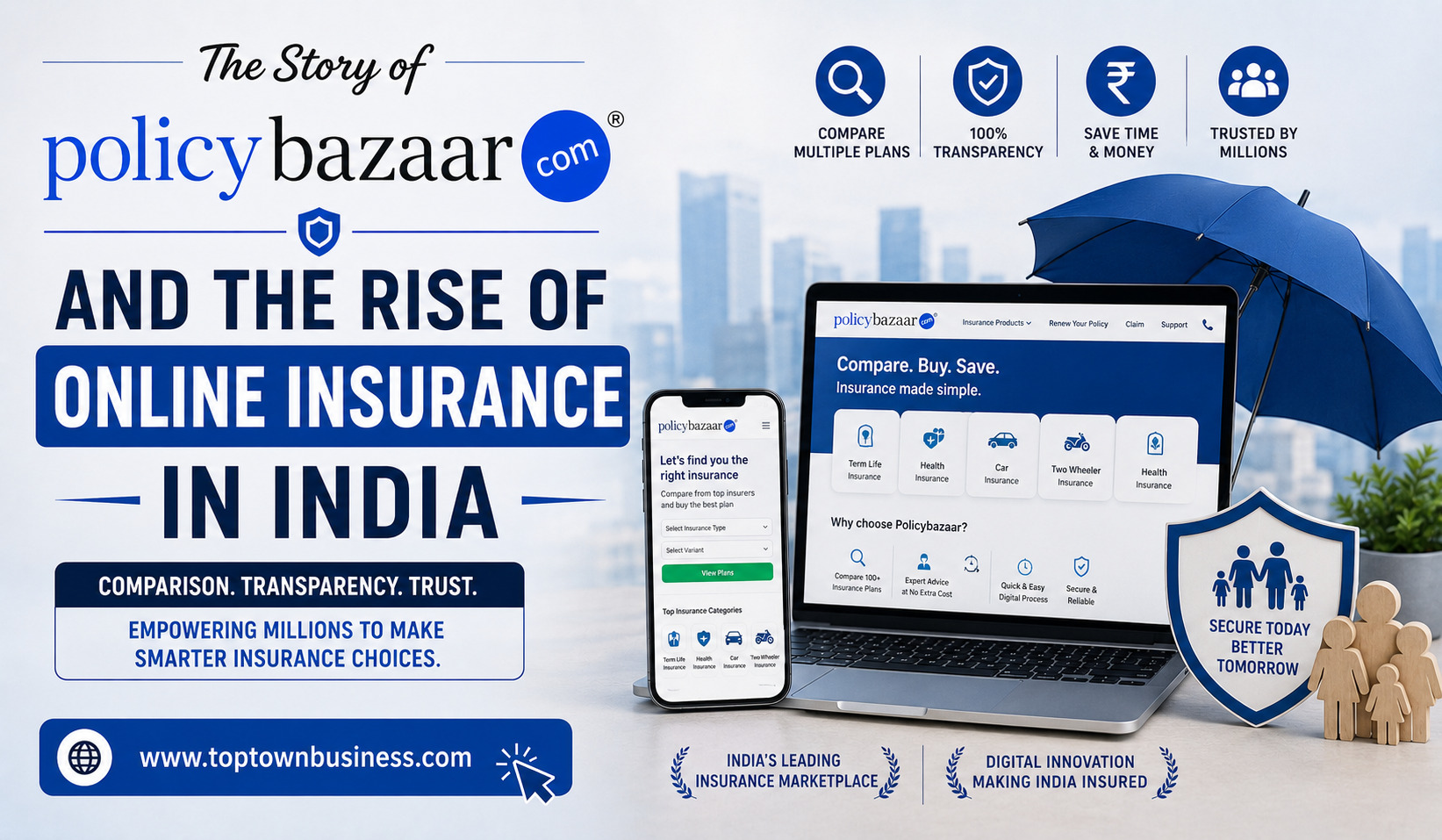
Buying insurance in India was once largely an offline experience. Customers often depended on agents to explain policies, compare plans and complete paperwork. Understanding the difference between premiums, coverage, exclusions and policy terms could be difficult for people who were unfamiliar with insurance.
Policybazaar entered this market with a different idea: use the internet to make insurance easier to understand and compare.
Founded in 2008, Policybazaar started with the objective of bringing greater transparency to insurance. The platform gradually evolved from an insurance comparison website into a large digital insurance marketplace, helping millions of consumers research, compare and purchase policies online.
Its growth is closely connected with the rise of India’s digital economy. As internet access, smartphones and online payments became more common, consumers became increasingly comfortable making important financial decisions online. Policybazaar was positioned at the intersection of these changes.
The Problem Policybazaar Wanted to Solve
When Policybazaar was launched, buying insurance could be a confusing process.
Customers typically had to contact individual insurance agents or companies to understand their options. Comparing policies from different insurers was not always straightforward, and consumers often had limited information before making a purchase.
The founders saw an opportunity to bring more information into one place.
Instead of asking consumers to visit multiple insurers individually, Policybazaar created a digital platform where different insurance products could be compared.
The company’s stated objective from the beginning was to simplify insurance information, improve transparency and reduce mis-selling.
This was an important shift because the company was not simply trying to sell another insurance product. It was attempting to change how consumers discovered and evaluated insurance.
How Policybazaar Started
Policybazaar was founded in 2008 by Yashish Dahiya, Alok Bansal and Avaneesh Nirjar.
The company initially focused on providing information and comparisons around insurance policies. Its early model was based on helping consumers understand different plans before making a decision.
This consumer-first approach helped distinguish Policybazaar from a conventional insurance sales operation.
The platform brought information about different insurance providers together, allowing consumers to compare products based on factors such as premiums, coverage and features.
As India’s internet population expanded, this model became increasingly relevant.
From Comparison Website to Insurance Marketplace
Policybazaar’s business model gradually evolved.
In its early years, the primary value proposition was comparison and information. Over time, the platform became more involved in the complete insurance journey.
This included helping customers research policies, submit applications, complete documentation and manage policies after purchase.
PB Fintech’s annual report describes Policybazaar as a technology-driven, self-service platform covering pre-purchase research, purchase and post-purchase policy management, including renewals and claims facilitation.
This broader role was important for the company’s growth.
Instead of being just a website where customers compared prices, Policybazaar became part of the entire insurance lifecycle.
Making Insurance Easier to Compare
Comparison became one of Policybazaar’s most important advantages.
Insurance products can differ significantly even when they appear similar at first glance. Two health insurance policies, for example, may have different coverage limits, exclusions, waiting periods and additional benefits.
Similarly, term insurance policies can differ in premiums and features depending on the customer’s age, health and coverage requirements.
A digital platform can organize this information in a way that makes comparison easier.
Policybazaar’s model allowed consumers to explore products from multiple insurers rather than depending entirely on information provided by one company or one agent.
This helped create a more informed customer.
Technology Changed the Insurance Buying Process
Technology became central to Policybazaar’s business.
The company developed digital processes for activities that traditionally required paperwork and physical interaction.
Online applications, digital documentation, e-KYC, medical checks and other technology-supported processes helped make policy issuance more convenient.
PB Fintech has described its technology as being designed to reduce human intervention and provide a more convenient customer experience.
This was particularly important as Indian consumers became more comfortable completing financial transactions through smartphones.
The shift toward digital payments and online verification created an environment in which insurance could increasingly move online.
Building Consumer Trust
Trust is especially important in insurance.
Customers are purchasing financial protection for uncertain future events, which means they need confidence not only in the insurer but also in the information they receive before buying a policy.
Policybazaar attempted to build trust by giving customers access to information from multiple insurers.
The company positioned itself around transparency and consumer choice rather than simply promoting one insurance provider.
Its business model has been described as consumer-pull based, meaning customers come to the platform to research their requirements and find suitable products from insurer partners.
This helped create a different relationship between consumers and insurance providers.
The Growth of Online Insurance in India
Policybazaar’s rise cannot be separated from the broader digital transformation of India.
Over the past decade, smartphones, affordable internet access and digital payments have changed the way Indians shop for financial products.
Consumers who once visited branches for banking services increasingly began using mobile applications. Online investment platforms changed how people bought mutual funds and stocks. E-commerce made customers comfortable purchasing products without visiting physical stores.
Insurance gradually followed the same path.
Policybazaar benefited from this transition because its business was designed around online discovery and comparison.
As more consumers searched the internet for financial information, the opportunity to research insurance online became much larger.
Expanding Into Different Insurance Categories
Policybazaar did not remain limited to one type of insurance.
The platform expanded across categories such as life insurance, health insurance, motor insurance and other protection products.
This diversification allowed the company to address different financial needs throughout a customer’s life.
A young consumer might initially visit the platform to understand term insurance. Later, the same customer could need health insurance or motor insurance.
By offering multiple categories, Policybazaar could build longer-term relationships with customers.
The company also expanded the range of insurers and products available through its platform, giving consumers more options.
The Importance of Data and Analytics
Data has become another important part of Policybazaar’s business model.
Insurance companies need information about customer profiles, risks and preferences when developing and pricing products.
A large digital platform can observe broad patterns in consumer demand and provide insights to its insurance partners.
PB Fintech has described how Policybazaar uses consumer data and behavioural insights to help insurer partners improve risk assessment, underwriting and product development.
This creates a two-sided advantage.
Consumers get more choice and easier access to information, while insurers gain access to a large digital customer base and data-driven insights.
The Rise of Paisabazaar
Policybazaar’s success eventually led its parent company to expand into another financial-services category.
In 2014, PB Fintech launched Paisabazaar, a digital platform focused on consumer credit products.
Although Paisabazaar is separate from Policybazaar, the two businesses share a broader philosophy: make complicated financial products easier for consumers to discover, compare and access online.
This helped transform the company from an insurance-focused startup into a broader financial technology business.
The parent company eventually became known as PB Fintech, with Policybazaar and Paisabazaar as its flagship platforms.
Policybazaar’s IPO
A major milestone came in 2021 when PB Fintech went public.
The company’s IPO marked a significant moment in the development of India’s digital financial-services industry. PB Fintech’s shares began trading on Indian stock exchanges in November 2021, with an issue price of ₹980 per share and a listing price of ₹1,150.
The public listing demonstrated how far the company had progressed since its early days as an insurance comparison platform.
It also reflected the growing investor interest in India’s fintech sector and digital financial marketplaces.
From Startup to Large Digital Insurance Platform
The scale of Policybazaar has expanded significantly over the years.
The company says more than 16 million individuals have purchased insurance through its platform and that more than 42 million policies had been sold through the platform by FY2024. It also reported more than 77 million registered customers cumulatively during that period.
PB Fintech’s more recent company information reports 67.3 million insurance policies sold through its platforms up to March 2026.
These figures illustrate the scale of India’s shift toward digital insurance distribution.
Policybazaar’s growth is therefore not only a company success story. It reflects a broader change in consumer behaviour.
How Policybazaar Changed the Role of Insurance Agents
The rise of online insurance did not necessarily eliminate the need for human assistance.
Instead, it changed the role of insurance advisors and intermediaries.
Customers can now research policies online before speaking to an advisor. They may arrive at a conversation already understanding the basic differences between products.
Technology can handle many routine activities, while human assistance can remain useful for complex decisions or specific customer requirements.
Policybazaar has also developed partner-based distribution models that connect insurance advisors with digital tools.
This creates a hybrid model combining technology with human assistance.
Challenges Facing Online Insurance
Despite its growth, online insurance has its own challenges.
Insurance remains a complex financial product, and customers may still misunderstand exclusions, waiting periods or policy conditions even when information is available online.
Trust is another continuing issue.
Consumers need to know that comparisons are useful, information is accurate and policies are suitable for their actual needs rather than simply being the cheapest option.
Data privacy and cybersecurity are also increasingly important as more financial transactions move online.
For digital insurance platforms, maintaining consumer confidence will remain essential.
What Made Policybazaar Successful?
Several factors contributed to Policybazaar’s rise.
The first was timing. The company entered the market as India’s internet and digital economy were beginning to expand.
The second was the problem it chose to solve. Insurance was a complicated category where consumers genuinely needed more information and comparison.
The third was technology. Digital tools made it possible to compare products, complete applications and manage policies online.
The fourth was scale. As more consumers joined the platform, Policybazaar became more valuable to insurance companies seeking access to digital customers.
Finally, the company built its brand around transparency, choice and convenience rather than simply traditional insurance sales.
Lessons Entrepreneurs Can Learn From Policybazaar
The Policybazaar story offers several lessons for entrepreneurs.
One important lesson is to identify industries where consumers face information gaps.
Insurance is a perfect example because customers often struggle to understand complex products. A business that makes information easier to access can create significant value.
Another lesson is the importance of technology in transforming traditional industries.
Policybazaar did not invent insurance. Instead, it changed the way consumers discovered and purchased insurance.
The company also demonstrates the power of becoming a marketplace. By bringing consumers and insurers together, the platform created value for both sides.
Most importantly, Policybazaar shows that digital transformation is not simply about moving an offline process onto a website. It can involve redesigning the entire customer journey.
The Future of Online Insurance in India
India’s insurance market still has significant room for digital expansion.
As consumers become more financially aware and comfortable with online transactions, digital platforms are likely to play an increasingly important role in insurance distribution.
Artificial intelligence, data analytics and automation could make insurance recommendations, underwriting and claims processes more efficient.
At the same time, customers will continue to need clear explanations and trustworthy information.
Policybazaar’s future growth will depend on how effectively it can combine technology with consumer trust while adapting to changes in India’s insurance industry.
Its parent company is already building a broader financial-services ecosystem, with Policybazaar remaining its flagship insurance platform.
Conclusion
The story of Policybazaar is closely connected to the rise of online insurance in India.
What began in 2008 as an attempt to make insurance information more transparent gradually became a large digital marketplace connecting consumers with insurance companies.
Policybazaar helped change the traditional insurance-buying journey by making comparison, research and policy management more accessible online. Its growth was supported by India’s expanding internet economy, increasing smartphone adoption and growing consumer comfort with digital financial services.
The company’s journey also demonstrates an important business principle: successful disruption does not always require creating a completely new product. Sometimes, the opportunity lies in taking an existing industry and making it simpler, more transparent and easier for customers to navigate.
From comparing policies online to becoming part of a much larger digital financial ecosystem, Policybazaar’s story reflects how technology is reshaping the way Indians buy and manage financial protection.