
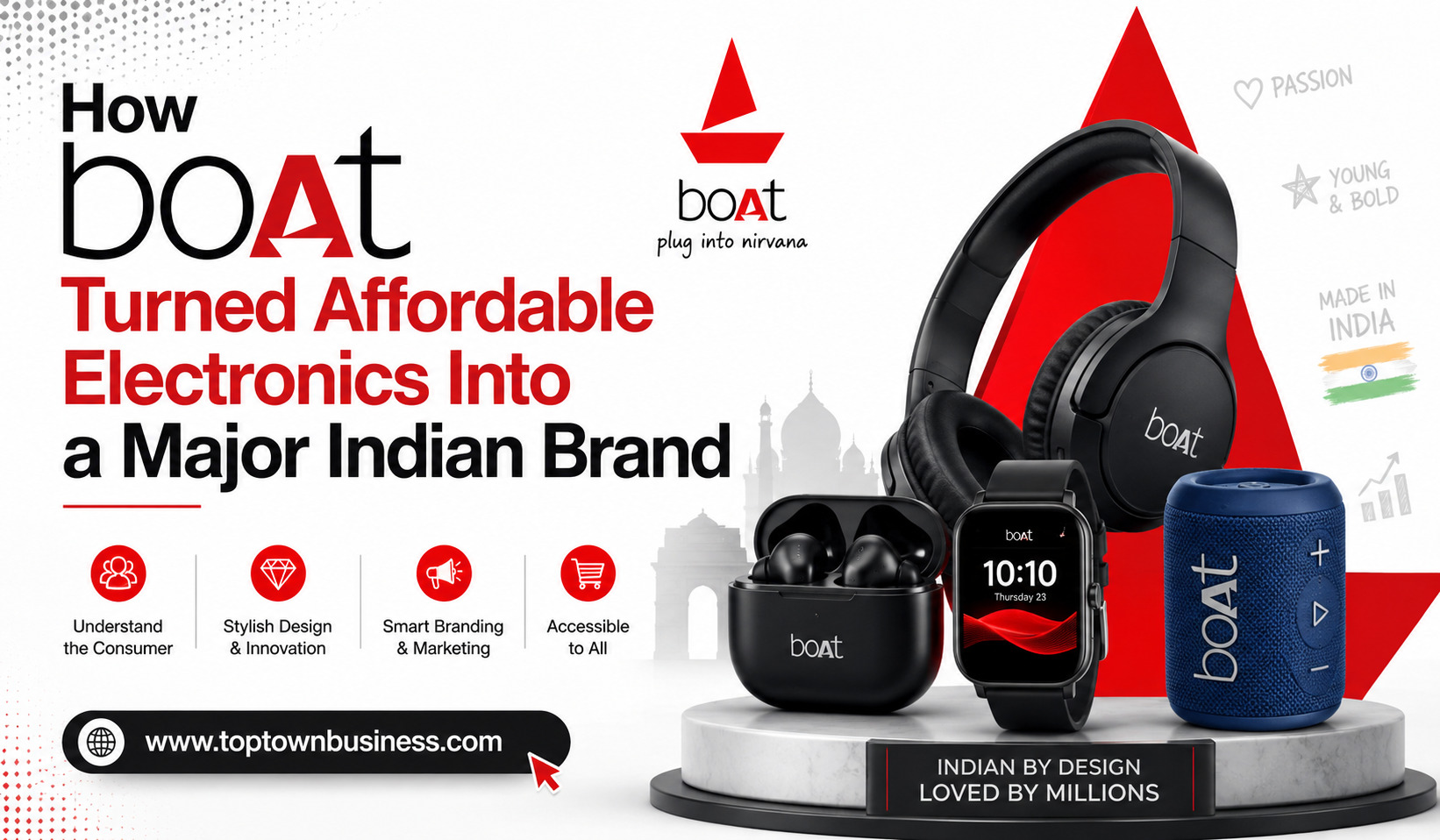
A few years ago, the Indian consumer electronics market was largely dominated by international brands. Companies such as JBL, Sony, Bose and other established names had strong recognition, particularly in audio products. For many Indian consumers, buying good-quality headphones, earphones or speakers often meant choosing between expensive global brands and inexpensive products with uncertain quality.
Then boAt entered the market with a different proposition: stylish, feature-rich and affordable electronics designed around the preferences of young Indian consumers.
Founded by Aman Gupta and Sameer Mehta, boAt began its journey in 2014 and formally launched its own products in 2016. The company initially focused on audio accessories before expanding into wireless earbuds, headphones, speakers, smartwatches and other consumer electronics.
Its rise is an interesting example of how an Indian startup used product design, digital marketing, celebrity partnerships, e-commerce and an understanding of young consumers to build a major consumer brand.
The Idea Behind boAt
The story of boAt began with a gap in the Indian electronics market.
Consumers wanted attractive and durable products, but premium international brands were often expensive. At the other end of the market were cheaper products that did not always offer the design, reliability or features consumers wanted.
Aman Gupta and Sameer Mehta believed there was room between these two extremes.
Their objective was to create products that were affordable without making consumers feel that they were buying a low-quality alternative.
The founders spent time researching consumer preferences before launching their own brand. Their research identified everyday problems with products such as charging cables and earphones, including durability, design and convenience.
This became the foundation of boAt’s strategy: understand what young consumers wanted and deliver it at a price they could realistically afford.
Starting With a Simple Problem
boAt did not begin by launching a huge range of electronic products.
One of its early products was a durable charging cable designed to address a familiar problem: cables breaking near the connector after repeated use.
The founders created a braided cable designed to withstand repeated bending and positioned it as a stronger alternative to ordinary charging cables.
This was an important lesson for the company.
Instead of trying to impress consumers with complicated technology, boAt focused on solving everyday problems.
The product also helped the founders understand how consumers responded to the brand and its pricing.
Once the company gained confidence, it expanded into the audio category.
Entering the Audio Market
The audio market became the heart of boAt’s early growth.
The company launched products including wired earphones, headphones, speakers and other accessories. One of its early insights was that Indian consumers had specific preferences when it came to music.
The founders believed that many Indian listeners preferred a powerful bass-heavy sound. boAt used this insight when developing products such as its BassHeads earphones.
This was an important difference from simply copying existing international products.
boAt attempted to adapt product characteristics to local preferences.
The company was not necessarily trying to beat premium brands by offering the most sophisticated technology. Instead, it aimed to offer consumers a combination of design, sound, durability and affordability.
The Middle-Priced Strategy
One of boAt’s most important decisions was avoiding a race to become the cheapest electronics company.
The founders understood that competing purely on price would be difficult because low-cost manufacturers could always offer cheaper alternatives.
Instead, boAt positioned itself between premium international brands and extremely low-cost electronics.
This gave the company room to focus on design and features while still maintaining accessible prices.
The strategy appealed particularly to young consumers who wanted products that looked modern but did not want to spend premium-brand prices.
In this way, boAt helped create a new space in India’s consumer electronics market.
Digital-First Growth
Another major reason behind boAt’s rapid rise was its understanding of how Indian consumers were changing the way they shopped.
E-commerce platforms such as Amazon and Flipkart were becoming increasingly important, particularly for younger customers.
boAt used these platforms to reach consumers without needing to immediately build a massive physical retail network.
Its early online presence also allowed the company to collect customer feedback quickly.
Product reviews became a valuable source of information about what consumers liked and disliked.
The company has said that community feedback and online reviews played an important role in improving its products.
This created a feedback loop: launch a product, listen to customers, identify problems and improve the next product.
Turning Customers Into a Community
boAt did something that many electronics companies struggled to achieve: it created a sense of community around an ordinary consumer product.
The company called its customers “boAtheads.”
Instead of presenting the brand as just another electronics manufacturer, boAt developed a lifestyle-oriented identity around music, fashion, sports and youth culture.
This made customers feel like they were part of something bigger than a product purchase.
The strategy was particularly effective among millennials and Gen Z consumers who often connect strongly with brands that reflect their interests and personality.
The company itself describes boAtheads as a community of consumers who identify with the brand’s lifestyle.
Marketing Became a Major Strength
Product quality and pricing helped boAt get started, but marketing helped turn it into a recognizable brand.
Instead of relying only on traditional advertising, boAt used social media, digital campaigns, influencers, celebrities and sports personalities to reach younger audiences.
The brand understood that its target customers spent significant amounts of time online.
Rather than simply saying that a pair of earphones had good sound, boAt connected its products with music, fitness, travel and entertainment.
This transformed the product from an electronic accessory into a lifestyle statement.
Celebrity Partnerships Changed the Brand’s Visibility
Celebrity marketing became another major part of boAt’s strategy.
The company worked with personalities from entertainment and sports to increase brand visibility.
This was particularly useful in smaller Indian cities, where celebrity recognition could help a relatively new brand gain credibility.
boAt has discussed how celebrity endorsements helped the company reach consumers across the country and strengthen brand awareness.
The strategy worked because boAt’s target customers were highly engaged with popular culture.
When consumers saw athletes, actors or musicians using or promoting a product, the electronics brand became more closely associated with the lifestyle they admired.
Understanding Young Indian Consumers
Perhaps boAt’s biggest strength was its understanding of its target audience.
The company did not attempt to appeal equally to everyone.
It focused heavily on young Indians who wanted affordable technology but also cared about appearance and personal style.
Colours, designs and product names were often created with this audience in mind.
This helped differentiate boAt from traditional electronics companies that sometimes focused more heavily on technical specifications.
boAt understood that consumers were not buying only a pair of earphones. They were buying something they would carry, wear and use publicly.
Design therefore became part of the product experience.
Expanding Beyond Earphones
Once boAt established itself in audio accessories, it began expanding into other categories.
The company moved into Bluetooth speakers, soundbars, headphones and other products. It later expanded significantly into wearables such as smartwatches and wireless earbuds.
This diversification allowed boAt to become a broader consumer electronics brand.
Instead of relying on one category, the company could serve customers across several everyday technology needs.
The move also increased the opportunities for customers to interact with the brand.
Someone who initially purchased a pair of earphones could later buy a smartwatch, speaker or another accessory from the same company.
The Rise of Wireless Audio
The shift from wired to wireless audio created another major opportunity for boAt.
Wireless earbuds and Bluetooth headphones became increasingly popular as smartphones evolved and consumers looked for greater convenience.
boAt was well positioned to take advantage of this trend because it had already built recognition among young consumers.
The company’s focus on affordable pricing made wireless products accessible to customers who might not have considered premium alternatives.
This helped accelerate its position in India’s rapidly expanding personal audio market.
From Startup to Major Consumer Brand
The speed of boAt’s growth was remarkable.
According to company-published material citing Registrar of Companies filings, its revenue increased from ₹27 crore in FY2017 to ₹108 crore in FY2018. The company also reported selling thousands of products daily during its early growth phase.
That rapid growth demonstrated that Indian consumers were willing to embrace a homegrown electronics brand.
boAt also attracted investment as its business expanded. Fireside Ventures became an early investor, while later financing helped support the company’s expansion.
However, funding alone did not create the brand.
The company had already developed a clear understanding of its target market and a business model built around affordable products and digital distribution.
Building an Indian Consumer Electronics Identity
One of boAt’s most significant achievements was helping change the perception of Indian consumer electronics brands.
Indian consumers had traditionally associated electronics with established international companies.
boAt demonstrated that an Indian company could compete through branding, product design, marketing and customer understanding.
The company’s success also encouraged other Indian consumer-tech startups to enter categories such as audio, wearables and accessories.
This contributed to the emergence of a broader Indian direct-to-consumer electronics ecosystem.
The Importance of Product Feedback
boAt’s growth also demonstrates why customer feedback can be valuable for consumer brands.
When products are sold online, customers leave reviews almost immediately.
Positive reviews can increase sales, while negative reviews can expose problems quickly.
Rather than ignoring this feedback, boAt used customer responses to identify opportunities for improvement.
The company has described using reviews and consumer insights to understand changing preferences and develop new products.
This helped the brand stay close to its target audience.
In a fast-moving electronics market, understanding what consumers want today can be more valuable than relying on assumptions based on what worked several years ago.
What Made boAt Successful?
Several factors came together to create boAt’s success.
First was its pricing strategy. The company offered products at accessible prices while trying to maintain a more premium look and feel.
Second was product-market fit. boAt focused on everyday problems and preferences relevant to Indian consumers.
Third was digital distribution. E-commerce allowed the company to reach customers across India without immediately depending on a huge physical retail network.
Fourth was branding. boAt turned electronics into lifestyle products through design, social media and celebrity marketing.
Finally, the company built a community around its customers rather than treating every purchase as a one-time transaction.
These factors created a business model that was difficult to replicate simply by offering cheaper electronics.
Challenges Ahead
The consumer electronics market is now far more competitive than when boAt entered it.
Indian and international companies compete aggressively in earbuds, headphones, smartwatches and other connected devices.
Price competition has also increased, while consumers have become more knowledgeable about specifications and product quality.
For boAt, maintaining its brand appeal will require continued innovation.
The company will need to develop products that are not only affordable but also reliable, technologically relevant and visually appealing.
It will also need to balance rapid product launches with quality and customer service.
The Future of boAt
boAt’s ambitions now extend well beyond its original audio-accessory business.
The company describes itself as a consumer electronics brand covering categories such as wireless earphones, headphones, smartwatches and home audio.
Its future growth could increasingly depend on wearables, connected devices, smart audio and other technology categories.
Another important opportunity is the growth of electronics manufacturing in India.
As the Indian government and industry push for greater domestic electronics production, companies such as boAt have opportunities to develop stronger local manufacturing and supply-chain capabilities.
The company will also have to compete internationally if it wants to transform itself from a major Indian brand into a truly global consumer electronics company.
Conclusion
The rise of boAt is one of India’s most interesting modern consumer-brand stories.
Aman Gupta and Sameer Mehta identified a gap between expensive international electronics and low-cost products that often lacked the combination of quality, design and reliability consumers wanted.
They built boAt around that opportunity.
The company focused on affordable products, Indian consumer preferences, digital distribution, strong branding and a close relationship with its customers. It turned earphones, charging cables and headphones from ordinary electronic accessories into lifestyle products.
Most importantly, boAt demonstrated that an Indian company could compete in a category traditionally dominated by international brands.
Its journey from a small startup to a major Indian consumer electronics brand shows that understanding customers can be just as important as having cutting-edge technology.
The real boAt story is therefore not simply about affordable electronics. It is about how the right combination of price, product, design, digital marketing and consumer insight can turn an ordinary product into a powerful Indian brand.
:::