
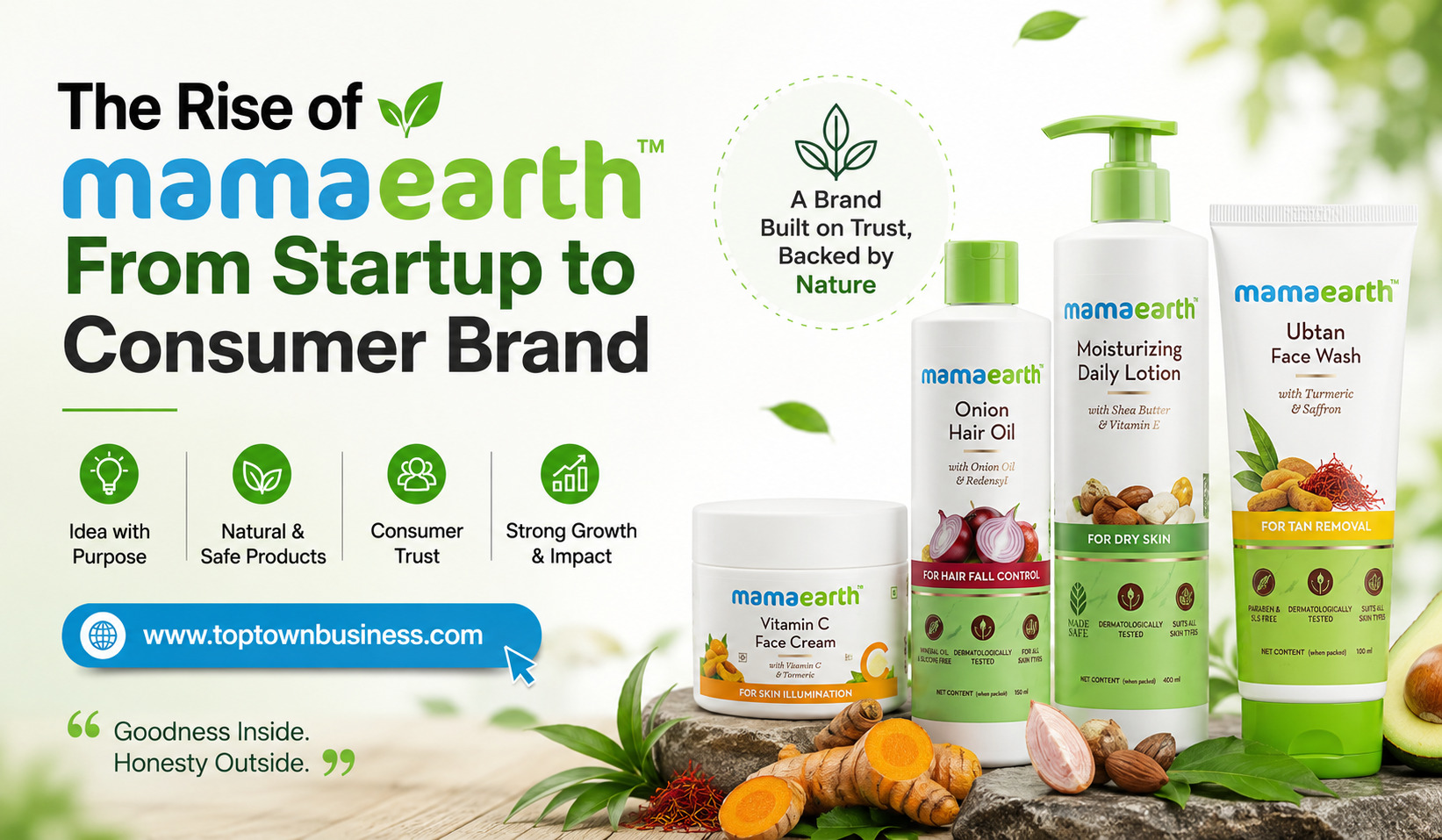
Mamaearth is one of the most recognizable names to emerge from India’s direct-to-consumer (D2C) revolution. What started as a small startup focused on baby-care products eventually grew into a major beauty and personal-care brand with a much wider product portfolio. Its journey is a strong example of how identifying a genuine consumer problem, building a relatable brand and using digital marketing effectively can transform a startup into a household name.
Founded in 2016 by husband-and-wife entrepreneurs Varun Alagh and Ghazal Alagh, Mamaearth was created after the couple struggled to find products they considered safe enough for their young child. Their personal experience became the starting point for a business that would later expand far beyond baby care.
The Idea Behind Mamaearth
The story of Mamaearth began with a simple problem. As new parents, Varun and Ghazal Alagh were increasingly concerned about the ingredients used in baby-care products available in India. They wanted products that offered greater transparency and met the safety standards they were looking for.
Instead of treating the problem as a personal inconvenience, they saw a larger market opportunity. Many young Indian parents were becoming more informed about product ingredients and actively searching online before making purchasing decisions.
Varun brought experience from the consumer goods industry, having worked with companies including Hindustan Unilever, Diageo and Coca-Cola. Ghazal brought a different perspective, with a background in art, design and entrepreneurship. Together, they decided to build a brand around the changing expectations of modern Indian consumers.
Mamaearth launched in December 2016 with just six baby-care products.
Finding Its Place in India’s D2C Market
When Mamaearth entered the market, India’s e-commerce ecosystem was developing rapidly. Consumers were becoming increasingly comfortable buying personal-care products online, while social media was creating new ways for brands to communicate directly with customers.
Mamaearth understood this shift early.
Rather than depending entirely on traditional advertising and large retail networks, the company focused heavily on digital channels. Its website, e-commerce marketplaces, social media campaigns, influencers and customer communities became important parts of its growth strategy.
The brand also tried to make its communication easy for consumers to understand. Instead of presenting itself simply as another personal-care company, Mamaearth built its identity around concerns such as ingredients, safety, natural positioning and responsible consumption.
This helped the brand connect particularly well with digitally active young parents and consumers who were researching products before purchasing them.
From Baby Care to a Wider Beauty Brand
One of Mamaearth’s biggest strategic moves was expanding beyond its original baby-care category.
The company gradually entered skincare, haircare and other personal-care segments. This allowed it to target not only parents but also teenagers, young adults and families looking for everyday beauty and personal-care products.
According to EY, the business expanded from six products to around 140 products across categories such as baby care, skincare and haircare during its early growth phase.
This diversification was important because it reduced Mamaearth’s dependence on a single category. Customers who first discovered the company through baby products could potentially purchase shampoos, face washes, moisturizers, hair products and other items from the same brand.
Over time, Mamaearth became the flagship brand of Honasa Consumer, the parent company founded by the Alaghs. Honasa subsequently developed a broader portfolio of beauty and personal-care brands, turning the business from a single-brand startup into a larger consumer company.
The Power of Digital Marketing
Marketing played a major role in Mamaearth’s rise.
The brand emerged at a time when traditional advertising was no longer the only way to build consumer awareness. Instagram, YouTube, blogs, online marketplaces and influencer communities created new opportunities for young companies.
Mamaearth used these platforms to educate consumers, promote products and create conversations around personal care. Its communication often focused on everyday consumer concerns rather than complicated technical messaging.
Customer feedback also became an important part of the company’s approach. In its early years, the founders interacted closely with consumers and influencers to understand how products were being received and what customers wanted next.
This created a feedback loop: consumers helped identify problems, the company developed products around those needs, and digital channels helped introduce those products to a wider audience.
Building a Recognizable Consumer Brand
Mamaearth’s growth was not only about selling personal-care products. It was also about building a recognizable identity.
Its packaging, product names, online campaigns and communication were designed to make the brand approachable to younger consumers. The company positioned itself as a modern Indian personal-care brand rather than simply another traditional FMCG label.
That positioning helped Mamaearth stand out in a crowded market.
The company’s success also demonstrated the changing relationship between consumers and brands. Indian shoppers were increasingly willing to discover new products online, read reviews, compare ingredients and follow recommendations from creators and influencers.
Mamaearth benefited from this behavioral shift.
From Startup to Major Business
As the brand expanded, Honasa Consumer attracted significant investor interest and grew into one of India’s notable consumer startups. The parent company became a unicorn in 2022, reflecting the scale of investor expectations around India’s digital-first beauty and personal-care market.
The next major milestone came in November 2023, when Honasa Consumer became publicly listed on the National Stock Exchange and Bombay Stock Exchange.
Going public marked an important transition. Mamaearth was no longer simply a startup experimenting with the D2C model. It had become part of a publicly listed consumer-business ecosystem.
The company’s strategy also increasingly included offline retail. This was significant because beauty and personal-care purchases in India are still strongly influenced by physical stores and wider distribution.
By December 2024, Mamaearth had reached more than 216,000 FMCG retail outlets in India, according to a company disclosure citing NielsenIQ data.
The Evolution of Honasa Consumer
The larger story behind Mamaearth is the evolution of Honasa Consumer.
After establishing Mamaearth, the company began building a portfolio of brands aimed at different consumer needs. These included The Derma Co., Aqualogica, BBlunt and Dr. Sheth’s, among others.
This “house of brands” strategy allowed Honasa to operate across different beauty and personal-care categories rather than relying entirely on Mamaearth.
It also reflects an important lesson in consumer business: a successful brand can create the foundation for a much larger company, but long-term growth may require entering new categories and serving different consumer segments.
Challenges and the Road Ahead
Mamaearth’s journey has not been without challenges. The beauty and personal-care industry is highly competitive, with established FMCG companies, specialist brands and new digital-first startups constantly fighting for consumer attention.
Changing consumer preferences have also forced the company to rethink its strategy. In 2024 and 2025, Mamaearth faced a period of slower performance, prompting efforts around product innovation, pricing and marketing. By early 2026, Honasa’s management was reporting a stronger recovery for the brand and targeting renewed growth.
This shows that becoming a successful consumer brand is not the end of the journey. Companies must continue adapting as customers, competition and buying habits change.
What Entrepreneurs Can Learn From Mamaearth
The rise of Mamaearth offers several valuable lessons for entrepreneurs.
First, a business idea does not always need to begin with complicated technology. Sometimes, it can start with an everyday problem that a large number of people experience.
Second, understanding the customer can be more important than simply following an existing market trend. Mamaearth emerged from the founders’ personal search for products that met their expectations.
Third, digital marketing can help new brands compete with much larger companies. A startup can build awareness through content, social media, influencers, marketplaces and direct customer engagement without immediately requiring the distribution infrastructure of a traditional FMCG giant.
Finally, successful brands need to evolve. Mamaearth’s journey from six baby-care products to a broader beauty and personal-care business shows how a focused idea can become the foundation for a much larger consumer company.
Conclusion
The rise of Mamaearth is a notable chapter in India’s startup and consumer-brand story. What began in 2016 as a response to a parenting problem developed into a digital-first personal-care brand and eventually became the flagship of Honasa Consumer’s broader beauty portfolio.
Its journey demonstrates the power of identifying an underserved consumer need, creating a clear brand identity and using digital platforms to build a direct relationship with customers.
Mamaearth’s future will depend on how effectively it can maintain consumer trust, innovate across categories and balance its digital roots with India’s vast offline retail market. But its transformation from a small baby-care startup into a widely distributed consumer brand has already made it an important example of India’s modern D2C success story.