

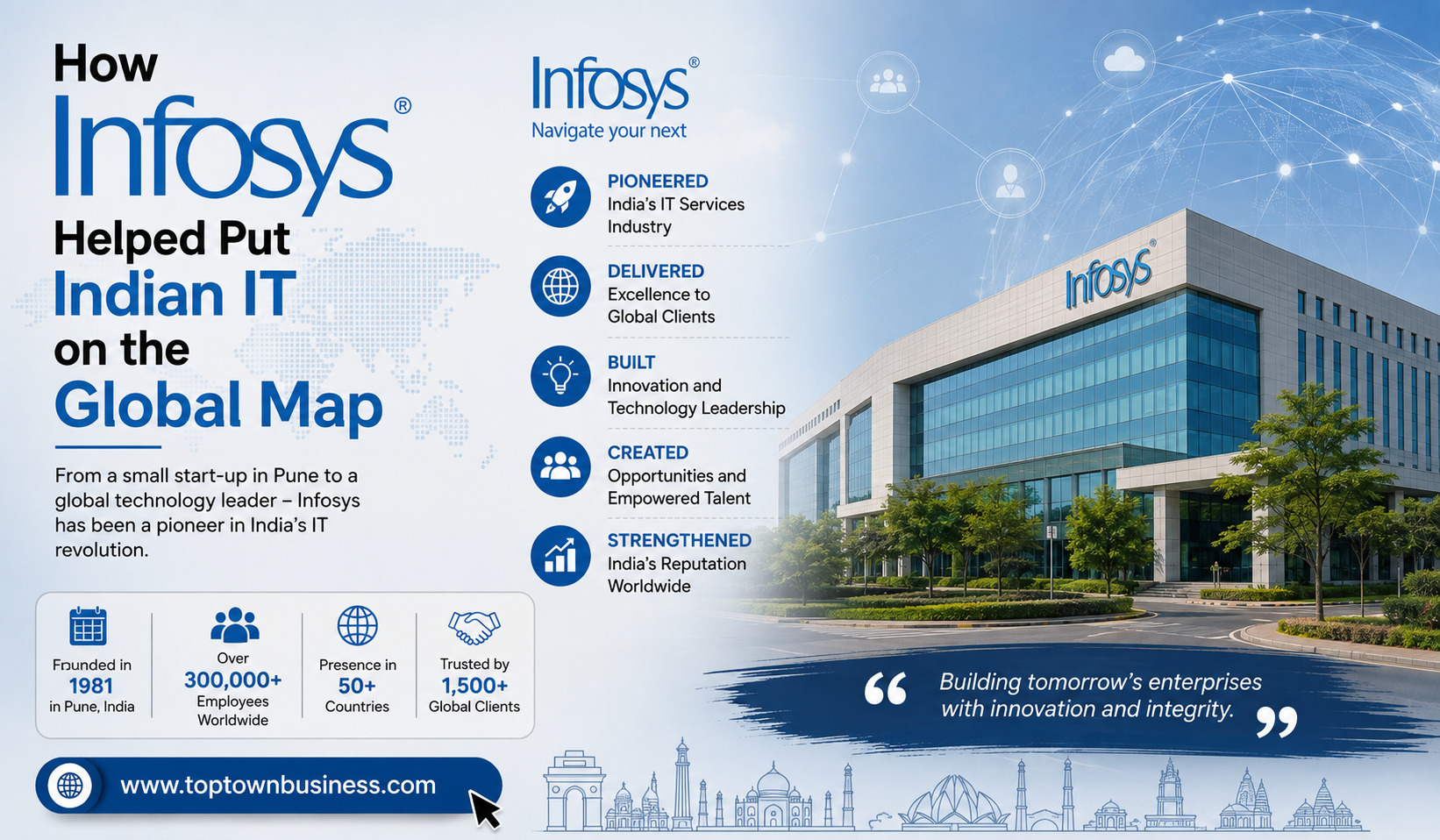
How Infosys Helped Indian IT Sector
Few companies have played as important a role in shaping India’s reputation as a global technology hub as Infosys. What began in 1981 with seven engineers and just US$250 eventually became one of India’s best-known technology companies, serving major businesses across the world.
But Infosys’ importance goes beyond its own financial success. The company helped demonstrate that Indian engineers and technology professionals could deliver complex software services to international companies at scale. Its emphasis on quality, corporate governance, employee development and the pioneering Global Delivery Model helped change how global businesses viewed India’s IT talent.
Today, Infosys operates across 59 countries and has more than 320,000 employees, according to the company’s current overview.
How Infosys Began
Infosys was founded in Pune in 1981 by N. R. Narayana Murthy and six other engineers. The company started with an initial capital of just US$250 and initially operated in a very different India from the one we know today.
India’s economy was relatively closed, international business was difficult and access to technology and foreign capital was limited. Building a software-export business under those conditions required patience.
The founders nevertheless believed that India’s engineering talent could serve customers outside the country.
That idea became the foundation of Infosys.
The company soon began working with international customers. Its first client was Data Basics Corporation in New York, showing from the beginning that the company’s ambitions were international rather than limited to the domestic market.
Building a Business Around Indian Talent
One of Infosys’ biggest contributions to Indian IT was proving that India’s talent could become an export industry.
The company focused on software development and technology services for international businesses. Instead of competing primarily by creating consumer software products, Infosys developed expertise in solving technology and business problems for corporate customers.
This model matched India’s strengths.
The country had a large pool of technically trained professionals, while global companies increasingly needed software developers and technology specialists.
Infosys connected these two opportunities.
Over time, the company built development centers in India while maintaining relationships and offices in international markets. This structure allowed it to combine Indian engineering talent with a global customer-facing presence.
The Global Delivery Model
Perhaps the most important innovation associated with Infosys was its Global Delivery Model (GDM).
Narayana Murthy conceptualized and implemented the model, which became an important part of the Indian software-services industry.
The basic idea was relatively simple but powerful.
Instead of completing an entire project in one location, work could be divided between customer locations and development centers in India and other parts of the world.
Different teams could work on different components simultaneously. Because teams were spread across time zones, projects could also continue beyond normal working hours.
Infosys described the model as a way to optimize costs while improving scalability and reducing delivery times.
This approach became especially valuable as companies in North America and Europe began looking for ways to obtain high-quality technology services while controlling costs.
The model effectively turned geography into an advantage.
A client could have business and consulting teams working with the customer in one country while engineers in India worked on development and implementation. This distributed approach became one of the foundations of India’s IT outsourcing industry.
Why the Model Changed Indian IT
Before the growth of Indian IT services, outsourcing software work to India was not a mainstream strategy for many global companies.
Infosys helped change that perception.
The company showed that software projects could be managed across borders without sacrificing quality. Its focus on standardized processes, training and quality management helped create confidence among international customers.
As more global businesses became comfortable working with Indian technology companies, the market expanded.
Infosys’ success also helped create opportunities for other Indian IT companies. The growth of the sector meant more jobs, more investment in technical education and greater demand for India’s software professionals.
In that sense, Infosys did not simply benefit from the growth of Indian IT. It became one of the companies that helped create the conditions for that growth.
The Importance of Quality and Process
Infosys understood that competing internationally required more than lower costs.
Global customers wanted reliability, predictable delivery and professional project management.
The company therefore invested heavily in processes and quality standards. In 1999, Infosys became the 21st company in the world to achieve CMM Level 5 certification, according to its corporate history.
These achievements mattered because they gave international customers another reason to trust an Indian technology company.
The message was clear: Indian IT companies could compete not only on price but also on quality, process discipline and technical expertise.
That shift in perception was crucial for India’s emergence as a major destination for global software services.
The 1993 IPO and Employee Ownership
Infosys also took an unusual approach to employee participation.
The company went public in India in 1993 and introduced an employee stock-options program. By March 1992, employees already owned 13.6% of the company’s shares, according to Infosys’ historical finance account.
The employee stock-option strategy eventually became an important part of Infosys’ corporate story.
It gave employees an opportunity to participate in the company’s financial success and helped reinforce a culture in which employees were viewed as stakeholders.
Infosys itself says its employee stock-options program created some of India’s first salaried millionaires.
This became symbolic of a broader change in India’s corporate workforce. Technology professionals were no longer simply employees working for established industrial companies; they could also build wealth through ownership in fast-growing technology businesses.
Going Global
During the 1990s, Infosys accelerated its international expansion.
It opened its first international office in Boston in 1987 and later established offices and development centers across North America, Europe and other markets.
By 1999, Infosys had reached US$100 million in revenue and became the first Indian IT company to be listed on Nasdaq.
The Nasdaq listing was particularly significant.
It placed an Indian technology company in front of international investors and strengthened its credibility among global customers.
For India’s emerging IT sector, the achievement had symbolic importance. An Indian software company had demonstrated that it could meet the expectations of major international capital markets.
The Role of India’s Economic Reforms
Infosys’ rise also coincided with a major transformation in India’s economy.
The economic reforms introduced in 1991 gradually opened India to greater international trade and investment. For technology companies with global ambitions, the changing environment created new opportunities.
Infosys was able to take advantage of these changes.
The company expanded internationally, attracted more customers and increased its ability to invest in infrastructure and talent.
Its revenue growth illustrates the transformation. Infosys reached US$1 billion in annual revenue in 2004 and crossed US$2 billion just two years later.
The company’s growth reflected not only its own execution but also the rapidly increasing global demand for software and technology services.
Creating India’s IT Brand
Infosys became an important symbol of India’s technology capabilities.
When international companies began considering India for software development and outsourcing, Infosys was one of the names that helped establish confidence in the country.
Its reputation for professional management and corporate governance was particularly important.
For many international businesses, outsourcing involved more than finding technical talent. They needed a partner that could manage large projects, protect information, communicate effectively and operate according to international standards.
Infosys built its brand around these expectations.
That helped change the global image of Indian technology professionals.
Instead of being viewed primarily as a source of inexpensive technical labor, India increasingly became known for software engineering, consulting, business-process expertise and large-scale technology delivery.
Growing Beyond Traditional IT Services
As technology changed, Infosys also evolved.
The company moved beyond traditional software development into consulting, cloud computing, digital transformation, artificial intelligence, data, automation and other technology services.
Its current business focuses heavily on helping enterprises navigate digital transformation and increasingly AI-driven technology changes. Infosys says it serves clients in 59 countries and has more than four decades of experience working with global enterprises.
This ability to adapt has been important because the technology industry is constantly changing.
The skills required during the software-outsourcing boom of the 1990s are not identical to those required in today’s AI and cloud-driven economy.
Infosys has therefore had to repeatedly reinvent parts of its business while maintaining its core strength in enterprise technology services.
Infosys and the Growth of India’s IT Workforce
The company’s influence can also be seen through employment.
Infosys helped establish the idea that a career in software and technology could provide Indian professionals with international opportunities without requiring permanent relocation abroad.
Its training programs, development centers and global projects exposed employees to international clients and business practices.
As Infosys expanded, thousands of professionals gained experience working with global companies.
Many employees subsequently moved into leadership roles, founded startups or joined other technology businesses.
This created a broader ecosystem around Indian IT.
The impact therefore extended beyond Infosys’ own workforce.
From a Small Startup to a Global Technology Company
The scale of Infosys today is dramatically different from its beginnings.
The company started with seven engineers and US$250. Its latest annual report says Infosys had 3,28,594 employees, 1,965 active clients and operations across 59 countries in fiscal 2026. It reported total revenue of ₹1,78,650 crore for the year.
These figures illustrate the extraordinary transformation of India’s IT industry over the past four decades.
Infosys was not the only company responsible for this transformation. Other Indian technology companies, entrepreneurs, engineers, policymakers and educational institutions all contributed.
But Infosys became one of the industry’s most visible international representatives.
What Entrepreneurs Can Learn From Infosys
The Infosys story offers several lessons for entrepreneurs.
The first is the importance of thinking globally from the beginning. Even though the company was founded in India, its founders understood that the global market could provide enormous opportunities.
The second is building systems rather than depending on individuals. Infosys invested in processes, quality standards, training and technology that allowed it to scale.
The third is trust. International customers needed confidence that an Indian company could manage important technology projects. Infosys built that confidence over many years.
Finally, the company’s journey demonstrates the value of adapting to change. From software outsourcing to cloud services, consulting and AI, Infosys has repeatedly adjusted its capabilities as technology has evolved.
Conclusion
Infosys helped put Indian IT on the global map by proving that Indian technology professionals could compete successfully in international markets.
Founded in 1981 with just US$250, the company developed a global business model built around Indian talent, international customers, strong processes and distributed delivery. Its Global Delivery Model became an important part of the Indian software-services industry, while its Nasdaq listing helped give Indian IT greater international visibility.
The company’s success also helped change the perception of India itself. Over time, India became associated with software engineering, outsourcing, technology consulting and digital services.
Today, Infosys is much larger and more technologically diverse than the company founded in Pune in 1981. Yet its biggest legacy may be the role it played in showing the world that India could become a global technology powerhouse.