

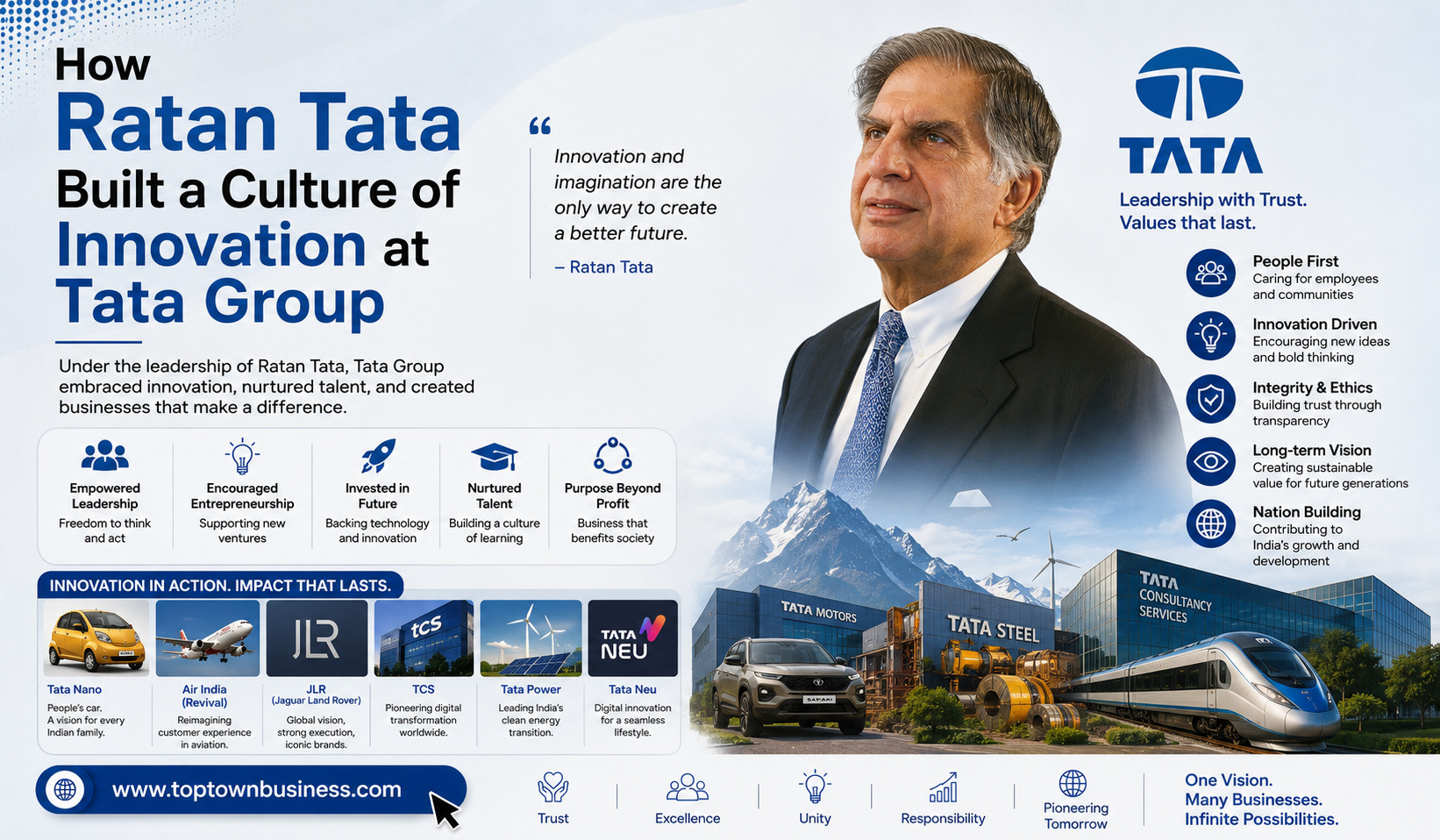
How Ratan Tata Built Tata Group
Ratan Tata is widely remembered as one of the most influential business leaders in modern India. During his tenure as chairman of Tata Sons, he helped transform the Tata Group from a collection of largely India-focused businesses into a more globally connected and diversified business group.
But his legacy was not built only through acquisitions or financial growth. One of his most important contributions was encouraging a culture in which innovation, experimentation and long-term thinking could coexist with the Tata Group’s traditional emphasis on values and responsibility.
From automobiles and steel to technology, hospitality and consumer products, the Tata Group under Ratan Tata increasingly looked beyond conventional business models. Some experiments succeeded spectacularly, while others struggled. Yet the willingness to try new ideas became an important part of the group’s identity.
Ratan Tata’s Approach to Leadership
Ratan Tata became chairman of Tata Sons in 1991, succeeding J. R. D. Tata. His appointment came at a crucial moment for India because the country was beginning a major period of economic liberalization.
The Tata Group itself was a huge organization with businesses operating independently across different industries. One of Ratan Tata’s early challenges was to create greater unity across the group while preparing it for a more competitive economy.
He introduced structural changes that gave the group greater strategic direction. At the same time, he encouraged companies within the group to think about products and markets that could shape India’s future rather than simply protect existing businesses.
This approach created space for innovation.
Moving Beyond Traditional Business
Before the 1990s, Tata had already built a strong presence in industries such as steel, automobiles, hotels, chemicals and engineering. But the changing Indian economy meant that established companies could no longer depend entirely on protected domestic markets.
Ratan Tata recognized that the group needed to become more competitive and more international.
The result was a greater emphasis on technology, modern consumer products, global markets and new business opportunities.
The group’s innovation journey was therefore closely connected to its transformation into a more modern conglomerate.
The Tata Indica: Creating an Indian Car
One of the clearest examples of Ratan Tata’s willingness to pursue ambitious ideas was the Tata Indica.
Launched in 1998, the Indica was India’s first indigenous passenger car, according to Tata Motors. (tatamotors.com)
The project was risky.
India’s passenger-car market was already competitive, and Tata Motors was better known for commercial vehicles. Developing a passenger car required new technology, design capabilities and manufacturing expertise.
Yet Ratan Tata supported the project.
The Indica became a symbol of India’s growing engineering capabilities. It demonstrated that an Indian company could design and manufacture a passenger vehicle for Indian consumers.
The car was not a perfect commercial success in every phase, but the project established capabilities that became important for Tata Motors’ later passenger-vehicle strategy.
The Tata Nano Experiment
Perhaps no Tata innovation received as much attention as the Tata Nano.
Ratan Tata envisioned a small, affordable car that could provide safer and more convenient transportation to families who might otherwise rely on two-wheelers.
The Nano was launched in 2009 and was positioned as an affordable people’s car. Tata Motors initially described it as the world’s most affordable car. (tatamotors.com)
Commercially, the Nano did not achieve the mass-market success the company had hoped for.
But from an innovation perspective, it remains important.
The project required Tata Motors to rethink manufacturing, engineering, materials, pricing and distribution.
The Nano demonstrated a key feature of Ratan Tata’s leadership philosophy: not every experiment has to succeed commercially to provide valuable lessons.
Innovation involves risk, and companies that never take risks can eventually become less competitive.
Encouraging Technology and Digital Innovation
The Tata Group’s innovation culture also expanded into technology.
Tata Consultancy Services (TCS) became one of the world’s major IT services companies, while Tata’s broader technology businesses expanded into software, digital services and communications.
The group also created Tata Digital, which developed digital consumer businesses and the super-app strategy around Tata Neu.
This reflected a broader shift in consumer behavior. As shopping, payments, travel and entertainment increasingly moved online, Tata needed to develop digital capabilities alongside its traditional businesses.
Ratan Tata remained interested in startups and technology even after stepping down as Tata Sons chairman. His investments in several Indian startups reflected his continued belief in young entrepreneurs and emerging business models.
Innovation Through Acquisitions
Ratan Tata’s approach to innovation was not limited to building everything internally.
He also used acquisitions to bring new capabilities, brands and technologies into the group.
The acquisition of Tetley by Tata Tea in 2000 was an early example of Tata’s international expansion. The deal helped Tata Tea become a major global tea company. (tata.com)
Then came one of the group’s most famous acquisitions: Tata Motors’ purchase of Jaguar Land Rover from Ford in 2008.
The deal gave Tata Motors ownership of two internationally recognized automotive brands during a period of enormous uncertainty in global markets. (tata.com)
This was not innovation in the traditional sense of inventing a new product. But it was strategic innovation.
Tata was willing to enter markets where the group had limited historical experience and learn from established international brands.
Creating Space for Young Entrepreneurs
Another important part of Ratan Tata’s innovation culture was his interest in startups.
Even after leaving his executive position at Tata Sons, he became an active angel investor in Indian startups.
His investments included companies operating in areas such as digital payments, e-commerce, mobility, technology and consumer services.
This gave Tata a direct connection with India’s emerging startup ecosystem.
It also demonstrated a broader belief: innovation does not always come from large established organizations. Young companies can challenge traditional industries with new technology, business models and customer experiences.
By supporting startups, Ratan Tata helped encourage entrepreneurship beyond the boundaries of the Tata Group itself.
Tata Innovation Center and New Ideas
The Tata Group also developed institutional mechanisms to encourage innovation.
Tata companies have historically operated with considerable autonomy, but the group created initiatives to encourage collaboration and idea-sharing across businesses.
The Tata Group Innovation Forum (TGIF) was established to promote innovation across Tata companies and provide a platform for sharing ideas and practices.
Such initiatives helped reinforce the idea that innovation should not belong only to a company’s research department.
It should involve employees, managers, engineers and business leaders.
Innovation With a Social Purpose
One of the distinctive aspects of Tata’s innovation culture is its connection to social impact.
Ratan Tata often emphasized that business success should coexist with broader social responsibility.
This philosophy can be seen in projects involving affordable healthcare, education, mobility, housing and consumer products.
The Nano is again a useful example. Although the commercial strategy did not ultimately deliver the expected results, the original idea was based on solving a real transportation problem for middle-class Indian families.
This reflects a different approach to innovation: rather than creating products simply because technology makes them possible, companies can begin with a social or consumer problem and then work backward toward a solution.
Tata Group’s Global Transformation
Ratan Tata’s innovation strategy was also closely connected to globalization.
During his tenure, Tata companies became significantly more international through acquisitions and expansion.
The Tata Group’s portfolio eventually included businesses with global brands and operations across multiple continents.
This international exposure created another source of innovation.
Indian companies could learn from international markets, while global acquisitions could bring technology, design expertise, management practices and brand capabilities into the Tata ecosystem.
The group therefore became more connected to global competition.
Learning From Failure
A strong innovation culture cannot be built by celebrating only successful projects.
Ratan Tata’s leadership demonstrated the importance of accepting failure as part of experimentation.
The Tata Nano is the clearest example. The company attempted something highly ambitious, but consumer expectations and market dynamics proved different from what Tata Motors had anticipated.
The lesson was not that innovation should be avoided.
Instead, it demonstrated that even large companies need to understand customer psychology, positioning and market perception alongside engineering and cost calculations.
This is one of the most valuable lessons for entrepreneurs: a technically innovative product can still fail if the market does not understand or want it in the way the company expects.
The Importance of Long-Term Thinking
Ratan Tata’s approach was also different from a purely short-term financial mindset.
Large innovations often require years of investment before their benefits become visible.
Whether it was developing passenger vehicles, entering international markets or supporting emerging technologies, Tata companies were often willing to make decisions with a long-term horizon.
This approach was supported by the Tata Group’s ownership structure.
A significant portion of Tata Sons is owned by philanthropic trusts, which have historically used dividends to support social and charitable initiatives. (tata.com)
This structure has helped Tata take a somewhat different approach to long-term business decisions.
Why Ratan Tata’s Innovation Culture Matters
Ratan Tata did not turn Tata Group into an innovation-driven organization by personally inventing every new product.
His larger contribution was creating an environment in which businesses could experiment, enter new industries, acquire capabilities and think beyond established markets.
The Tata Group’s innovation story therefore includes both successes and failures.
The Indica showed that an Indian company could create a domestic passenger car. The Nano demonstrated the possibilities and challenges of ultra-affordable engineering. Acquisitions such as Tetley and Jaguar Land Rover expanded Tata’s global capabilities. Startup investments connected Ratan Tata with India’s new generation of entrepreneurs.
Together, these efforts created a culture that was more comfortable with calculated risk.
Lessons Entrepreneurs Can Learn From Ratan Tata
There are several important lessons in Ratan Tata’s approach.
First, innovation begins with problems. Businesses should understand what customers actually need rather than developing technology simply because it is available.
Second, failure can provide useful information. The Nano’s commercial difficulties did not erase the engineering and strategic lessons generated by the project.
Third, innovation can come through partnerships and acquisitions. Companies do not always need to build every capability internally.
Finally, long-term thinking matters. Some of the Tata Group’s most important transformations took years to produce their full impact.
Conclusion
Ratan Tata’s contribution to the Tata Group was about much more than expanding revenue or acquiring international companies. He helped create an environment in which innovation, experimentation and global ambition became central to the group’s evolution.
From the Tata Indica and Tata Nano to the acquisition of Jaguar Land Rover, the growth of TCS and support for India’s startup ecosystem, his leadership encouraged Tata companies to explore opportunities beyond traditional business boundaries.
Not every idea succeeded, and that is precisely what makes the story valuable. A genuine culture of innovation does not guarantee that every experiment will work. Instead, it gives organizations the confidence to experiment, learn and try again.
Ratan Tata’s legacy demonstrates that one of the most powerful forms of business innovation is not simply creating a new product. It is building an organization that remains willing to imagine what could come next.