
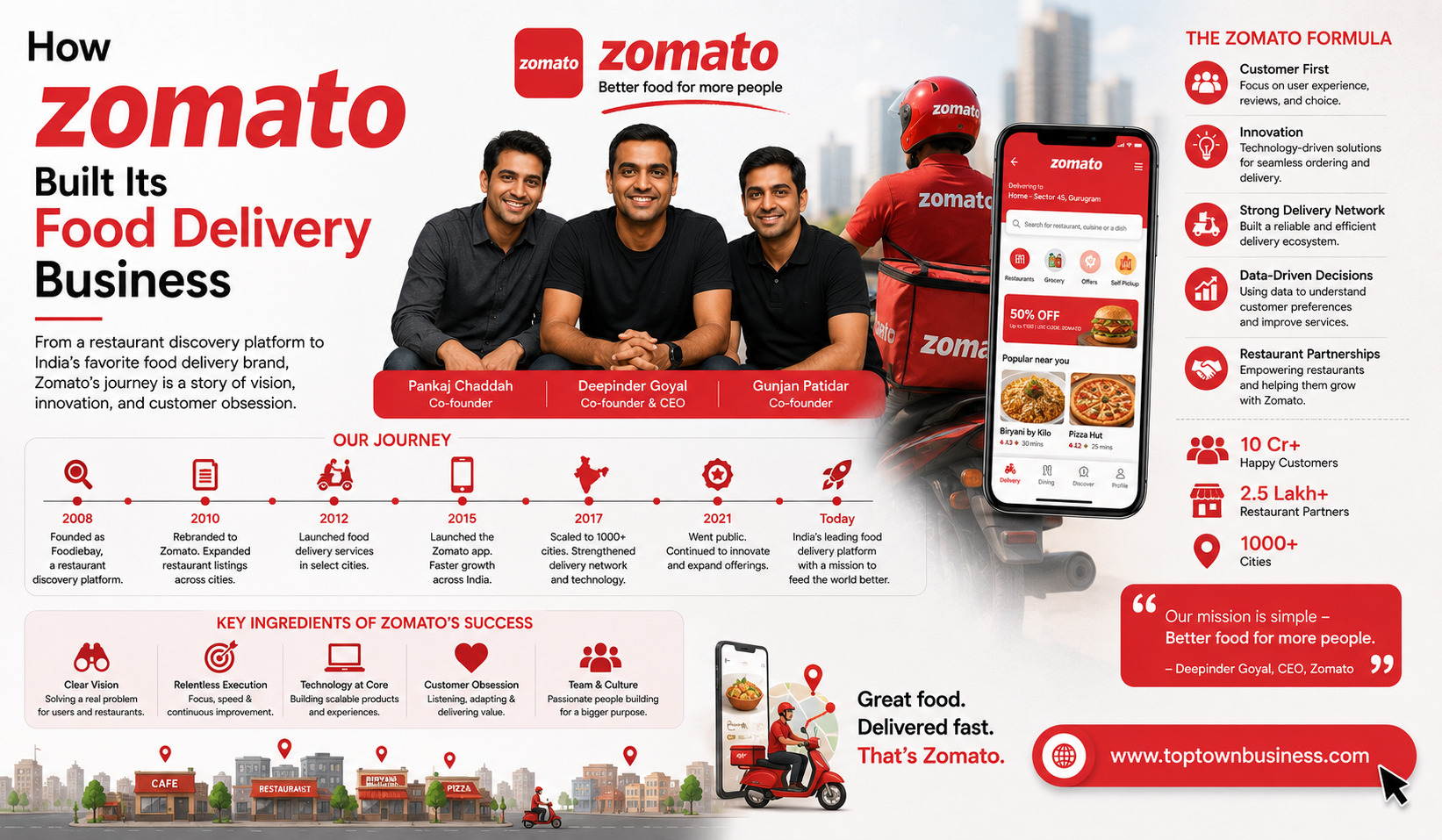
Zomato has become one of the most recognizable names in India’s food delivery industry, but the company did not begin as a food delivery platform. Its journey started with a much simpler idea: helping people discover restaurants and decide where to eat.
Over time, Zomato transformed from a restaurant information website into a large technology-driven food ordering and delivery business. Its growth was built on several important factors, including a strong restaurant network, digital convenience, delivery infrastructure, customer data, technology and aggressive expansion.
Today, Zomato describes its food delivery business as a platform where customers can discover local restaurants, order food and have it delivered quickly and reliably. In Q4 FY25, the company reported food-delivery gross order value of ₹9,778 crore and 20.9 million average monthly transacting customers.
How Zomato Started
Zomato’s story goes back to 2008, when Deepinder Goyal and Pankaj Chaddah began building what was initially called Foodiebay. Goyal had created the website after noticing how difficult it was for people to find restaurant menus and information online.
In the early days, the team personally collected restaurant menus, scanned them and uploaded them to the website. The platform initially attracted only a small number of visitors, but it gradually gained traction. Goyal later described how Foodiebay evolved from a small side project into a serious business.
In 2010, Foodiebay was renamed Zomato. The founders wanted a name that would allow the company to expand beyond being simply a restaurant directory.
This decision became important because Zomato eventually moved far beyond restaurant discovery.
From Restaurant Discovery to Online Ordering
Zomato’s early advantage came from the large amount of restaurant information available on its platform.
The company provided menus, photographs, locations, reviews and other information that helped customers decide where to eat. Zomato itself explained that it was designed as a guide to help people decide where to order or dine rather than simply as a review website.
This created an important foundation for the future food delivery business.
Once millions of users were already visiting Zomato to discover restaurants, adding online ordering became a natural next step. Instead of sending customers somewhere else after they selected a restaurant, Zomato could allow them to place an order directly through its platform.
The company launched its online ordering business around 2015 and began learning how to manage the much more complicated world of transactions and delivery.
Building the Technology Behind Food Delivery
Food delivery is much more complicated than displaying restaurant information.
A successful platform needs to connect customers, restaurants and delivery partners in real time. Orders must reach the correct restaurant, restaurants must prepare them on time, delivery partners must collect them and customers need accurate delivery updates.
Zomato built a dedicated transactions team to handle this challenge. The company created a separate ordering app initially, allowing its technology teams to experiment and improve the product before integrating the experience into the main Zomato platform.
This technology-first approach helped Zomato move from being primarily a content and discovery platform toward becoming a transaction-focused business.
Solving the Delivery Problem
One of Zomato’s biggest challenges was logistics.
Restaurant discovery could be handled digitally, but delivering food required a physical network of delivery workers. In the early stages, many orders were fulfilled directly by restaurants.
As Zomato expanded, the company increasingly invested in its own delivery capabilities.
The acquisition of Runnr became an important part of this strategy. Zomato said the combination gave it a stronger logistics capability, covering important parts of the food delivery process from restaurant listings and discovery to ordering and delivery.
By 2018, Zomato reported that around 90% of its orders were being delivered by its own delivery partners. The company also reported that its delivery network had grown dramatically, helping reduce average delivery times.
This was a crucial development because faster and more reliable delivery could improve the customer experience while giving Zomato greater control over its operations.
Expanding Across Indian Cities
Zomato understood that food delivery could not remain limited to India’s biggest metropolitan areas.
The company expanded into more cities and towns, attempting to bring online food ordering to consumers outside major urban centres. In one expansion milestone, Zomato said it had reached 300 cities and was focusing on moving beyond India’s largest cities to reach a much broader customer base.
This expansion helped create a larger restaurant ecosystem.
For restaurants, joining Zomato provided access to customers who might otherwise have been difficult to reach. For customers, a growing restaurant network meant more choices.
That created a powerful marketplace effect: more restaurants attracted more customers, while more customers made the platform more attractive to restaurants.
Competing Through Convenience
Zomato’s food delivery business grew by making ordering food simple.
Instead of calling restaurants, checking whether they delivered to a particular location and waiting without knowing the status of an order, customers could search, compare, order and track their meals through one platform.
The convenience became especially important as smartphone and internet usage increased across India.
Zomato also used restaurant ratings, menus, photographs, reviews and recommendations to influence purchasing decisions. This gave the company an advantage that was difficult for a basic delivery company to replicate.
It was not simply delivering food. It was helping customers decide what food they wanted in the first place.
Managing the Economics of Food Delivery
Food delivery is a difficult business because every order involves multiple costs.
There are delivery expenses, technology costs, customer support, restaurant acquisition, marketing and promotional spending. Zomato therefore had to focus not just on increasing orders but also on improving the economics of every delivery.
The company has discussed its focus on improving delivery efficiency, increasing deliveries per rider and reducing last-mile costs. Its FY19 annual report, for example, showed significant improvements in delivery economics as the business scaled.
This illustrates an important lesson from Zomato’s journey: building a large food delivery business requires scale, but scale alone is not enough. The company also needs efficient operations.
The Uber Eats Acquisition
Competition in India’s food delivery market became intense as several well-funded companies fought for customers and restaurants.
Zomato strengthened its position when it acquired Uber Eats India’s business in January 2020. According to Zomato, the acquisition helped propel the company into a stronger market position, while the transition successfully retained 97% of the combined gross merchandise value on the Zomato platform.
The acquisition gave Zomato access to additional customers, restaurant partners and delivery activity.
It also demonstrated how important scale had become in India’s food delivery industry.
COVID-19 and the Shift in Consumer Behaviour
The COVID-19 pandemic created an unprecedented challenge for food delivery companies.
During the early phase of the pandemic, Zomato’s food delivery business experienced a dramatic decline in activity as lockdowns and restrictions changed consumer behaviour. The company reported that its food delivery gross merchandise value fell by 80% in the final week of March 2020 compared with its pre-pandemic peak.
However, food delivery eventually became an important part of the changing digital consumption landscape.
Customers became increasingly comfortable ordering meals through apps, while restaurants became more dependent on digital ordering channels.
The pandemic therefore accelerated several trends that were already developing in India’s food industry.
Creating a Food Delivery Ecosystem
Zomato’s strategy eventually expanded beyond simply connecting restaurants and customers.
The company developed additional businesses around the food ecosystem, including Hyperpure, which supplies food ingredients and other products to restaurants. This gave Zomato a role on the supply side of the restaurant industry as well.
The broader strategy was to build a connected ecosystem around food rather than operate only as a delivery marketplace.
This approach potentially creates additional opportunities to serve restaurants while strengthening relationships across the food industry.
Why Zomato’s Food Delivery Model Worked
Several factors explain Zomato’s growth.
First, the company already had a large restaurant-discovery platform before aggressively entering food delivery. Second, it invested heavily in technology and logistics. Third, it expanded its restaurant network and geographic reach. Fourth, acquisitions helped it strengthen its market position.
Most importantly, Zomato understood that food delivery is a three-sided marketplace involving customers, restaurants and delivery partners.
If customers receive poor service, they leave. If restaurants do not receive enough orders or face operational problems, they may leave. If delivery partners cannot earn sustainably, the logistics network becomes difficult to maintain.
Managing these relationships at scale became one of Zomato’s biggest business challenges—and achievements.
Conclusion
Zomato’s food delivery journey is a story of transformation.
What began as a simple restaurant information website eventually became a technology-driven food ordering and delivery platform. The company built its advantage by combining restaurant discovery, customer data, digital ordering, logistics and a large restaurant network.
Its journey also shows how successful digital businesses can evolve by building on an existing customer relationship. Zomato did not start by trying to solve every problem in food delivery. It first solved restaurant discovery, developed a strong user base and then expanded into transactions and logistics.
Today, food delivery is one of Zomato’s core businesses, serving millions of monthly transacting customers and thousands of restaurants.
The larger lesson from Zomato’s rise is simple: in a competitive digital market, convenience, technology, scale and customer experience can work together to change how an entire industry operates.