
India’s beauty industry has changed dramatically over the past decade, and one company played a major role in bringing that transformation online: Nykaa.
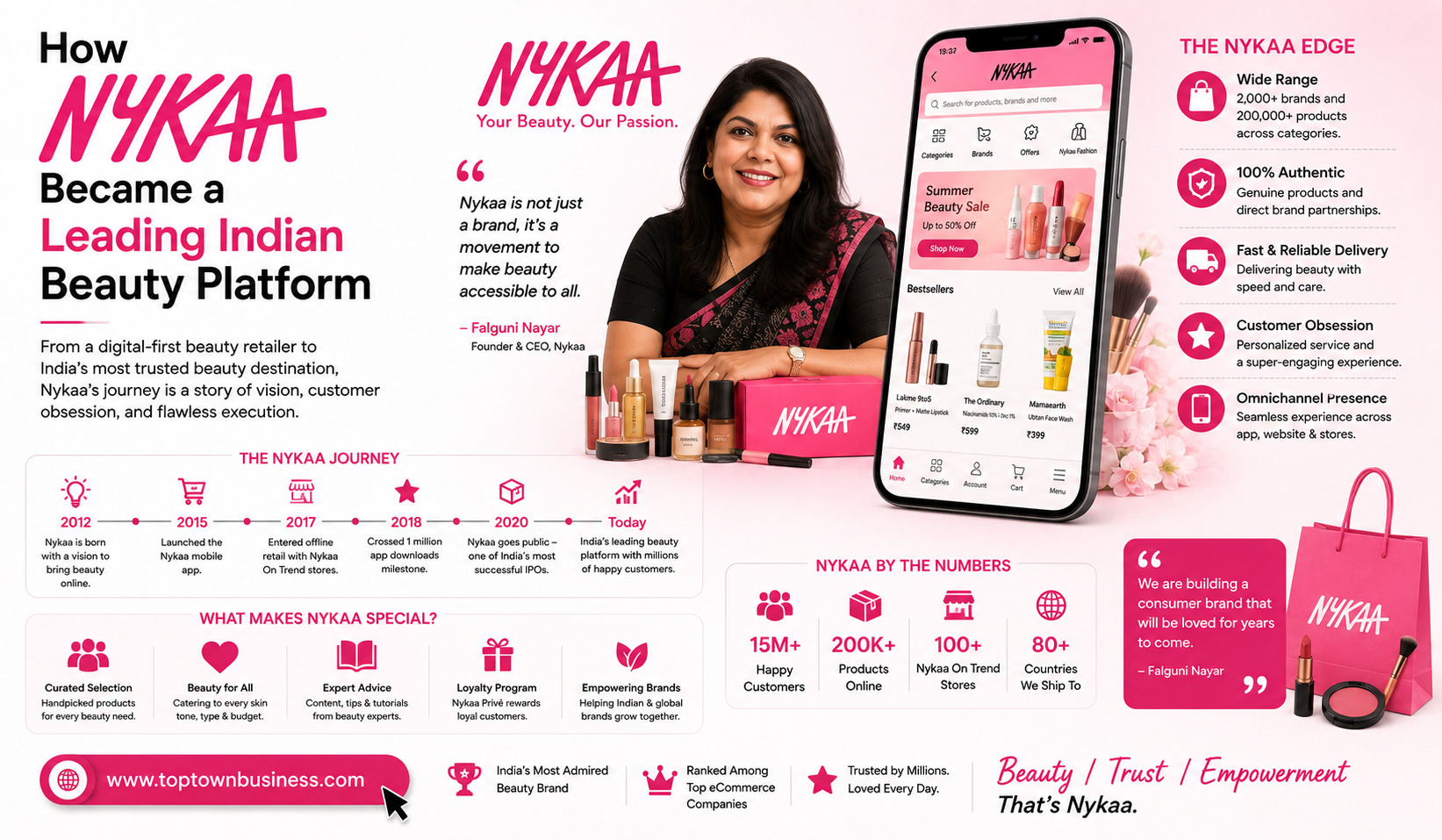
Founded by Falguni Nayar in 2012, Nykaa began as a digital-first beauty platform at a time when buying cosmetics online was still relatively new in India. The company identified a gap in the market and built a business around authenticity, product variety, beauty education and convenience. Over time, Nykaa expanded from an online beauty retailer into an omnichannel beauty and lifestyle company with its own brands, physical stores and a growing ecosystem around consumers and beauty businesses.
Its success offers an interesting lesson in how a focused e-commerce company can build a strong consumer brand by understanding an underserved market.
The Beginning of Nykaa
Nykaa was founded by Falguni Nayar after she left a long career in investment banking. She had spent years working in the financial sector, including a senior role at Kotak Mahindra Capital, before deciding to become an entrepreneur.
The opportunity she identified was simple but significant. India’s beauty market had many products and brands, but consumers often had limited access to authentic products, product information and a wide selection, particularly online.
Nayar believed the internet could change that.
Nykaa launched as a digital-first beauty business in 2012, with the goal of making beauty products more accessible to Indian consumers.
Instead of trying to become a general marketplace immediately, Nykaa focused heavily on beauty and personal care. That specialization became one of its biggest competitive advantages.
Understanding India’s Beauty Market
Beauty products are different from many other e-commerce categories.
Customers often want to understand how a product works, which shade suits them, whether a product is genuine and how it compares with alternatives. Simply displaying products online is therefore not always enough.
Nykaa focused on creating a more complete beauty-shopping experience.
The platform offered products across categories such as makeup, skincare, haircare, fragrances, bath and body, grooming and wellness. Nykaa says its platform now offers thousands of brands, including domestic, international, premium, prestige and luxury names.
This wide selection helped Nykaa become a destination rather than simply another online store.
Trust Became a Major Part of the Brand
One of Nykaa’s biggest challenges was building trust in online beauty shopping.
Consumers buying cosmetics and skincare products need confidence that what they receive is genuine. Counterfeit concerns can be particularly damaging in beauty and personal care because customers put products directly on their skin and hair.
Nykaa positioned authenticity and curated product selection as important parts of its value proposition. The company describes its mission around giving consumers access to a curated and authentic assortment of products and services.
That emphasis helped differentiate Nykaa from general online marketplaces.
Rather than competing only on price, the company worked to build a reputation around selection, authenticity and expertise.
Content Became a Powerful Growth Engine
Nykaa understood that beauty is an industry where customers often need education before making a purchase.
Someone buying foundation may want to know how to select the right shade. A customer interested in skincare may want to understand ingredients. Another shopper may want a tutorial explaining how to use a particular makeup product.
Nykaa therefore built content into its customer experience.
The platform has used tutorials, expert advice, product information, videos and beauty-focused content to help consumers discover products. Nykaa itself describes the combination of commerce, expert-led content and beauty communities as an important part of its platform.
This strategy helped turn shopping into discovery.
Instead of customers visiting Nykaa only when they already knew what they wanted, content could bring them to the platform while they were still researching or learning.
Building Its Own Beauty Brands
Nykaa eventually moved beyond selling other companies’ products.
The company developed its own beauty brands, creating another layer to its business model. Nykaa Cosmetics became one of its important homegrown brands, while other brands were added to its portfolio over time.
This strategy allowed Nykaa to participate directly in product development rather than depending entirely on third-party brands.
Its House of Nykaa portfolio has expanded across beauty and lifestyle categories. The company has highlighted brands including Nykaa Cosmetics, Kay Beauty, Dot & Key and other owned brands as part of its broader strategy.
Owning brands can also provide greater control over product positioning, pricing, innovation and customer relationships.
From Online Store to Omnichannel Retailer
Although Nykaa started online, the company eventually recognized that physical stores could strengthen the beauty-shopping experience.
Beauty is a category where customers may want to touch products, test shades, smell fragrances or speak with beauty advisors before buying.
Nykaa therefore developed an omnichannel model combining online shopping with physical retail.
According to its FY2024-25 annual report, Nykaa had 237 beauty stores across 79 Indian cities as of March 31, 2025. More than two-thirds of these stores were located outside major metropolitan areas, while its physical beauty business recorded 31% year-on-year GMV growth in FY2025.
The physical network also gave Nykaa an opportunity to introduce consumers to products that they might later purchase online.
Creating a Premium Shopping Experience
Nykaa did not limit itself to mass-market cosmetics.
The company built different retail formats to serve different consumer segments, including Nykaa Luxe and Nykaa On Trend stores. Its flagship stores showcase premium and luxury beauty brands and provide a more immersive shopping experience.
This helped Nykaa occupy multiple positions within the beauty market.
A customer looking for an affordable cosmetic could use the same platform as someone searching for a premium international skincare or fragrance brand.
That combination of mass reach and premium positioning helped strengthen Nykaa’s identity as a specialized beauty destination.
Expanding Beyond Beauty
After establishing a strong position in beauty, Nykaa expanded into other lifestyle categories.
Nykaa Fashion launched in 2018 as a curated fashion and lifestyle marketplace. The company also developed Nykaa Man and Superstore by Nykaa, expanding its presence across consumer and business segments.
However, beauty remained central to the company’s business.
In FY2025, the beauty vertical represented approximately 75% of consolidated GMV, while beauty accounted for about 91% of consolidated revenue, according to Nykaa’s annual report.
This shows that the original beauty business continued to be the company’s primary engine even as Nykaa diversified.
The Power of Customer Loyalty
Nykaa’s business model is also built around repeat purchases.
Beauty products such as skincare, haircare and personal-care items can create recurring demand. Once consumers find products and brands they trust, they may return regularly to purchase them again.
Nykaa’s content strategy, product assortment, loyalty initiatives and personalized shopping experience can help strengthen those relationships.
The company’s FY2025 annual report said existing customers contributed 76% of Beauty GMV, compared with 57% for its Fashion vertical.
This highlights how important repeat customers have become to Nykaa’s beauty business.
Nykaa’s IPO and Business Transformation
Nykaa reached another major milestone when its parent company, FSN E-Commerce Ventures, went public in 2021.
The IPO attracted considerable attention because Nykaa had become one of India’s prominent consumer-tech businesses and was led by its founder, Falguni Nayar.
The public listing also marked the transformation of Nykaa from a relatively young e-commerce startup into a major publicly traded consumer company.
Falguni Nayar’s journey became an important part of the company’s story as well. She left investment banking at the age of 49 to build Nykaa, demonstrating that entrepreneurship does not necessarily have to begin immediately after college or in one’s twenties.
What Makes Nykaa’s Business Model Different?
Nykaa’s success comes from combining several elements instead of relying on one advantage.
Its online platform provides scale and convenience. Physical stores provide an opportunity for customers to experience products. Content helps consumers learn. Private-label brands provide greater control over products. A large assortment gives shoppers more choice, while technology helps personalize the buying experience.
This creates an ecosystem around beauty rather than simply an online catalogue.
The company says it now serves more than 52 million customers and operates more than 276 offline beauty destinations, reflecting the scale its omnichannel model has reached.
Lessons From Nykaa’s Success
Nykaa’s journey offers several important lessons for entrepreneurs.
The first is the value of identifying an underserved market. When Nykaa launched, online beauty shopping was still developing in India. Instead of competing immediately across every category, the company concentrated on an area where it saw significant potential.
The second lesson is the importance of trust. In categories where authenticity matters, building consumer confidence can be more valuable than competing purely on discounts.
The third is that content can become a business asset. By helping consumers understand beauty products, Nykaa turned education and inspiration into part of the shopping journey.
Finally, Nykaa demonstrated that an online-first company can successfully build physical retail when the two channels complement each other.
Conclusion
Nykaa’s rise from a digital beauty startup to a leading Indian beauty platform is a story of focused execution and changing consumer behaviour.
Falguni Nayar recognized that India’s beauty market needed more than another online store. Consumers needed access to authentic products, broader selection, expert information and a shopping experience designed specifically around beauty.
Nykaa built its business around those needs.
It started online, developed a strong beauty-focused brand, invested in content and education, launched its own products, expanded into physical stores and eventually created a wider beauty and lifestyle ecosystem.
The company’s journey shows that successful e-commerce businesses are not always built by selling everything to everyone. Sometimes, the strongest strategy is to understand one category deeply, earn customer trust and gradually build an ecosystem around it.