

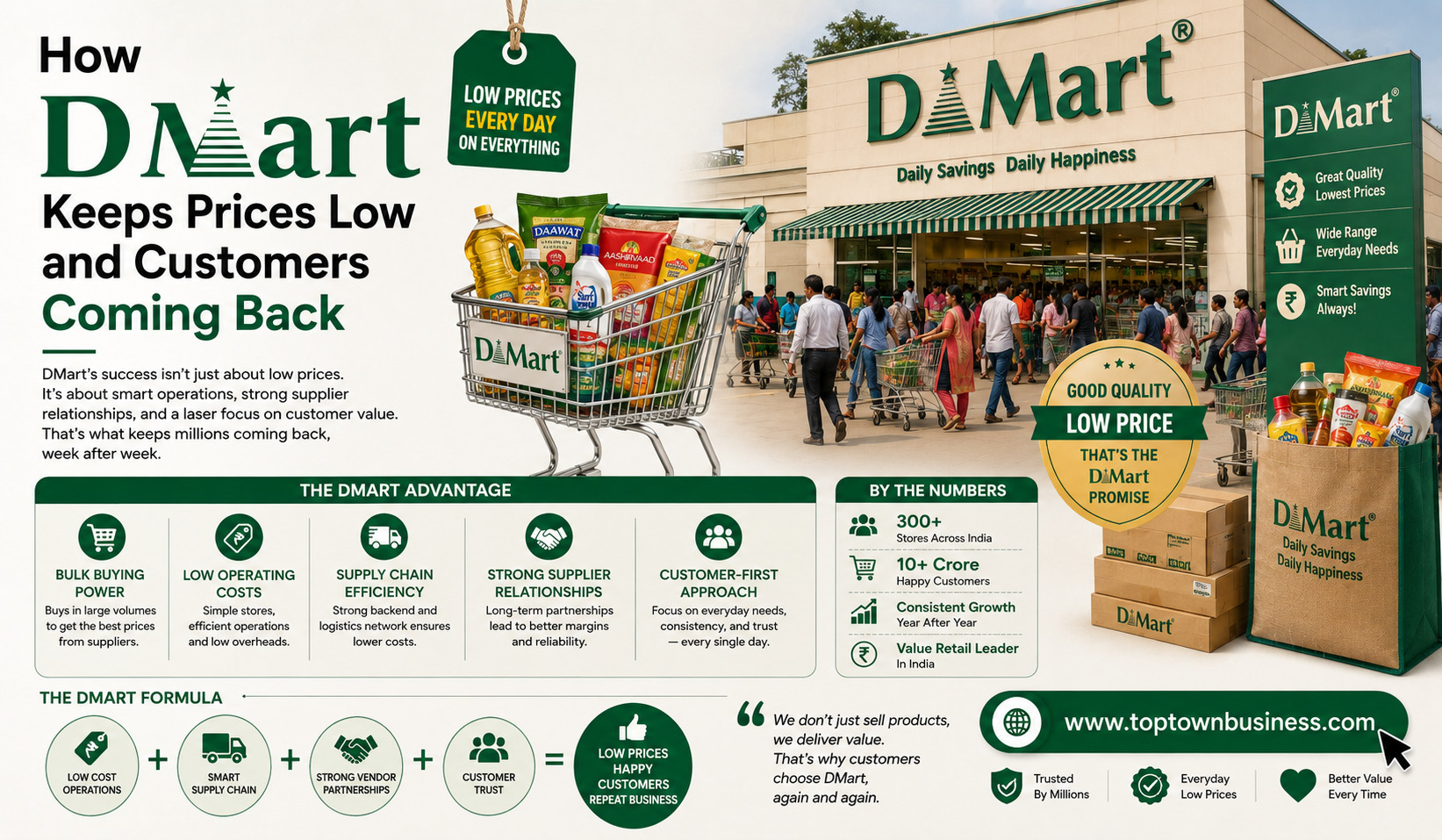
Walk into a DMart store and one thing quickly stands out: the prices. From groceries and packaged foods to personal-care products, household essentials, clothing and general merchandise, DMart has built its reputation around offering everyday products at competitive prices.
But low prices alone do not explain why millions of Indian shoppers keep returning.
Behind DMart’s success is a carefully designed retail model built around low procurement costs, operational efficiency, large sales volumes, selective product assortment and disciplined expansion. The company, operated by Avenue Supermarts Limited, follows an Everyday Low Cost/Everyday Low Price (EDLC/EDLP) strategy rather than depending primarily on short-term promotional discounts.
This approach has helped DMart become one of India’s most successful value retailers.
The Beginning of DMart
DMart was founded by Radhakishan Damani, who opened the first store in Mumbai in 2002.
The basic idea was straightforward: create a supermarket where customers could purchase everyday necessities at attractive prices while the business maintained tight control over its costs.
Instead of building a retail brand around luxury interiors or an extremely broad product catalogue, DMart focused on products that consumers regularly need.
That focus became an important part of its business model.
Over the years, DMart expanded across India while maintaining its value-retailing identity. As of March 31, 2026, Avenue Supermarts had 500 DMart stores across multiple states and the National Capital Region, with a retail business area of 20.6 million square feet.
The Secret: Everyday Low Prices
DMart’s most important strategy is its Everyday Low Cost/Everyday Low Price model.
The principle is different from relying heavily on occasional sales. Instead, the company attempts to keep procurement and operating costs low so that it can offer competitive prices throughout the year.
DMart explains that its EDLC/EDLP strategy is based on achieving lower procurement and operating costs rather than treating low prices as special promotions limited to certain products or periods.
This creates a simple value proposition for customers.
Shoppers do not necessarily have to wait for a festival sale to find attractive prices. The expectation is that many everyday products will already be competitively priced.
That consistency can encourage repeat visits.
Buying Products at Competitive Prices
One major reason DMart can keep prices low is its focus on procurement.
The company works with a large supplier network and sources products from regions where they are widely available or manufactured. It also focuses on local assortments and sourcing products closer to its distribution centres and stores where possible.
Lower procurement costs create room for competitive retail prices.
This is especially important in categories such as food, groceries and FMCG products, where customers frequently compare prices across stores.
DMart’s ability to purchase at competitive rates and move products in large volumes allows it to build its business around relatively small margins on many products.
Volume Is More Important Than Huge Margins
DMart’s business model depends heavily on selling large quantities.
Instead of trying to make a very high margin on every individual product, the company focuses on attracting large numbers of shoppers and generating substantial sales volumes.
This creates an important retail cycle.
Competitive prices can attract more customers. More customers generate greater sales volumes. Higher volumes can strengthen purchasing power and improve the economics of the business. Some of those benefits can then support competitive pricing.
This volume-driven model is one reason DMart has focused so strongly on everyday essentials.
In FY2024-25, the company reported 35.3 crore bill cuts, compared with 30.3 crore in FY2023-24. Its revenue from sales per retail business area was ₹33,896 in FY2025.
Keeping Operating Costs Under Control
Buying products cheaply is only one part of the equation.
A retailer can lose its pricing advantage if its stores, employees, logistics and other operating costs become too high.
DMart therefore places considerable emphasis on operational efficiency.
Its annual report highlights supply-chain efficiencies, careful product assortment and local market knowledge as factors supporting its competitive pricing.
The company’s large distribution network supports its stores. As of March 31, 2025, DMart had 75 distribution centres and 10 packing centres.
A strong supply chain can help products move efficiently from suppliers to stores, reducing unnecessary costs and supporting product availability.
A Carefully Selected Product Range
DMart does not try to stock every possible product.
Instead, it focuses heavily on fast-moving categories and everyday shopping needs. Its major categories include foods, non-food FMCG products, general merchandise and apparel.
This approach helps the company concentrate its shelf space on products with strong consumer demand.
A carefully managed assortment can also make inventory management easier. Products that sell quickly can generate more sales from limited store space, while slow-moving inventory can tie up money and space.
For DMart, product selection is therefore closely connected to its low-cost strategy.
Why DMart Stores Can Feel Different
A DMart store is generally designed around practicality rather than creating an expensive shopping environment.
The company describes its stores as offering a wide range of everyday-value products in a modern ambience while focusing on one-stop shopping convenience.
The objective is not necessarily to make customers pay more for an elaborate retail experience.
Instead, the business prioritizes value.
That philosophy allows DMart to concentrate resources on the things that matter most to its target customers: product availability, competitive prices and convenience.
Customers Come Back Because of Value
Low prices can attract customers once.
Consistent value is what can bring them back.
When shoppers believe that a store regularly offers competitive prices on products they purchase frequently, the store can become part of their routine.
This is especially powerful for groceries and household essentials because consumers need these products repeatedly.
DMart itself identifies customer loyalty and repeat purchases as benefits of its EDLC/EDLP model.
In other words, the company’s strategy is not simply about making a product cheaper. It is about creating a shopping habit based on value.
Location and Local Understanding Matter
Retail success also depends on where stores are located.
DMart has historically focused on understanding local markets and selecting products that match local demand. Its annual report specifically mentions local assortment and the development of local vendors as part of its approach.
This can be particularly useful in India, where consumer preferences vary significantly between cities and regions.
A supermarket in Maharashtra may need a different product mix from one in Karnataka, Telangana or Uttar Pradesh.
Understanding these differences can help DMart stock products that customers actually want.
The Power of Scale
As DMart has expanded, its growing store network has created additional scale.
More stores can mean larger purchasing requirements, a broader supplier network and greater distribution efficiency.
By March 2025, DMart had 415 stores, 17.2 million square feet of retail business area and 75 distribution centres.
By March 2026, the company had reached 500 stores and 20.6 million square feet of retail business area.
This expansion gives the business greater scale while allowing it to serve more customers across different regions.
DMart Does Not Depend Only on Discounts
One common misconception about value retailers is that their success comes mainly from offering temporary discounts.
DMart’s model is different.
Its core strategy is based on controlling costs so that competitive prices can be maintained more consistently. This distinction is important because constant promotional activity can become expensive.
Instead of telling customers that a product is cheap only during a particular sale, DMart aims to make value part of the everyday shopping experience.
That consistency strengthens the brand’s positioning.
Why Customers Trust the DMart Model
Over time, DMart has created a simple association in the minds of many shoppers: everyday products at good value.
That positioning is powerful because it is easy to understand.
Customers do not necessarily need to understand DMart’s supply-chain structure or procurement strategy. They simply experience the result when they compare prices while shopping.
This is one of the strongest aspects of the business model. Complex operational efficiencies are converted into a straightforward customer benefit.
DMart Ready and the Changing Retail Market
Although physical stores remain central to the business, DMart has also developed an online grocery operation through DMart Ready.
The company’s e-commerce strategy has evolved as consumer preferences have changed. In March 2026, Avenue Supermarts said DMart Ready operated in 18 cities and had increased its focus on home delivery.
This gives the company another way to serve customers while maintaining its broader value-retailing philosophy.
The growth of quick commerce and online grocery has increased competition, but DMart’s physical-store model continues to rely on its established strengths in procurement, scale and cost control.
The Business Lesson Behind DMart’s Success
DMart’s success demonstrates that a retail company does not always need to compete by offering the most premium experience or the largest possible assortment.
Instead, it can win by becoming extremely good at one thing: delivering value consistently.
Its strategy connects several pieces:
low procurement costs → efficient operations → competitive prices → higher customer footfall → greater sales volumes → stronger scale.
Each part supports the others.
This is why DMart’s low-price strategy is not simply about reducing prices. It is about designing the entire business around cost efficiency.
Conclusion
DMart keeps prices low by controlling costs throughout its business rather than relying solely on temporary discounts.
Its focus on competitive procurement, efficient supply chains, carefully selected products, large sales volumes, local market understanding and disciplined operations allows the company to maintain its value-retailing strategy.
At the same time, customers keep returning because the value proposition is simple and consistent. For everyday products, shoppers want a combination of reasonable prices, convenience and availability.
DMart has built its brand around exactly that expectation.
The company’s journey shows that in India’s highly competitive retail market, success does not always come from having the most glamorous stores or the biggest advertising campaigns. Sometimes, the strongest competitive advantage comes from doing the basics exceptionally well buying efficiently, controlling costs, selling at scale and giving customers a reason to return.