

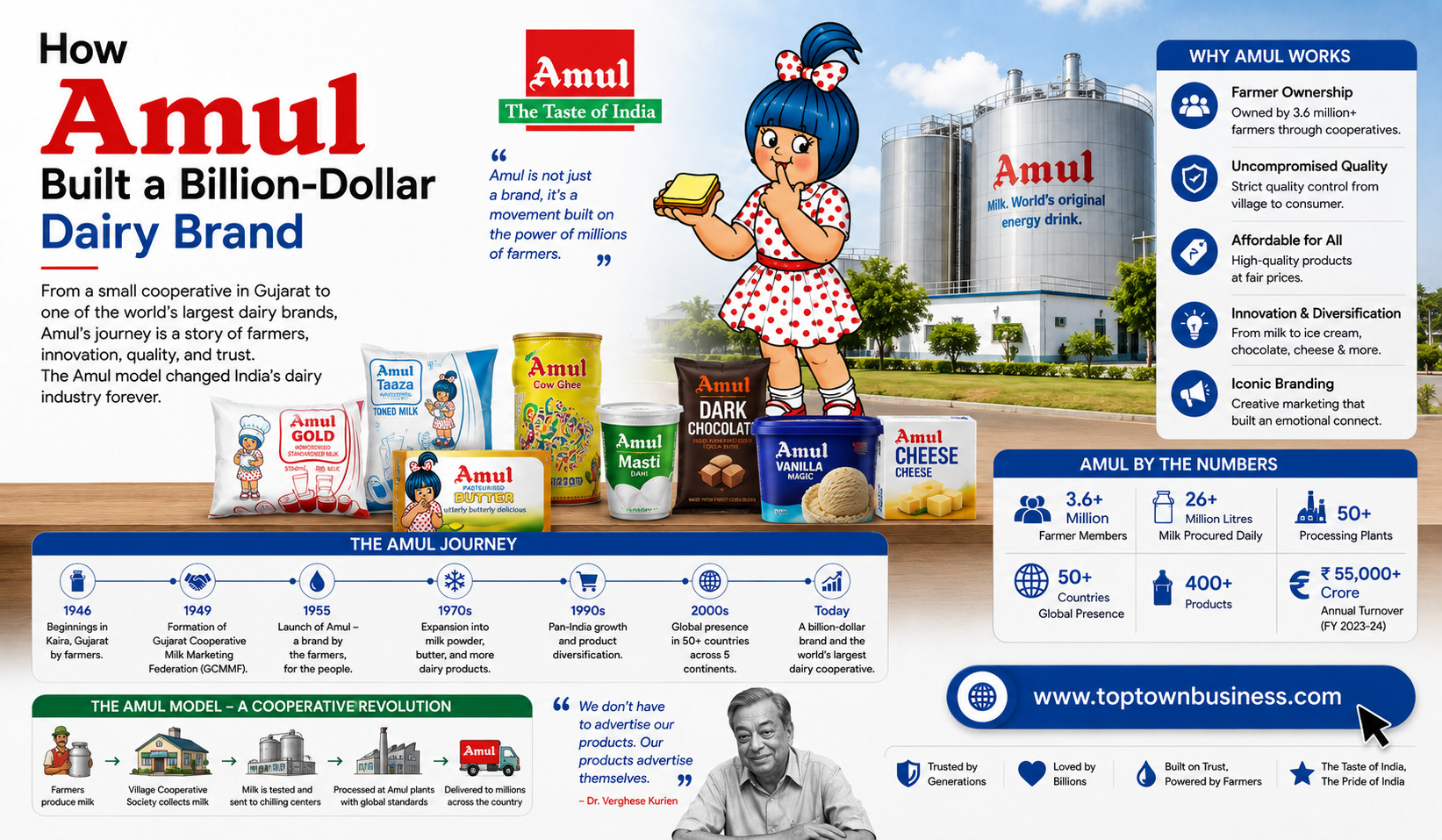
Amul is more than a dairy company. It is one of India’s most successful consumer brands and one of the world’s best-known examples of how a farmer-owned cooperative can become a powerful business.
From milk and butter to cheese, ice cream, ghee, chocolates and other dairy products, Amul has built a massive product portfolio while maintaining a strong connection with millions of milk producers. In FY2024-25, Gujarat Cooperative Milk Marketing Federation (GCMMF), which markets the Amul brand, reported a turnover of ₹65,911 crore. The wider Amul group reported an unduplicated brand turnover of around ₹90,000 crore, equivalent to roughly US$11 billion.
But Amul’s success was not created overnight. Its story began with farmers trying to solve a basic problem: how to receive a fair price for the milk they produced.
How Amul Started
Amul’s story began in Anand, Gujarat, in 1946.
At the time, dairy farmers in the Kaira district faced exploitation by middlemen and private traders. Farmers had limited control over milk collection and pricing. To challenge this system, local farmers formed a cooperative that would allow them to collectively control milk procurement, processing and marketing.
The cooperative began with just two village societies and 247 litres of milk. It eventually became the foundation of what is now known as Amul.
The basic idea was revolutionary for its time: instead of individual farmers negotiating separately with intermediaries, farmers could collectively own and control the dairy business.
That cooperative principle became the foundation of Amul’s long-term success.
The Role of Tribhuvandas Patel and Verghese Kurien
Two names are particularly important to Amul’s early development: Tribhuvandas Patel and Dr. Verghese Kurien.
Tribhuvandas Patel helped establish and lead the farmers’ cooperative movement in Gujarat. Dr. Verghese Kurien, who joined the dairy in 1950, brought professional management, technology and business discipline to the organization.
Kurien understood that a cooperative could not survive simply because it had a social purpose. It also needed to operate efficiently, build a strong brand and compete successfully in the marketplace.
Under his leadership, Amul developed modern dairy processing capabilities and became an example of how farmer ownership and professional management could work together. Amul’s own account describes this combination of farmer ownership, elected representatives and professional management as central to the model.
The Three-Tier Amul Model
One of Amul’s biggest strengths is its organizational structure.
The Amul model operates through three major levels.
At the village level, milk producers supply milk to village dairy cooperative societies. These societies are connected to district milk unions, which handle processing and related operations. At the state level, GCMMF markets products under the Amul brand.
This structure creates a direct connection between farmers and consumers while reducing dependence on traditional middlemen.
The model also allows thousands of individual producers to become part of a much larger economic organization.
According to GCMMF, its network currently includes 18 member unions, around 18,600 village milk cooperative societies and approximately 3.64 million milk producer members in Gujarat. Daily milk procurement is around 35 million litres.
That scale gives Amul enormous strength in procurement, processing and distribution.
Farmers Became the Owners
The most distinctive feature of Amul’s business model is that farmers are not simply suppliers.
They are the owners of the cooperative system.
This creates a fundamentally different relationship between the producer and the brand.
Instead of maximizing profits for outside shareholders alone, the cooperative is designed to provide remunerative returns to its farmer members while also offering consumers quality products at competitive prices.
Amul says that farmers receive a substantial share of the consumer price. At its annual general meeting, GCMMF stated that ₹80-85 of every ₹100 spent by consumers on Amul products goes back to dairy farmers.
This farmer-focused structure has helped create loyalty at the supply end of the business.
Building a Strong National Brand
Having milk was not enough. Amul needed consumers to recognize and trust its products.
The company therefore invested heavily in branding and marketing.
The famous Amul girl became one of the most recognizable advertising characters in India. The brand’s topical advertisements, which respond humorously to current events and popular culture, have helped Amul maintain a distinctive personality for generations.
The result is a brand that consumers recognize far beyond its core milk products.
Amul’s marketing strategy has consistently combined affordability, familiarity and Indian cultural identity. Instead of positioning dairy products as luxury items, the brand made them part of everyday Indian life.
From Milk to a Huge Product Portfolio
Another major reason Amul became a giant dairy brand was diversification.
The company gradually expanded beyond liquid milk into butter, cheese, ghee, milk powder, ice cream, chocolates, paneer, curd, beverages and traditional Indian sweets.
This strategy allowed Amul to capture more value from the milk supplied by farmers.
It also reduced dependence on a single product category.
When consumers think about Amul today, they may associate the brand with butter, cheese or ice cream just as easily as milk. GCMMF’s current product portfolio spans milk, milk powder, health beverages, ghee, butter, cheese, ice cream, paneer, chocolates and traditional sweets.
Turning Milk Into Value-Added Products
Dairy businesses face an important challenge: milk is perishable.
A strong dairy company therefore needs efficient systems for collection, processing, storage and distribution.
Amul developed a system that could convert milk into products with longer shelf lives and different market opportunities.
Butter, milk powder, ghee, cheese and other products allowed the cooperative to manage milk supplies more effectively and create additional sources of revenue.
This became particularly important during periods when milk production was higher than immediate consumer demand.
Instead of allowing surplus milk to become a problem, it could be processed into products that could be sold later.
The White Revolution and Amul’s Wider Influence
Amul’s success did not remain limited to Gujarat.
Its cooperative model became an important inspiration for India’s dairy development strategy.
In 1965, the National Dairy Development Board was established, with Dr. Verghese Kurien becoming its chairman. The objective was to replicate successful elements of the Amul model across India.
This contributed to the broader transformation known as India’s White Revolution.
The result was a major expansion of organized dairy production and marketing across the country.
Amul therefore became more than a successful company. It became a model for rural economic development.
Distribution Became a Major Competitive Advantage
A great product is not enough if consumers cannot find it.
Amul built one of India’s largest food distribution networks to ensure its products were widely available.
GCMMF currently operates through 87 branches and has a network of around 20,000 dealers and 2.8 million retailers, according to its organization information.
This massive distribution network gives Amul a major advantage.
Whether a consumer is shopping in a major city, a smaller town or a local neighborhood store, there is a strong possibility of finding Amul products.
Availability reinforces brand familiarity, while high sales volumes strengthen the overall business.
Affordable Pricing Helped Amul Win Mass-Market Consumers
Amul’s brand philosophy has also focused heavily on value for money.
The company has historically positioned many of its products as affordable everyday foods rather than premium luxury products.
This strategy helped Amul reach a huge consumer base.
Its cooperative structure also supports this positioning because the company seeks to balance farmer returns with consumer affordability.
That combination—fair returns for producers and value for consumers—has been central to the Amul model.
Innovation Kept the Brand Relevant
Amul’s long-term survival has also depended on its ability to evolve.
Consumer preferences have changed significantly over the decades. People now demand products such as high-protein beverages, packaged snacks, premium cheeses and convenient dairy products.
Amul has responded by expanding its product range and adopting new technologies across production, distribution and other parts of the business. The company describes technology adoption and product innovation as important parts of its growth strategy.
The lesson is important: a heritage brand cannot depend only on nostalgia.
It needs to continue developing products that match changing consumer needs.
Taking Amul Beyond India
Amul’s ambitions have increasingly become global.
The brand already exports products to more than 50 countries. More recently, GCMMF has expanded its international strategy through partnerships and local dairy operations.
According to GCMMF’s 2025 chairman’s speech, Amul partnered with Michigan Milk Producers Association to launch fresh milk products in the United States and also collaborated with COVAP in Spain to expand its milk presence in Europe.
This represents a significant evolution from the organization’s original focus on serving farmers and consumers in Gujarat.
Amul is now attempting to take the cooperative dairy model and Indian dairy brand to international consumers.
Why Amul Became So Successful
Amul’s success comes from the combination of several strengths rather than one single strategy.
Its farmer-owned cooperative structure created a strong supply network. Professional management helped turn that supply into a competitive business. Product diversification created multiple revenue streams. Strong branding built consumer trust. Massive distribution made products widely available.
Most importantly, Amul created a connection between its business purpose and its brand identity.
Consumers were not simply buying milk or butter. They were buying products from a brand associated with Indian farmers, affordability and national dairy development.
That emotional connection is difficult for competitors to replicate.
The Business Lessons From Amul
Amul’s journey provides several lessons for entrepreneurs and businesses.
First, solving a real problem can create a powerful foundation for a business. Amul began by addressing unfair conditions faced by dairy farmers.
Second, ownership and professional management do not have to conflict. Amul demonstrates how farmers can own an organization while professionals manage its operations.
Third, a strong brand can transform ordinary commodities into valuable consumer products.
Finally, scale matters. Amul connected millions of producers with millions of consumers through an integrated procurement, processing and marketing system.
Conclusion
Amul’s journey from a small cooperative in Anand to a dairy business with a group turnover of around ₹90,000 crore is one of India’s most remarkable business stories.
Its success was built on a simple but powerful idea: farmers could become owners of the business instead of remaining dependent on middlemen.
From that foundation, Amul developed professional management, modern dairy processing, a powerful national brand, a huge distribution network and an extensive portfolio of value-added products.
Today, Amul represents more than milk and dairy products. It represents a business model in which producers, consumers and a strong brand can grow together.
The story of Amul shows that a company does not always have to choose between commercial success and social impact. With the right structure, efficient management and a trusted brand, the two can reinforce each other.