

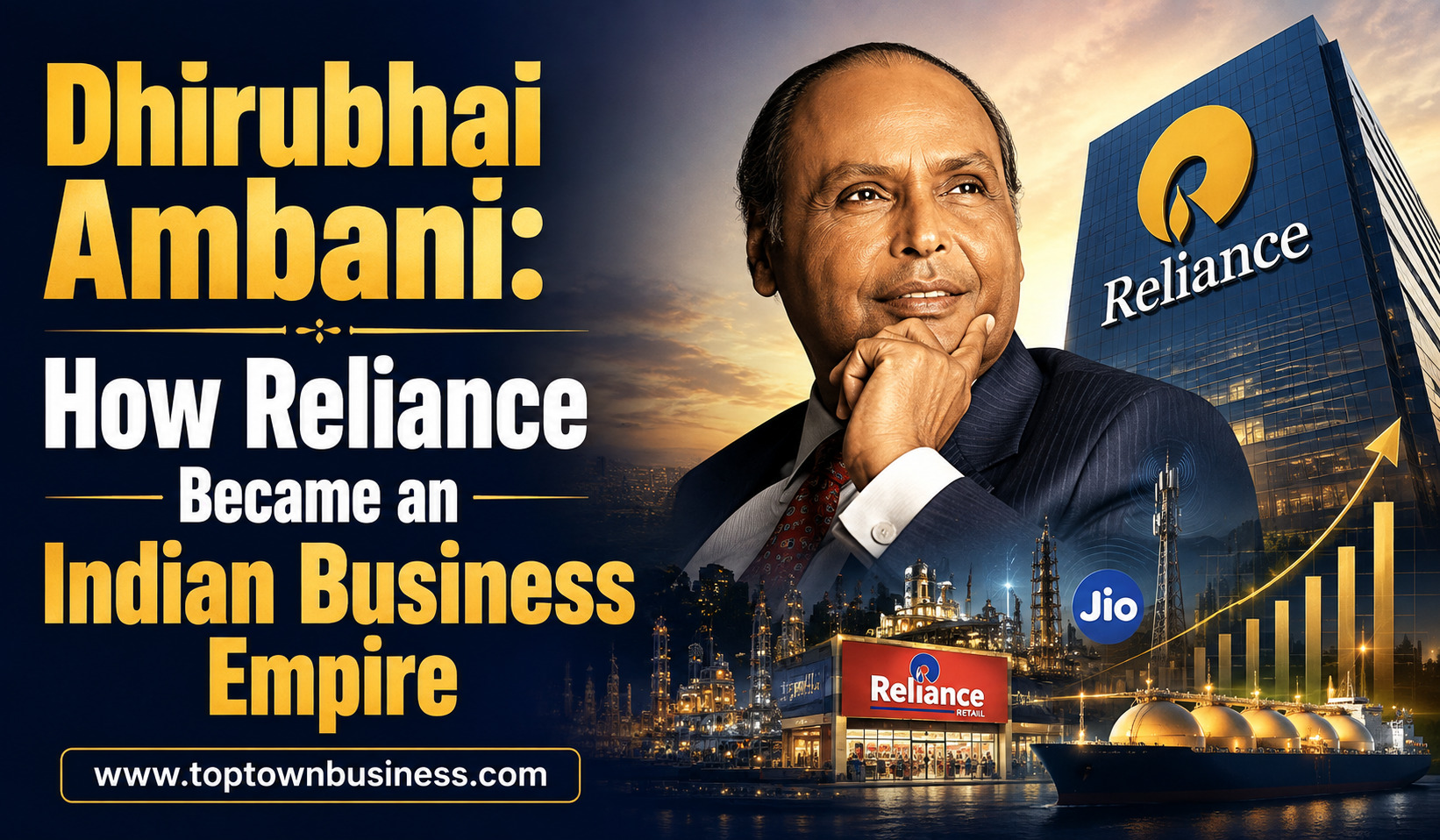
Dhirubhai Ambani is one of the most influential names in the history of Indian business. From starting his career as a young worker in Yemen to building one of India’s most powerful business groups, his journey is often seen as a story of ambition, risk-taking and entrepreneurship. The rise of Reliance Industries is closely connected with his belief that ordinary Indians could become investors and participate in the growth of a company.
Today, Reliance has interests across industries including energy, petrochemicals, telecommunications, retail, media and digital services. However, the foundation of this enormous business empire was laid decades ago with a much smaller trading venture.
Who Was Dhirubhai Ambani?
Dhirajlal Hirachand Ambani, popularly known as Dhirubhai Ambani, was born on December 28, 1932, in Chorwad, Gujarat. He came from a modest family and did not begin his career with the financial resources normally associated with large industrialists.
As a young man, Dhirubhai travelled to Aden, Yemen, where he worked for a trading company. His experience there introduced him to international trade, markets and the importance of understanding customers and prices. This exposure later influenced his approach to business in India.
After returning to India, he entered the trading business and established Reliance Commercial Corporation in 1960 with his cousin Champaklal Damani. The company initially dealt in polyester yarn and other commodities. The business was small compared with the Reliance of today, but Dhirubhai had much bigger ambitions.
From Trading to Manufacturing
One of the key reasons behind the growth of Reliance was Dhirubhai Ambani’s decision to move beyond traditional trading.
During the early years, Reliance built its business by trading textiles and synthetic yarn. Dhirubhai understood that greater control over manufacturing could provide opportunities for stronger growth. This eventually led the company into textile manufacturing.
The establishment of a textile manufacturing facility at Naroda in Gujarat became an important milestone. Reliance developed its textile brand, Vimal, which became widely recognised in India.
The Vimal brand helped Reliance connect directly with Indian consumers. Instead of remaining only a trading company, Reliance was becoming a consumer-facing manufacturing business.
This transition demonstrated one of Dhirubhai Ambani’s important business principles: a company should continually move into areas where it can create greater value.
Bringing Ordinary Indians Into the Stock Market
Perhaps one of Dhirubhai Ambani’s most important contributions to Indian business was his approach to raising capital.
At a time when investing in shares was not common among ordinary Indian households, Reliance attracted a large number of small investors. Dhirubhai believed that the public could become partners in a company’s growth by owning its shares.
Reliance’s public offering in 1977 became a major moment in its corporate history. Thousands of investors participated, helping create a strong relationship between the company and its shareholders.
This approach also helped change perceptions about equity investment in India. Reliance became associated not only with industrial growth but also with the idea that ordinary people could participate in the success of a large business.
Building a Large-Scale Industrial Business
Reliance continued expanding into areas that were strategically connected to its existing operations. The company moved deeper into petrochemicals and related industries, creating an increasingly integrated business structure.
Rather than depending entirely on external suppliers, Reliance developed capabilities across different stages of production. This helped the company achieve greater control over its supply chain and improve efficiency.
Large manufacturing projects and investments in infrastructure eventually transformed Reliance into a major industrial group.
Dhirubhai was known for thinking on a large scale. He was willing to invest heavily in capacity and technology when he believed there was long-term demand. This willingness to take calculated risks became one of the defining features of his business strategy.
The Power of Vision and Scale
The story of Reliance cannot be separated from Dhirubhai Ambani’s belief in scale.
He recognised that India’s growing population and expanding middle class could create enormous demand for consumer products, textiles, energy and other goods. Instead of treating India as a small or limited market, he saw it as a country with tremendous long-term potential.
His strategy was to build businesses capable of serving that potential demand.
This vision eventually helped Reliance evolve from a textile company into a diversified industrial group. Its expansion into petrochemicals and energy created the foundation for the larger Reliance business that developed in later decades.
Challenges and Controversies
Dhirubhai Ambani’s rise was not without controversy. His aggressive business style, political connections and methods of dealing with competitors and regulators attracted criticism at different points in his career.
Reliance also faced disputes and allegations involving corporate practices and market operations. Supporters viewed Dhirubhai as an innovative entrepreneur who understood how to operate in a complicated business environment, while critics questioned some of his strategies.
Understanding the Reliance story therefore requires looking at both sides. Its growth was remarkable, but the company’s expansion also occurred during a period when India’s business environment was heavily regulated and relationships between industry and government were frequently debated.
The Legacy Dhirubhai Left Behind
Dhirubhai Ambani died on July 6, 2002. By then, he had already established Reliance as one of India’s most important corporate groups.
After his death, his sons Mukesh Ambani and Anil Ambani eventually separated their business interests. Mukesh Ambani continued leading the businesses that became part of Reliance Industries.
Under Mukesh Ambani, Reliance entered new sectors, most notably telecommunications and retail. The launch and expansion of Jio dramatically changed India’s telecom market by making high-speed mobile data widely accessible and pushing competitors to rethink their strategies.
Reliance Retail also became a major player in India’s rapidly expanding consumer economy.
These developments show how the original business philosophy of scale, technology and mass-market opportunity continued to influence Reliance long after Dhirubhai’s death.
What Entrepreneurs Can Learn From Dhirubhai Ambani
The rise of Reliance offers several lessons for entrepreneurs.
The first is the importance of thinking beyond the size of a business today. Dhirubhai started with a relatively small trading operation but constantly looked for opportunities to expand.
The second lesson is understanding the market. He recognised the potential of India’s growing consumer base and built businesses around products and industries that could serve millions of people.
Another important lesson is adaptability. Reliance did not remain limited to one business category. It moved from trading to textiles, then into petrochemicals and energy, while later generations expanded into telecommunications, retail and digital businesses.
Most importantly, Dhirubhai demonstrated the importance of ambition. His story shows that entrepreneurship is not simply about starting a company; it is about developing a long-term vision and continuously finding ways to turn that vision into reality.
Conclusion
Dhirubhai Ambani’s journey from a modest background to the creation of the Reliance business empire remains one of the most remarkable stories in Indian entrepreneurship. He transformed a small trading venture into the foundation of a diversified corporate group and helped popularise the idea of ordinary Indians becoming shareholders in major companies.
The Reliance story is ultimately a story of scale, ambition, risk-taking and adaptation. While Dhirubhai’s business methods remain debated, his impact on Indian corporate culture and entrepreneurship is difficult to ignore.
For today’s entrepreneurs, his journey offers a powerful reminder that a business can begin small but grow dramatically when its founders understand the market, embrace change and think about opportunities far beyond the present.