

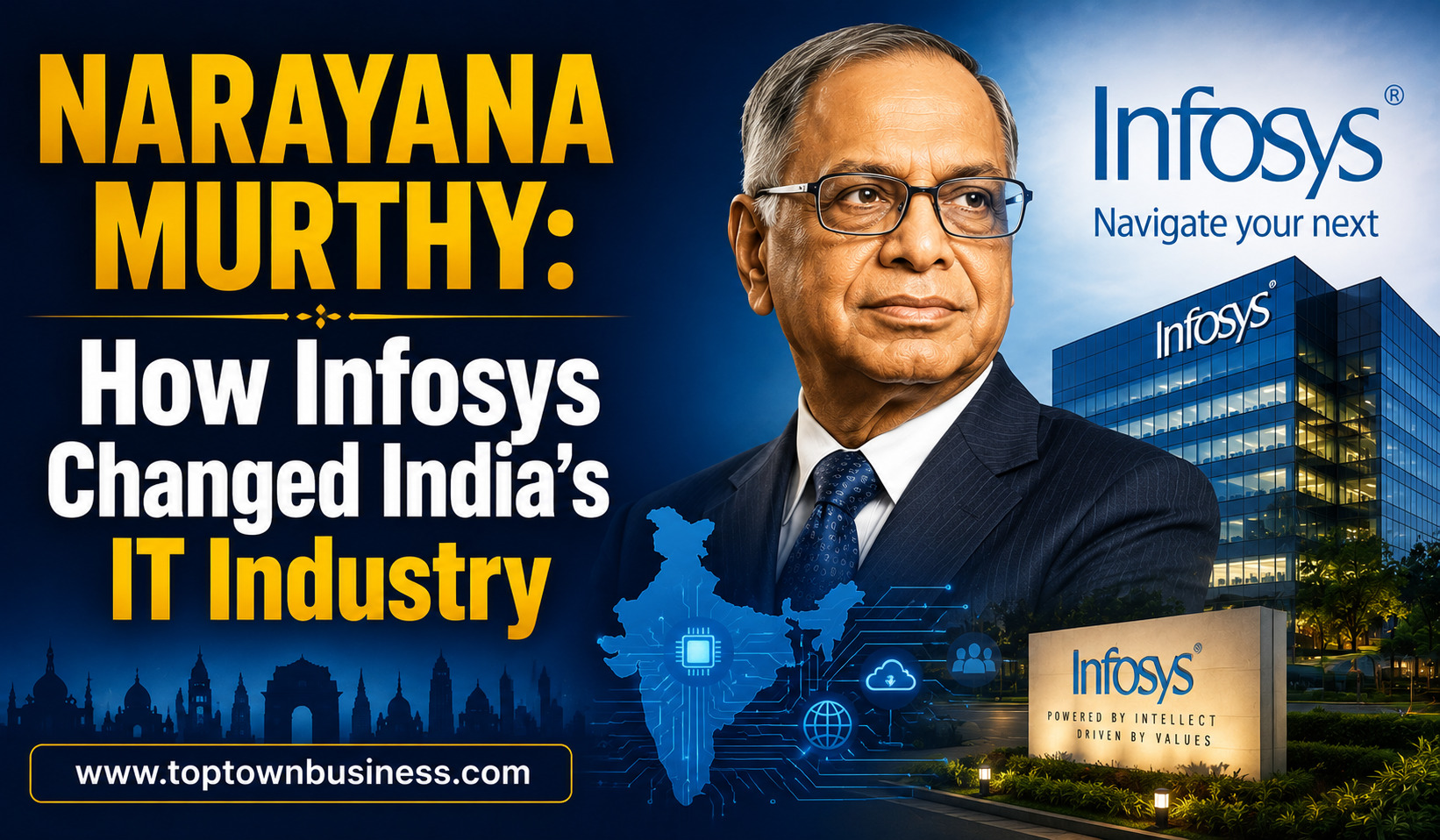
Narayana Murthy is one of the most influential figures in the history of India’s technology industry. As the co-founder of Infosys, he played a major role in demonstrating that an Indian technology company could build a global reputation through software, professionalism, transparency and skilled talent.
The story of Narayana Murthy and Infosys is more than the story of one successful entrepreneur. It reflects the transformation of India from a country better known for traditional industries into one of the world’s major destinations for information technology and software services.
From starting a company with limited resources to building a globally recognised technology organisation, Murthy’s journey offers important lessons about entrepreneurship, leadership and long-term thinking.
Who Is Narayana Murthy?
Nagavara Ramarao Narayana Murthy, popularly known as N.R. Narayana Murthy, was born on August 20, 1946, in Karnataka, India. He studied engineering and later developed a strong interest in computers and technology.
Before becoming an entrepreneur, Murthy worked in different technology-related roles and gained experience in software and computer systems. His professional experiences helped shape his understanding of the opportunities that technology could create.
In 1981, Murthy and six other professionals founded Infosys. The company began with a modest amount of capital and a relatively small team.
At that time, India’s technology industry was still developing. Computers were expensive, international business opportunities were limited and India’s regulatory environment could make it difficult for entrepreneurs to operate and expand.
Yet Murthy and his co-founders believed that India’s skilled professionals could compete in the global software market.
The Beginning of Infosys
Infosys was founded with a clear focus on software services.
The company’s early growth was not immediate. It operated in an environment where entrepreneurs faced considerable challenges, including bureaucratic procedures, limited access to technology and restrictions affecting international business.
Instead of abandoning their plans, the founders continued building the company.
One of Infosys’s important advantages was its access to India’s growing pool of engineering and technology talent. The company developed a business model around providing software development and technology services to international clients.
As global companies increasingly began using technology to improve their operations, the potential market for Indian software services expanded.
Infosys was positioned to benefit from this transformation.
How Infosys Helped Build India’s IT Reputation
The rise of Infosys contributed to a major change in how international businesses viewed India’s technology sector.
Indian companies had traditionally been associated with areas such as manufacturing, agriculture and traditional services. Infosys helped demonstrate that Indian professionals could successfully deliver sophisticated technology services to customers around the world.
The company focused heavily on quality, process management and professional standards.
This helped establish confidence among international clients and contributed to the broader growth of India’s IT services industry.
Infosys was not alone in driving India’s technology revolution. Several other Indian companies also played major roles. However, Infosys became one of the most recognisable examples of how an Indian technology business could develop a global presence.
The Importance of Corporate Governance
One of Narayana Murthy’s strongest contributions to Indian corporate culture was his emphasis on corporate governance and transparency.
As Infosys grew, the company developed a reputation for professional management and clear communication with investors.
This was particularly important because India’s corporate environment was evolving rapidly. Investors increasingly wanted reliable financial information, accountability and professional management.
Infosys became associated with these principles, helping strengthen confidence in Indian technology companies.
Murthy’s approach demonstrated that transparency was not simply a regulatory requirement. It could also become a competitive advantage by building trust among employees, customers and investors.
Infosys and the Rise of Indian IT Jobs
The growth of Infosys also had a major impact on employment.
As the company expanded, it created opportunities for thousands of engineers, software developers, consultants and other professionals.
Its success encouraged more Indian students to consider careers in engineering, computer science and information technology.
Over time, the IT sector became an important source of employment for India’s growing middle class.
The success of Infosys also encouraged other entrepreneurs to establish technology companies, creating a wider ecosystem of software services, startups and technology professionals.
The Global Delivery Model
One of the major factors behind the growth of India’s IT services industry was the development of the global delivery model.
Indian technology companies could use India’s large pool of skilled professionals while serving customers in international markets.
Infosys became an important participant in this model.
Work could be divided between client locations and development centres in India, allowing companies to deliver services efficiently across different time zones.
This model became especially powerful as telecommunications and internet connectivity improved.
India gradually became a major global destination for software development, business process services and technology consulting.
Infosys and India’s Economic Transformation
The growth of companies such as Infosys coincided with India’s economic liberalisation in the 1990s.
The technology sector benefited from greater integration with global markets and increasing demand for software services.
Infosys expanded internationally and developed relationships with major corporations across different countries.
The success of the company showed that India’s competitive advantage was not limited to low-cost labour. Skilled human capital could become a major export.
This helped change India’s position in the global economy.
Instead of simply exporting physical products, India increasingly exported knowledge, software and professional services.
Narayana Murthy’s Leadership Philosophy
Murthy’s leadership style was strongly connected with discipline, professionalism and long-term thinking.
He frequently emphasised the importance of creating value for customers, employees, shareholders and society.
Rather than presenting entrepreneurship purely as a path to personal wealth, his approach highlighted institution-building.
This distinction became important as Infosys grew from a small startup into a large corporation.
Murthy and his co-founders focused on creating systems that could continue functioning beyond the founders themselves.
That approach helped Infosys develop a professional management structure and a strong organisational culture.
The Human Side of Infosys
Technology companies depend heavily on people, and Infosys invested significantly in training and developing employees.
The company became known for creating large campuses and training programmes designed to prepare young graduates for careers in the technology sector.
This had a wider impact on India’s workforce.
Young professionals from cities and towns across the country increasingly saw IT as a career that could offer international exposure, professional growth and financial opportunities.
The IT boom also contributed to the growth of technology hubs such as Bengaluru, Hyderabad, Pune and Chennai.
Challenges Along the Way
The journey of Infosys was not without challenges.
The company had to navigate changing global technology markets, economic downturns, competition from international firms and rapid technological changes.
The global financial crisis and changes in the outsourcing industry created pressure on technology companies.
More recently, the rise of cloud computing, artificial intelligence, automation and new digital technologies has forced traditional IT services companies to rethink their business models.
The ability to adapt to these changes remains essential for companies that were built during the earlier era of software outsourcing.
Narayana Murthy’s Lasting Legacy
Narayana Murthy’s greatest contribution may be the example he set for Indian entrepreneurs.
Infosys showed that a company could begin with limited resources and still build a global business through talent, technology and professional management.
His career also demonstrated the importance of creating institutions rather than simply building personal wealth.
The company’s growth inspired generations of Indian entrepreneurs and helped establish Bengaluru as a major global technology hub.
The broader IT industry created millions of career opportunities and contributed significantly to India’s services-driven economic growth.
Lessons Entrepreneurs Can Learn From Narayana Murthy
There are several lessons modern entrepreneurs can take from Murthy’s journey.
First, strong companies require more than a good product. They also need reliable systems, professional management and customer trust.
Second, talent can become a country’s greatest competitive advantage. Infosys demonstrated how India’s educated workforce could serve customers around the world.
Third, transparency matters. A business that communicates honestly with investors, employees and customers can build long-term credibility.
Finally, entrepreneurship requires patience. Infosys did not become a global technology company overnight. Its growth came through years of persistence, learning and adaptation.
Conclusion
Narayana Murthy’s journey is closely connected with the story of India’s IT revolution. Through Infosys, he and his co-founders demonstrated that Indian technology professionals could compete successfully in the global market.
The company helped strengthen India’s reputation as a technology destination, created employment opportunities and contributed to the growth of a new generation of software professionals.
Perhaps the biggest lesson from Murthy’s career is that business success and institution-building can go together. His emphasis on professionalism, transparency, talent and long-term thinking helped create a company that became far larger than its founders.
As India enters a new era shaped by artificial intelligence, cloud computing, digital platforms and emerging technologies, the foundation created by pioneers such as Narayana Murthy continues to influence the country’s technology industry.