

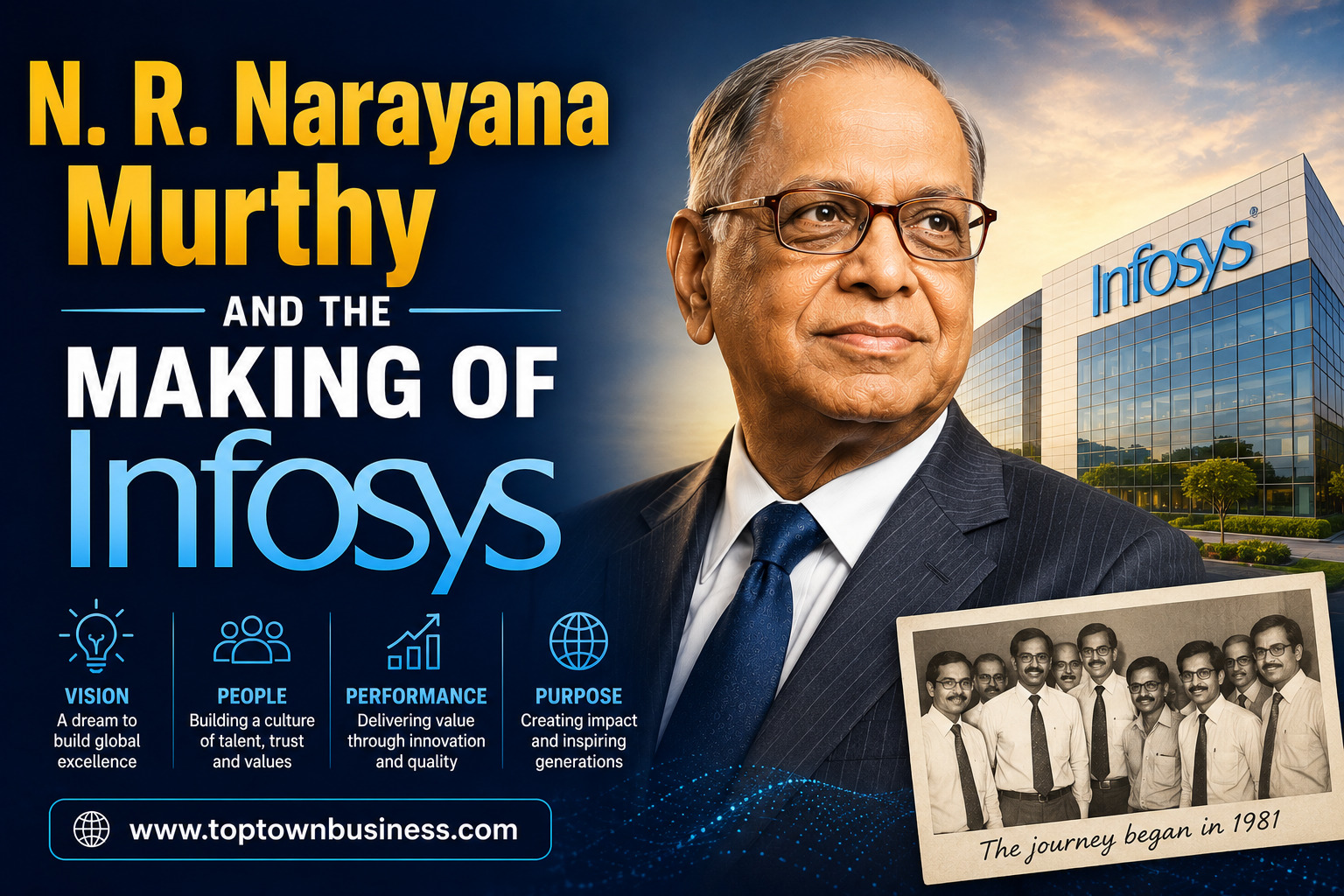
N. R. Narayana Murthy is one of the most important figures in the story of modern Indian entrepreneurship. As the co-founder of Infosys, he helped build a company that became a symbol of India’s software revolution and demonstrated that an Indian technology business could compete successfully in global markets.
The making of Infosys was not an overnight success. It began in 1981 with a small group of professionals, limited financial resources and a belief that India’s skilled workforce could create world-class software for international customers. Over the decades, Infosys grew into a major technology services company, while Murthy became known for his emphasis on professionalism, transparency and corporate governance.
His journey provides an important look at how a small technology venture became one of India’s most recognised global companies.
The Early Life of Narayana Murthy
Nagavara Ramarao Narayana Murthy was born on August 20, 1946, in Karnataka. He developed an interest in mathematics, science and technology during his education and later studied engineering.
After completing his education, Murthy worked in technology-related roles and gained experience with computers and software systems. These early experiences helped him understand how technology could transform businesses.
Before founding Infosys, Murthy also worked with other technology professionals and entrepreneurs. These experiences exposed him to both the opportunities and difficulties involved in building a technology business.
By the late 1970s, India’s technology sector was still relatively small. Computers were expensive, access to advanced technology was limited and international business opportunities were not as accessible as they are today.
Murthy nevertheless believed that Indian engineers had the talent to compete internationally.
The Birth of Infosys
In 1981, Narayana Murthy and six other co-founders established Infosys.
The founders included N. S. Raghavan, N. S. Krishna, S. Gopalakrishnan, S. D. Shibulal, K. Dinesh and Ashok Arora.
The company started with modest resources. Murthy reportedly contributed a small amount of personal capital, while the founders relied heavily on their technical skills and determination.
Their objective was not simply to create another Indian software company. They wanted to build an organisation that could provide high-quality technology services to international clients.
This was a bold idea at a time when India’s technology infrastructure and business environment presented significant challenges.
Building a Company in a Difficult Environment
The early years of Infosys were challenging.
India’s economy was highly regulated, and businesses often had to deal with complicated procedures before importing computers or accessing international markets.
Technology infrastructure was also limited.
For a company that wanted to serve global clients, these obstacles could have been enough to prevent growth.
Murthy and his colleagues, however, remained focused on building a professional organisation.
They gradually developed relationships with international customers and expanded their software services.
The company’s growth was slow in the beginning, but the founders concentrated on creating a foundation that could support long-term expansion.
Why Global Clients Became Important
One of Infosys’s most important strategic decisions was its focus on international customers.
India’s domestic market for sophisticated software services was limited during the company’s early years. International markets offered much greater opportunities.
Infosys began serving clients outside India and developed a model in which Indian engineers could work on software projects for global companies.
This eventually became an important part of India’s technology industry.
As telecommunications improved and the cost of international communication declined, Indian software companies could provide services across borders more efficiently.
Infosys was well positioned to benefit from this transformation.
The Global Delivery Model
The growth of Infosys was closely connected to the development of India’s offshore software services model.
Instead of requiring large numbers of employees to work permanently at customer locations, technology projects could be managed partly from India.
Indian engineers could develop, test and maintain software while communicating with international clients through increasingly advanced communication networks.
This model provided customers with access to skilled professionals while allowing Indian companies to operate efficiently.
Infosys became one of the companies that helped establish this approach as a major business model in the global technology industry.
The 1990s: A Turning Point
India’s economic liberalisation in 1991 created a new environment for businesses.
Greater integration with the global economy opened opportunities for companies capable of serving international customers.
For Infosys, the 1990s became a period of significant transformation.
The company expanded its international presence, strengthened its technology capabilities and developed a larger workforce.
Its public listing also increased visibility among Indian investors.
As the Indian stock market and technology sector developed, Infosys became increasingly associated with professional management and transparent corporate practices.
Corporate Governance as a Competitive Advantage
One of Narayana Murthy’s most important contributions was his emphasis on corporate governance.
Murthy believed that a successful company needed the trust of its customers, employees and shareholders.
Infosys developed a reputation for communicating financial information clearly and following professional management practices.
At a time when corporate governance was becoming increasingly important in India’s business environment, this approach helped differentiate Infosys.
The company’s reputation became an important asset as it expanded internationally.
For Murthy, transparency was not simply about meeting legal requirements. It was part of building a sustainable institution.
Creating a Professional Workplace
Infosys also invested heavily in its employees.
Technology companies depend on skilled professionals, and Infosys developed training systems designed to help young graduates build careers in software and technology.
The company became particularly attractive to India’s growing pool of engineering graduates.
As Infosys expanded, thousands of professionals gained opportunities to work with international clients and develop technology expertise.
This had a wider impact on India’s workforce.
The success of companies such as Infosys helped make software engineering and IT services highly attractive career choices for young Indians.
The Rise of India’s IT Industry
Infosys was one of several companies that helped transform India’s position in the global economy.
Alongside organisations such as TCS and Wipro, Infosys contributed to the development of a powerful Indian IT services industry.
The sector created large numbers of jobs and generated significant export revenue.
More importantly, it changed international perceptions of Indian talent.
India increasingly became known not only for its large population and traditional industries but also for engineering, software development and technology services.
The success of Infosys helped strengthen this new image.
Murthy’s Leadership Philosophy
Narayana Murthy’s leadership approach focused on institution-building rather than creating a company dependent on one individual.
He promoted professionalism, merit and ethical conduct.
His vision was to create a company where systems and values would continue even when individual leaders changed.
This approach helped Infosys develop a strong management structure.
Murthy also believed that entrepreneurs should create value for multiple stakeholders rather than focusing only on personal wealth.
Customers, employees, shareholders and society all had a role in the company’s long-term success.
Challenges Faced by Infosys
Infosys has faced several challenges during its long history.
The global technology industry changes rapidly, and companies must constantly adapt.
Economic downturns can reduce technology spending, while new competitors and technologies can disrupt established business models.
The rise of cloud computing, automation, artificial intelligence and digital transformation has created both opportunities and challenges for traditional IT services companies.
Infosys has had to invest in new capabilities and adjust its services to meet changing customer needs.
This ability to adapt remains essential for the company’s future.
Beyond Infosys: Murthy’s Broader Influence
Narayana Murthy’s influence extends beyond Infosys.
His success inspired many Indian entrepreneurs to pursue technology businesses and helped establish entrepreneurship as an attractive career path.
The Infosys story also demonstrated that a company could be built around professional management, transparency and global ambitions rather than depending primarily on government contracts or domestic markets.
Murthy’s approach therefore influenced not only the technology sector but also India’s wider corporate culture.
Lessons Entrepreneurs Can Learn From Narayana Murthy
The story of Infosys offers several lessons for entrepreneurs.
The first is to start with a clear vision. Murthy and his co-founders understood that India’s skilled workforce could serve a global technology market.
The second is patience. Infosys took years to develop into a major company. Sustainable growth requires investment in people, customers and systems.
Another lesson is the importance of trust. Transparent business practices can strengthen relationships with investors and customers.
Finally, entrepreneurs should focus on building institutions rather than businesses that depend entirely on one founder. A strong organisation should be capable of continuing to grow even when leadership changes.
Conclusion
The making of Infosys is one of the defining stories of India’s technology revolution. N. R. Narayana Murthy and his co-founders started the company in 1981 with limited resources, but they had an ambitious vision: to build an Indian technology company capable of serving the world.
Over the years, Infosys helped popularise India’s global software services model, created opportunities for thousands of professionals and strengthened the country’s reputation as a technology destination.
Murthy’s greatest contribution was not simply the creation of a successful company. It was the creation of an institution built around professionalism, transparency, talent and long-term thinking.
For modern entrepreneurs, the Infosys story remains relevant because technology will continue to change, but the fundamental principles of building trust, developing people and thinking globally remain powerful.