
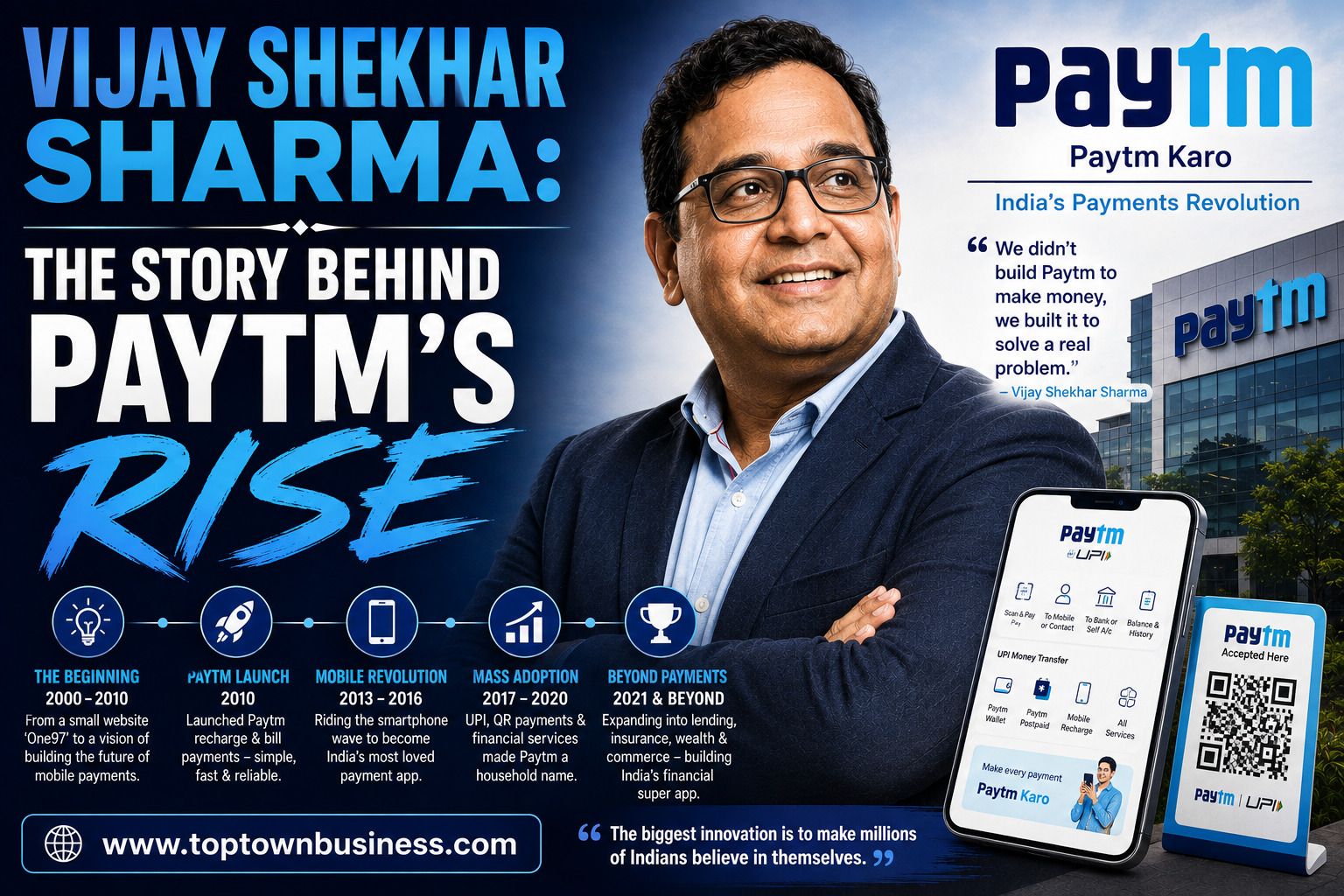
Vijay Shekhar Sharma is one of the entrepreneurs most closely associated with India’s digital payments revolution. As the founder and CEO of Paytm, he helped turn a simple digital recharge service into a large payments and financial-services platform used by consumers and merchants across the country.
What makes his journey particularly interesting is that Paytm was built before digital payments became an everyday habit for most Indians. When Sharma launched Paytm in 2010, mobile wallets were still a relatively new concept. Smartphones, affordable mobile data and digital payments had not yet reached the scale they have today.
Sharma saw an opportunity in this changing environment and built Paytm around a simple idea: make digital transactions easier and more accessible for ordinary Indians. Over time, the company expanded from mobile recharges into wallets, QR payments, merchant services, financial-services distribution and other digital products. Paytm itself identifies 2010 as the year it was founded in Noida by Vijay Shekhar Sharma.
Who Is Vijay Shekhar Sharma?
Vijay Shekhar Sharma is an Indian technology entrepreneur and the founder of Paytm’s parent company, One97 Communications. He studied engineering at Delhi College of Engineering and developed an interest in technology and entrepreneurship early in his career.
Before Paytm became a household name, Sharma had already founded One97 Communications in 2000. The company initially focused on mobile value-added services and worked with telecom operators.
This early experience was important because it helped Sharma understand mobile technology, consumer behaviour and the rapidly changing telecommunications market.
When smartphones and mobile internet began creating new possibilities, he saw an opportunity to move beyond telecom services and build a consumer-facing digital platform.
The Birth of Paytm
Paytm was launched in 2010, initially focusing on mobile recharges and payments.
At the time, asking consumers to pay bills or recharge mobile phones through a digital platform was still a relatively new concept in India.
The company had to convince users that digital transactions could be convenient and trustworthy.
Paytm’s early growth came from solving simple, everyday problems. Users could recharge their mobile phones, pay bills and later use digital wallets without depending entirely on cash.
This focus on frequent, small transactions helped Paytm become part of consumers’ everyday financial habits.
The company describes its early mission as making payments simple for Indians and says it later expanded its mobile payment ecosystem through QR payments and merchant-focused products.
How Paytm Became a Household Name
One of Paytm’s biggest strengths was its ability to expand beyond a single use case.
Instead of remaining only a recharge platform, Paytm gradually developed into a broader digital payments ecosystem.
The company’s wallet became an important part of this expansion.
Consumers could use Paytm for payments across different merchants, while businesses could accept digital transactions through the platform.
As smartphone adoption increased, the potential market became much larger.
The company also invested heavily in marketing and brand recognition, helping the Paytm name become familiar to millions of Indians.
The QR Code Revolution
A major turning point came with the expansion of QR-based merchant payments.
Paytm scaled QR acceptance across India, allowing small businesses such as neighbourhood shops, street vendors and other merchants to accept digital payments through smartphones.
This was particularly important because digital payments did not have to be limited to large retailers.
Small merchants could participate in the digital economy with relatively simple technology.
Paytm says it began scaling QR payment acceptance in 2015, helping bring mobile payments to merchants across different parts of India.
The strategy helped connect two sides of the ecosystem: consumers who wanted convenient digital payments and merchants who wanted an easy way to receive them.
The Impact of Demonetisation
India’s 2016 demonetisation became a major turning point for digital payments.
As high-value currency notes were withdrawn from circulation, consumers and businesses rapidly explored alternatives to cash.
Digital wallets became significantly more visible during this period.
Paytm was one of the platforms that benefited from the sudden increase in demand for digital transactions.
The company expanded its presence among consumers and small merchants, while the broader Indian payments ecosystem began moving more rapidly toward digital methods.
Although India’s digital-payments growth cannot be attributed to one company or one event, the period helped accelerate consumer familiarity with mobile payments.
From Wallets to QR and UPI
The Indian digital payments market continued changing after the wallet boom.
The introduction and expansion of UPI created a new payment infrastructure that allowed users to transfer money directly between bank accounts through mobile applications.
Paytm adapted to this changing environment and expanded its UPI offering.
The company increasingly focused on payments infrastructure, merchant services and financial-services distribution rather than depending solely on the wallet model.
This ability to evolve became essential as India’s payments industry became more competitive.
Building a Merchant Ecosystem
One of Paytm’s most important strategic moves was building products specifically for merchants.
QR codes provided a basic payment solution, but Paytm continued developing tools designed to help businesses manage transactions.
The introduction of Paytm Soundbox was particularly notable.
The device provides an audio confirmation when a digital payment is received, addressing a practical problem faced by merchants who may not want to constantly check their phones.
Paytm says it launched Soundbox at scale in 2019 as an audio payment confirmation device for merchants.
This is a good example of product innovation based on a real-world problem rather than simply adding technology for its own sake.
Expanding Into Financial Services
Paytm eventually expanded beyond payments into financial-services distribution.
Its platform began offering access to products such as loans, insurance and wealth-related services through partnerships and digital channels.
The strategy was designed around a larger opportunity: consumers and small businesses that use digital payments may also need access to financial products.
This created the possibility of building multiple revenue streams around the same customer and merchant ecosystem.
Paytm has described payments and financial-services distribution as core areas of its business.
Paytm’s Journey to the Stock Market
Another major milestone came when One97 Communications, the company behind Paytm, went public in 2021.
The IPO attracted enormous attention and became one of the most closely watched technology listings in India’s stock market.
The listing reflected the growing importance of India’s consumer internet and fintech industries.
However, becoming a publicly listed company also brought greater scrutiny. Investors began paying closer attention to profitability, business performance, regulation and long-term sustainability.
For Paytm, this represented a new stage in its journey.
Challenges and the Need to Reinvent
Paytm’s journey has not been without difficulties.
The fintech industry is heavily regulated, highly competitive and constantly changing. Companies must balance growth with compliance, financial discipline and customer trust.
Paytm has faced regulatory and business challenges in recent years, forcing the company to rethink parts of its strategy and place greater emphasis on its core payments and financial-services businesses.
This period demonstrated that building a large technology company is not simply about acquiring users. Sustainable growth requires strong operations, regulatory compliance and a business model capable of generating long-term value.
The company has subsequently focused on profitability and operational efficiency. Paytm reported its first full-year profit for FY26, with revenue of ₹8,437 crore and EBITDA of ₹502 crore, according to its May 2026 investor update.
Paytm’s New Growth Direction
As the digital payments industry matures, Paytm is increasingly looking at new opportunities beyond its early wallet business.
AI, merchant technology, financial-services distribution and digital marketing are becoming part of the company’s growth strategy.
In July 2026, Paytm reported Q1 FY27 revenue of ₹2,448 crore and EBITDA of ₹203 crore, while highlighting AI-led operating leverage and growth across payments and financial services.
This shows how the company continues to evolve as India’s fintech market becomes more sophisticated.
Vijay Shekhar Sharma’s Leadership Style
Sharma’s leadership has been closely associated with experimentation and aggressive expansion.
His willingness to enter emerging markets before they became mainstream helped Paytm gain an early advantage in digital payments.
At the same time, his journey demonstrates that rapid growth can create new challenges.
As a fintech company becomes larger, leadership must balance innovation with financial discipline, regulatory requirements and operational stability.
This balance has become increasingly important in Paytm’s later stage of development.
Lessons Entrepreneurs Can Learn From Vijay Shekhar Sharma
There are several lessons entrepreneurs can learn from Sharma’s journey.
First, identifying a future trend early can create enormous opportunities. When Paytm started, mobile payments were far from mainstream in India.
Second, successful businesses often solve simple everyday problems. Recharges, bill payments and merchant transactions may appear ordinary, but solving these problems at enormous scale can create a powerful business.
Another lesson is adaptability. Paytm moved from mobile recharges to wallets, QR payments, UPI, merchant devices and financial-services distribution as consumer behaviour and technology changed.
Finally, entrepreneurs must understand that growth alone is not enough. A large company must eventually build sustainable economics, strong governance and the ability to operate successfully within regulatory boundaries.
Conclusion
Vijay Shekhar Sharma’s journey from a young technology entrepreneur to the founder of one of India’s most recognised fintech brands is a significant chapter in the country’s digital transformation.
Paytm helped popularise mobile payments, expanded QR acceptance among small merchants and introduced products such as Soundbox that addressed practical problems in everyday commerce.
The company’s story has also included challenges, particularly as India’s fintech sector became more regulated and competitive. Yet Paytm’s ability to adapt continues to be an important part of its story.
For aspiring entrepreneurs, Sharma’s journey offers a powerful lesson: recognise changing consumer behaviour early, solve real problems, build for scale and be prepared to reinvent the business when the market changes.