

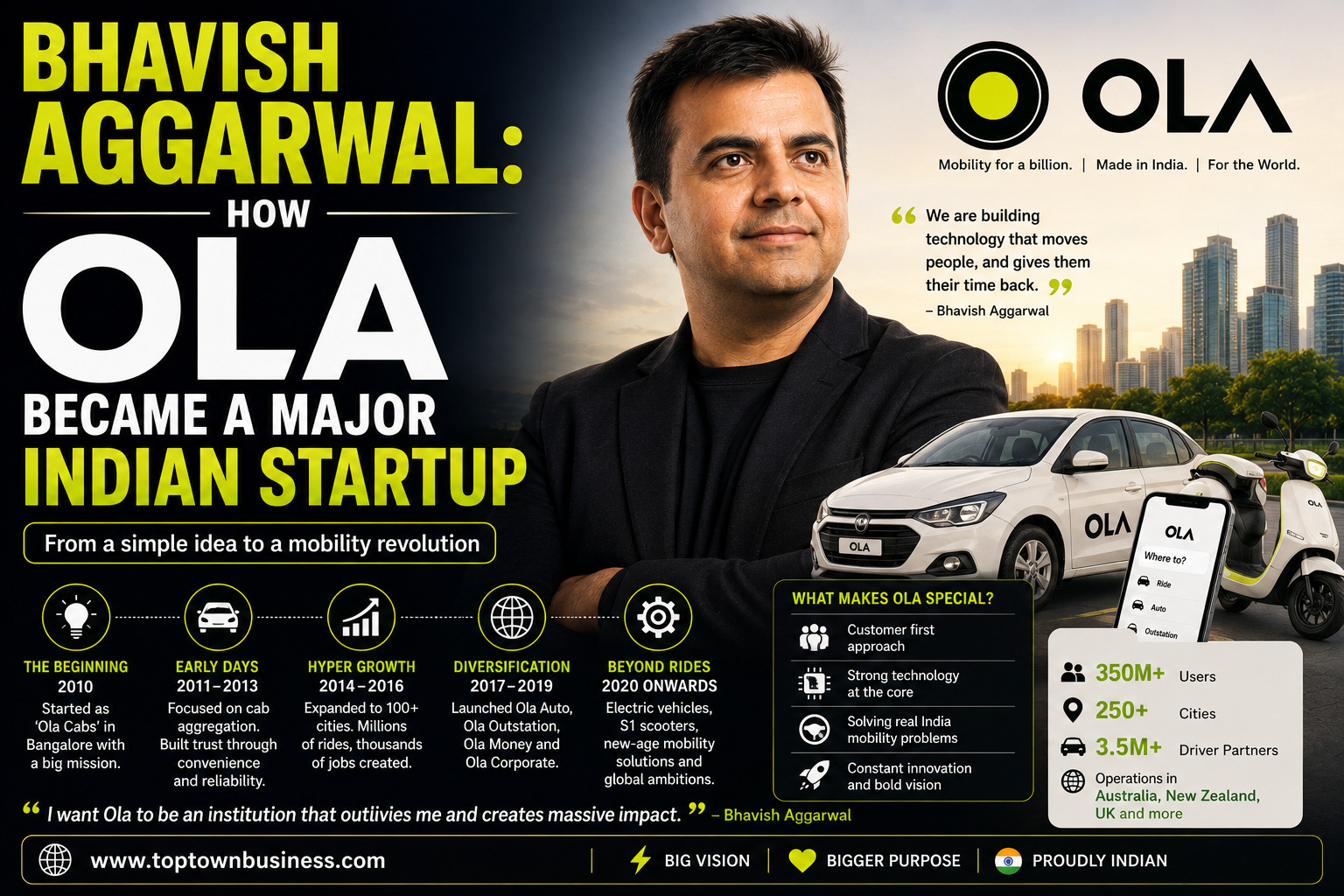
Bhavish Aggarwal is one of the entrepreneurs who helped redefine urban transportation in India. As the co-founder of Ola, he transformed a relatively simple idea—booking a cab through a mobile phone—into a major technology-driven mobility business.
Ola was founded in December 2010 by Bhavish Aggarwal and Ankit Bhati with the mission of building mobility for a billion people. What started during the early years of India’s smartphone revolution eventually grew into a platform connecting customers with driver-partners across cities.
Aggarwal’s journey is interesting because Ola was built in a market that was highly fragmented. Finding a reliable taxi was often inconvenient, prices could be unpredictable and customers had limited visibility into the availability of vehicles. Ola used technology to bring these different pieces together.
The company’s story also shows that building a major startup involves more than having a good idea. It requires experimentation, fundraising, rapid expansion, competition and the ability to respond when market conditions change.
Who Is Bhavish Aggarwal?
Bhavish Aggarwal studied computer science and engineering at the Indian Institute of Technology Bombay. Before becoming an entrepreneur, he worked at Microsoft Research, where he was involved in research and received patents while publishing academic papers.
Although he had a promising technology career, Aggarwal decided to pursue entrepreneurship.
His experience with transportation helped inspire the idea behind Ola. One frequently discussed incident involved a difficult taxi journey in Bengaluru, which highlighted problems around pricing and reliability. The experience contributed to his thinking about creating a more organised transportation service.
Instead of accepting these problems as normal parts of urban travel, Aggarwal saw an opportunity to use technology to improve the experience.
The Beginning of Ola
Ola’s early journey was not exactly the same as the platform people know today.
The founders initially experimented with an inter-city travel business. However, they soon realised that the larger opportunity was in city transportation.
This was an important entrepreneurial lesson: the first version of a business does not always reveal its biggest opportunity.
The company shifted its focus toward car rentals and urban transportation before developing the cab-booking model that eventually became its core business.
Ola’s technology allowed customers to discover available vehicles, request rides and increasingly make payments through digital channels.
For customers, this offered convenience. For drivers, the platform created access to a larger pool of potential passengers.
Solving a Real Indian Problem
One reason Ola gained traction was that it addressed an everyday problem.
Urban transportation in India was often fragmented. Customers had to search for taxis manually, negotiate prices or depend on limited local taxi services.
Ola introduced a technology-based marketplace connecting riders and drivers.
The smartphone became the bridge between the two.
Customers could use an app instead of physically searching for a taxi, while driver-partners could use the platform to find passengers.
This simple marketplace model created the foundation for Ola’s expansion.
Expanding Across Indian Cities
After establishing its presence in major urban markets, Ola expanded into more cities.
The company’s growth was supported by increasing smartphone adoption, improving mobile internet connectivity and changing consumer attitudes toward app-based services.
Ola’s official platform says it has served rides across more than 250 cities and worked with a large network of driver-partners.
This expansion helped make app-based cab booking familiar to millions of Indians.
The company also introduced different categories of transportation, attempting to serve customers with different budgets and travel requirements.
The Importance of Driver-Partners
Ola’s business model depended heavily on its driver network.
Unlike a traditional taxi company that owns a large fleet, a ride-hailing platform can connect independent or commercially operated vehicles with customers through technology.
This asset-light approach allowed Ola to expand without purchasing every vehicle itself.
Drivers gained access to customers through the platform, while Ola earned revenue by facilitating transactions.
Building this network was one of the most important challenges in the company’s early growth.
The more drivers joined the platform, the more useful it became for customers. At the same time, a larger customer base made the platform more attractive to drivers.
This created a network effect that supported Ola’s expansion.
Ola and the Indian Startup Revolution
Ola’s rise coincided with the rapid development of India’s startup ecosystem.
During the 2010s, smartphones, digital payments, venture capital and changing consumer behaviour created opportunities for technology businesses.
Ola became one of the companies at the centre of this startup boom.
Large investments helped the company expand rapidly and compete aggressively in the mobility market.
The growth of Ola also demonstrated how venture-backed technology companies could attempt to transform traditional industries such as transportation.
Competing in a Crowded Market
Ola’s growth was not without competition.
The company faced strong competition from Uber and other transportation platforms. Competing in this market required significant investment in technology, driver acquisition, customer incentives and brand building.
The rivalry helped accelerate innovation in India’s ride-hailing sector.
Customers gained access to app-based booking, digital payments, different vehicle categories and other features that gradually changed expectations around urban transportation.
For Ola, competition also meant that simply becoming a large company was not enough. It had to continuously improve its service and find ways to build a sustainable business.
Ola’s International Ambitions
Ola eventually looked beyond India.
The company expanded into international markets, including Australia and other regions, as it attempted to establish itself as a global mobility platform.
This was an ambitious step because international expansion requires understanding different regulations, consumer preferences, transportation systems and competitive environments.
Although Ola’s international journey evolved over time, the attempt reflected Aggarwal’s broader ambition to build more than a domestic startup.
From Ride-Hailing to Electric Mobility
One of the most significant developments in Bhavish Aggarwal’s entrepreneurial journey came when the business expanded into electric mobility.
Ola Electric was established as a separate business focused on electric vehicles. Aggarwal became its founder and later chairman and managing director.
The move represented a major shift from connecting customers with existing vehicles to becoming involved in the development and manufacturing of electric vehicles.
Ola Electric focused initially on electric scooters and later expanded its ambitions toward motorcycles, batteries and other energy-related technologies.
This move reflected Aggarwal’s belief that India’s transportation future could increasingly depend on electric mobility.
Building Ola Electric
Ola Electric invested heavily in manufacturing and battery technology.
The company developed its Futurefactory and established a Battery Innovation Center as part of its effort to build capabilities across the electric-vehicle value chain.
The business eventually became a publicly listed company in 2024.
Its journey, however, has been challenging. Ola Electric has faced competition, service-related issues, financial pressure and changes in the electric two-wheeler market.
In 2026, the company has been working to improve operations, reduce costs and strengthen its EV business. Recent results showed a narrower quarterly loss, although revenue remained under pressure.
This illustrates an important part of Aggarwal’s story: entrepreneurship does not end after a startup becomes successful. Large companies must continually adapt to changing markets.
Bhavish Aggarwal’s Leadership Style
Aggarwal has developed a reputation for taking ambitious bets.
His decision to move from Microsoft into entrepreneurship was an early example. Later, expanding Ola into new mobility categories and building an electric-vehicle company involved even larger risks.
His leadership has often been associated with technology, speed and long-term disruption.
However, rapid expansion can also create challenges. A large startup must eventually balance growth with profitability, customer satisfaction, operational reliability and regulatory compliance.
This balance is particularly important for companies operating in transportation, where service quality directly affects everyday customers.
What Entrepreneurs Can Learn From Bhavish Aggarwal
Aggarwal’s journey offers several valuable lessons for entrepreneurs.
The first is to solve a real problem. Ola succeeded because it addressed genuine difficulties in urban transportation rather than creating a technology solution without a clear consumer need.
The second lesson is experimentation. Ola’s early business model changed before the company found its strongest opportunity. Entrepreneurs should be prepared to change direction when customer behaviour reveals a better market.
Another lesson is the power of technology to transform traditional industries. Ola showed that smartphones could change the way people book and experience transportation.
Finally, entrepreneurs need to understand that growth brings new responsibilities. Once a startup becomes large, maintaining service quality, financial discipline and customer trust becomes just as important as acquiring new users.
The Legacy of Bhavish Aggarwal and Ola
Bhavish Aggarwal’s story is closely connected with India’s startup revolution.
Ola helped popularise app-based transportation and changed how many Indians thought about booking taxis and other mobility services. Its platform connected customers and driver-partners at a scale that would have been difficult to achieve through traditional transportation models.
Aggarwal’s move into electric vehicles has added another chapter to the story. Instead of stopping at ride-hailing, he has attempted to participate in the larger transformation of transportation and energy.
Whether every part of that strategy succeeds remains to be seen, but the willingness to pursue ambitious opportunities has been a defining feature of his career.
Conclusion
Bhavish Aggarwal’s journey from a technology professional to the founder of Ola is one of India’s most notable startup stories.
Ola began in 2010 with a simple goal of improving mobility and evolved into a major ride-hailing platform. Its growth was driven by smartphone adoption, technology, driver networks and changing consumer expectations.
The company’s later expansion into electric mobility demonstrates Aggarwal’s willingness to reinvent his business and pursue emerging industries.
For aspiring entrepreneurs, his journey offers a powerful lesson: identify a real problem, experiment with your business model, use technology to scale and remain willing to reinvent the company when the next major opportunity appears.