

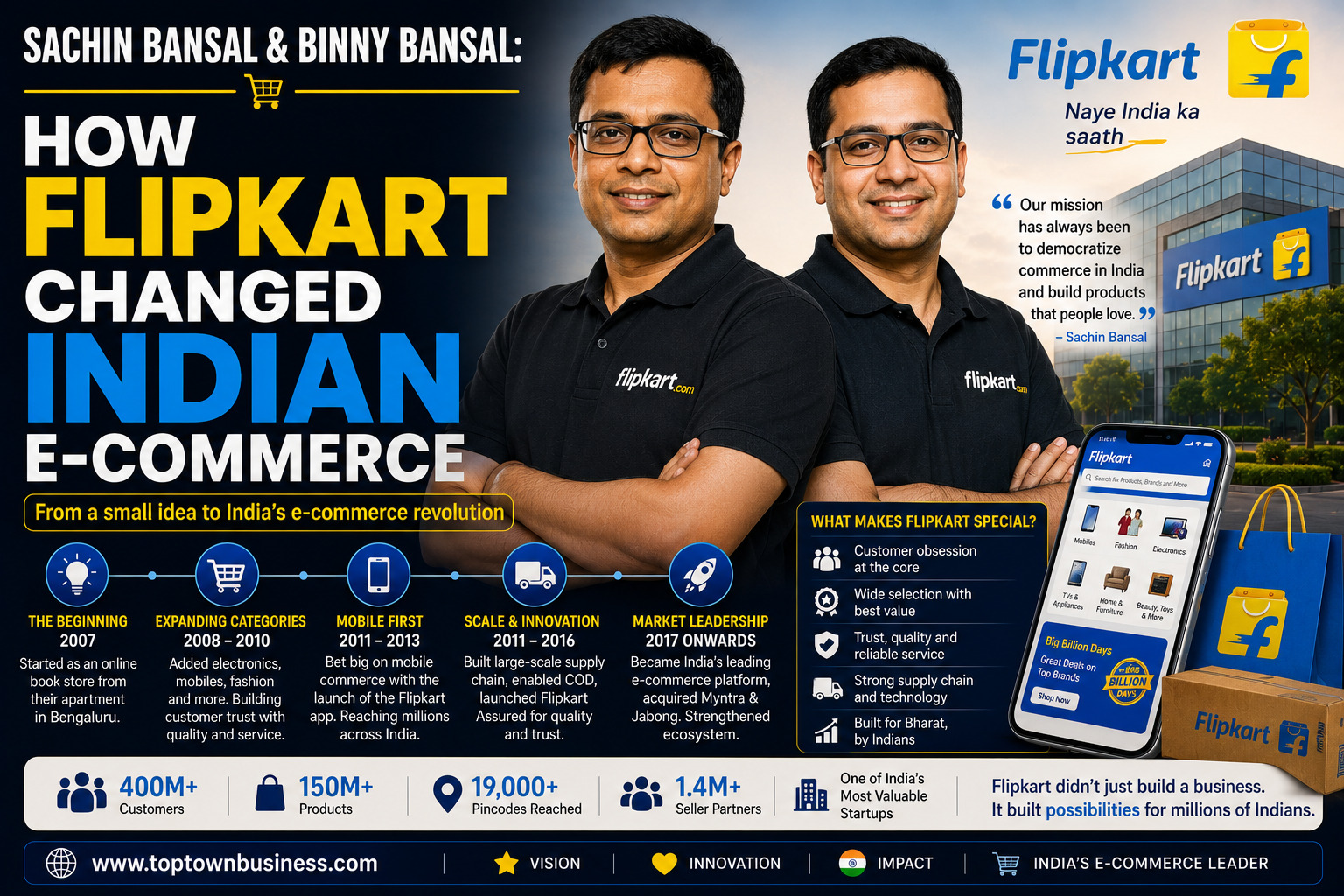
Sachin Bansal and Binny Bansal are two names that are deeply connected with the rise of India’s e-commerce industry. When the two former Amazon employees founded Flipkart in 2007, online shopping in India was still in its early stages. Internet access was limited, consumers were cautious about paying online and reliable delivery infrastructure was still developing.
The Bansal cousins saw an opportunity to change the way Indians bought products. What started as a small online bookstore eventually grew into one of India’s biggest e-commerce companies and helped create an ecosystem of digital payments, logistics, online retail and technology-driven consumer services.
Flipkart’s journey is not simply a story about selling products online. It is a story about solving uniquely Indian problems, building consumer trust and developing technology and logistics systems for a huge and diverse market.
Who Are Sachin and Binny Bansal?
Sachin Bansal and Binny Bansal are both engineering graduates of the Indian Institute of Technology Delhi. Despite sharing the same surname, they are not brothers; they are cousins.
Before starting Flipkart, both worked at Amazon in India.
Their experience at Amazon exposed them to the potential of online commerce. They understood that e-commerce could eventually become a major part of India’s retail market.
However, India’s market was very different from the markets where large e-commerce businesses had already developed.
Many Indian consumers were unfamiliar with online shopping, credit-card usage was limited and logistics networks were not designed for large-scale e-commerce deliveries.
Instead of viewing these problems as reasons to wait, the Bansals saw them as opportunities.
The Beginning of Flipkart
Flipkart was founded in 2007 in Bengaluru.
The company began with a simple idea: sell books online.
Books were a logical starting point because customers could choose titles without physically examining every product. The category also allowed a small company to build an online catalogue without immediately dealing with the complexity of selling thousands of different product categories.
The early Flipkart operation was extremely small compared with the company it eventually became.
The founders focused on building a reliable shopping experience and gradually convincing Indian consumers that buying products online could be safe and convenient.
Solving India’s Online Payment Problem
One of the biggest barriers to e-commerce in India was trust.
Many customers were uncomfortable paying online before receiving their products.
Flipkart responded by popularising cash on delivery, allowing customers to pay when their order arrived.
This approach became extremely important in the development of Indian e-commerce.
Cash on delivery reduced the perceived risk of online shopping. Customers did not have to provide payment details or trust an unfamiliar website with money before seeing their order.
For Flipkart, this strategy helped convert people who might otherwise never have tried online shopping.
It demonstrated an important lesson in entrepreneurship: sometimes a business model needs to adapt to local customer behaviour rather than simply copying a successful model from another country.
Building a Delivery Network
Selling products online is only one part of e-commerce.
A company also needs to collect products, store inventory, process orders and deliver packages to customers across different locations.
The Bansals understood that logistics would become a major competitive advantage.
Flipkart invested heavily in supply-chain capabilities and technology.
The company also became closely associated with Ekart, its logistics arm, which developed delivery capabilities across India.
This infrastructure allowed Flipkart to serve customers beyond major cities and helped improve delivery speed and reliability.
Expanding Beyond Books
Once Flipkart had established itself as a trusted online bookstore, the company began expanding into other product categories.
Electronics became a particularly important category.
Mobile phones, computers and other consumer electronics were increasingly popular among India’s growing middle class.
Flipkart expanded its catalogue to include a wide range of products, eventually becoming a broad online marketplace.
This expansion transformed Flipkart from a niche bookstore into a major e-commerce platform.
The Rise of Online Shopping in India
Flipkart’s growth coincided with major changes in India’s digital economy.
Smartphone adoption increased rapidly, mobile internet became cheaper and more widely available, and digital payments gradually became easier.
A new generation of consumers became comfortable searching for products online, comparing prices and ordering goods through mobile applications.
Flipkart played an important role in this transformation.
Its marketing campaigns, technology platform and delivery infrastructure helped introduce millions of Indian consumers to online shopping.
The company also encouraged traditional retailers and brands to think differently about digital commerce.
Competition With Amazon
Flipkart’s rise attracted strong international competition.
Amazon entered the Indian e-commerce market in 2013, creating a fierce battle for customers, sellers and market share.
The competition pushed both companies to invest heavily in logistics, technology, customer service and pricing.
For Indian consumers, the rivalry helped expand the availability of online products and improve the overall e-commerce experience.
For Flipkart, competing against Amazon required constant innovation and significant financial investment.
The company had to balance rapid growth with the challenge of building a sustainable long-term business.
Walmart’s Acquisition of Flipkart
One of the biggest milestones in Flipkart’s history came in 2018, when Walmart acquired a majority stake in the company.
The deal valued Flipkart at around $16 billion and became one of the largest acquisitions involving an Indian technology company.
The transaction demonstrated how far Indian e-commerce had come.
A company that had started as a small online bookstore had become valuable enough to attract one of the world’s largest retail corporations.
The acquisition also provided Flipkart with greater financial resources and access to Walmart’s global expertise.
Sachin Bansal’s Departure
Following Walmart’s acquisition, Sachin Bansal left Flipkart.
He later founded Navi, a financial technology company focused on digital financial services.
His departure marked the end of an important chapter in Flipkart’s story, but the company’s development continued under new leadership.
Binny Bansal also eventually moved away from the company after Walmart’s acquisition and later became involved in entrepreneurship and investments.
The transition demonstrated another reality of startup businesses: founders may create a company, but its future can continue to evolve long after they leave.
Binny Bansal and Entrepreneurship After Flipkart
After leaving Flipkart, Binny Bansal remained active in India’s startup ecosystem.
He has invested in and supported technology companies and entrepreneurs.
His post-Flipkart journey shows how founders can become part of a broader entrepreneurial ecosystem after building a successful company.
The knowledge gained from scaling Flipkart became valuable not only to Bansal himself but also to other businesses he supported.
How Flipkart Changed Indian Retail
Flipkart’s biggest contribution may have been changing consumer expectations.
Before the rise of e-commerce, shopping generally required customers to visit physical stores.
Online marketplaces introduced a different model.
Consumers could browse thousands of products from home, compare prices and have products delivered to their doorstep.
This shift forced traditional retailers to rethink their own strategies.
Many brands began developing online channels, while smaller sellers gained access to customers outside their local markets.
E-commerce therefore became more than a new shopping channel. It became a major part of India’s retail transformation.
Technology Behind Flipkart’s Growth
Technology was central to Flipkart’s expansion.
The company needed systems capable of handling millions of product listings, customer searches, payments, orders and delivery updates.
It also used data to understand customer preferences and improve recommendations.
As India’s e-commerce market became more competitive, artificial intelligence, data analytics, cloud computing and automation became increasingly important.
This technology infrastructure allowed Flipkart to operate at a scale that would have been impossible through traditional retail methods alone.
Lessons Entrepreneurs Can Learn From the Bansals
The Flipkart story offers several important lessons.
The first is to solve local problems. Cash on delivery and extensive logistics were not simply copies of foreign e-commerce strategies; they addressed specific challenges faced by Indian consumers.
Second, entrepreneurs should start with a focused idea. Flipkart began with books before expanding into a much broader marketplace.
Another lesson is the importance of infrastructure. A strong online platform is not enough if customers cannot receive products reliably.
Finally, founders need to think beyond their first business model. Flipkart evolved repeatedly as technology, customer behaviour and competition changed.
Conclusion
Sachin Bansal and Binny Bansal helped lay the foundation for India’s modern e-commerce industry. Their decision to start Flipkart in 2007 came at a time when online shopping was still unfamiliar to most Indians.
By beginning with books, building consumer trust through cash on delivery, investing in logistics and expanding into multiple categories, Flipkart gradually became a major force in Indian retail.
The company’s competition with Amazon helped accelerate India’s e-commerce development, while Walmart’s acquisition demonstrated the enormous value created by the business.
The story of Flipkart shows that successful entrepreneurship is often about understanding a market’s unique problems and building solutions around them.
For aspiring entrepreneurs, the Bansals’ journey offers a powerful lesson: start with a real customer problem, adapt to local conditions, build strong infrastructure and remain willing to evolve as the market grows.