

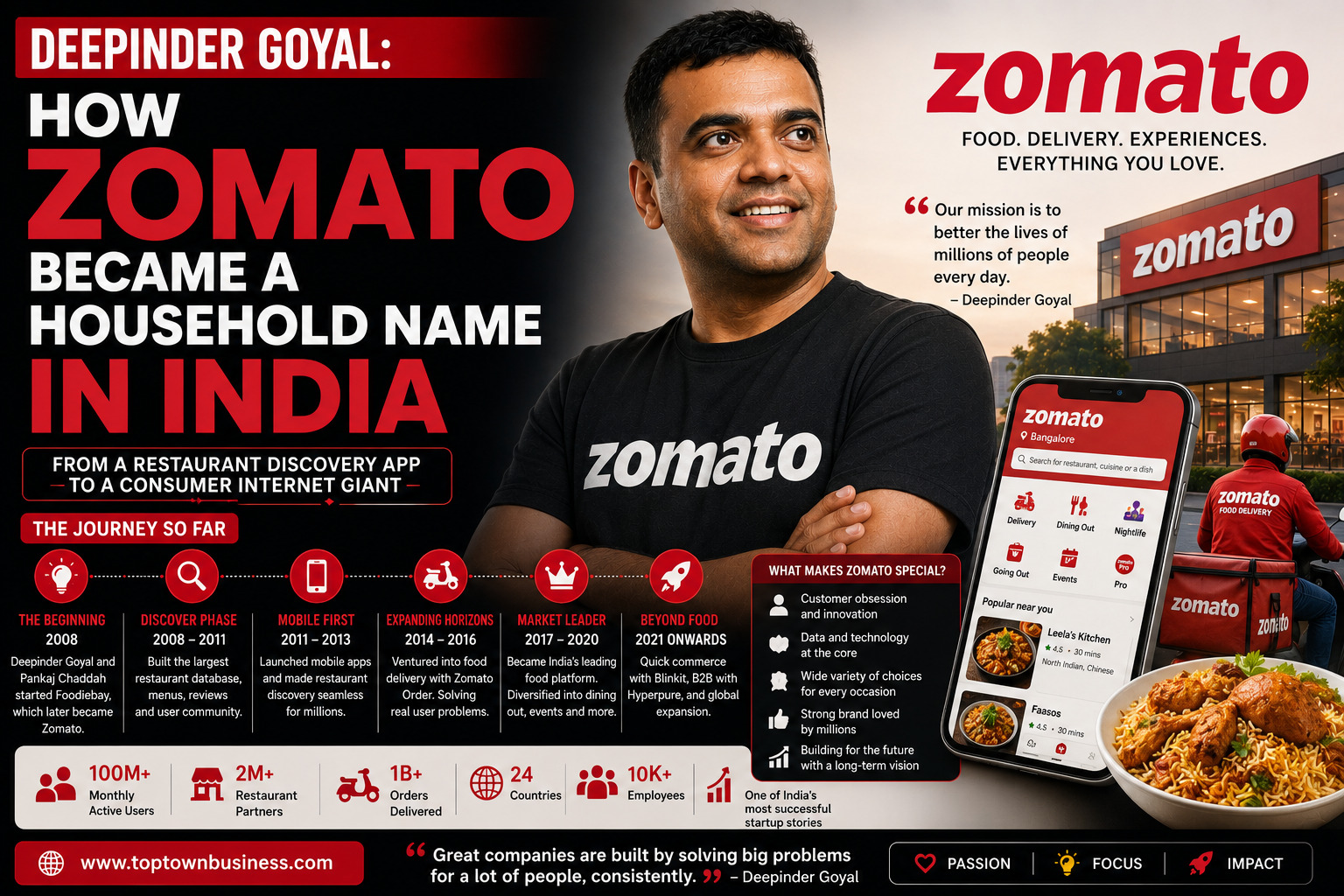
In India, ordering food online has become part of everyday life. Whether it is a quick lunch at work, a late-night meal, or a weekend dinner with family, food delivery apps have changed the way millions of Indians discover restaurants and order meals. At the center of this transformation is Zomato, a company that grew from a simple restaurant-discovery platform into one of India’s best-known consumer internet brands.
Behind this journey is Deepinder Goyal, the entrepreneur who co-founded Zomato and played a major role in shaping its business strategy, technology, and expansion. His story is not simply about building a food-delivery company. It is about identifying a common problem, understanding changing consumer behavior, surviving intense competition, and continuously reinventing a business.
The Beginning of Deepinder Goyal’s Entrepreneurial Journey
Deepinder Goyal’s professional journey began far away from the restaurant industry. He studied mathematics and computing at the Indian Institute of Technology Delhi before beginning his career at Bain & Company.
While working at Bain, Goyal noticed that employees often struggled to find restaurant menus. At a time when smartphones and food apps were not as deeply integrated into everyday life as they are today, restaurant information was often difficult to access.
This simple observation led to an important idea: what if restaurant menus could be collected and made easily available online?
In 2008, Goyal and Pankaj Chaddah started a platform called FoodieBay. The initial concept was relatively simple—help people discover restaurants, view menus, and make better dining decisions.
The company later changed its name to Zomato. This rebranding marked the beginning of a much bigger ambition.
From Restaurant Discovery to a Major Digital Platform
Zomato’s early business was focused primarily on restaurant discovery. Users could search for restaurants, read information, explore menus, and make dining choices.
But Goyal understood that consumer technology businesses cannot remain successful by depending on only one service. As internet access expanded and smartphones became more affordable, Indian consumers increasingly expected convenience from digital platforms.
Zomato gradually expanded beyond restaurant listings. It entered areas such as restaurant reservations and food delivery, allowing the company to become more deeply connected with the customer’s complete dining journey.
This shift was important because food discovery and food ordering naturally complement each other. A person searching for a restaurant could eventually become a customer ordering food through the same platform.
That evolution helped Zomato move from being an information website to becoming a major player in India’s food-tech ecosystem.
How Zomato Built a Strong Brand in India
One of the biggest reasons behind Zomato’s popularity has been its ability to build a recognizable consumer brand.
Instead of presenting itself merely as a technology company, Zomato developed a distinct personality through its advertising, social media communication, app experience, and customer-focused services.
Its brand often used humor and relatable cultural references to connect with Indian consumers. This helped Zomato stand apart in a market where several companies were competing for attention.
The company also benefited from the growing popularity of online food ordering. As consumers became more comfortable making digital payments and ordering through smartphones, food delivery became a regular part of urban life.
Zomato was therefore not just selling food delivery. It was selling convenience, choice, discovery, and speed.
The Battle for India’s Food Delivery Market
Zomato’s growth did not happen without competition. The Indian food-delivery market became one of the most fiercely contested segments of the startup economy.
Companies invested heavily in technology, delivery networks, restaurant partnerships, discounts, customer acquisition, and marketing. Competing effectively required enormous operational scale.
Zomato had to balance several difficult challenges at the same time. It needed enough customers to generate orders, enough restaurant partners to provide variety, and enough delivery capacity to fulfill orders efficiently.
This created a complicated business model in which technology and logistics had to work together.
Goyal’s leadership involved making difficult strategic decisions while navigating a market where growth alone was not enough. The company increasingly had to focus on improving efficiency and building a sustainable business.
Zomato’s IPO and a New Chapter
One of the most significant milestones in Zomato’s history came when the company went public in 2021.
Zomato became one of the most closely watched Indian technology companies to enter the stock market. Its IPO attracted considerable attention because it represented the growing influence of India’s startup ecosystem.
The listing was also symbolic. It demonstrated that a company built around an everyday consumer service could grow into a major technology business with national visibility.
However, becoming a publicly listed company also brought greater scrutiny. Investors began paying closer attention to revenue growth, losses, profitability, competition, customer acquisition costs, and long-term strategy.
For Goyal, this meant leading Zomato through a different stage of its development—one in which scale had to increasingly be balanced with financial discipline.
Beyond Food Delivery
Perhaps the most interesting part of Zomato’s story is that the company did not stop at food delivery.
The broader business ecosystem has expanded into areas connected to food, restaurants, quick commerce, and consumer convenience. Zomato’s wider corporate journey has also been shaped by acquisitions and strategic moves designed to strengthen its position in India’s rapidly changing digital economy.
The acquisition of Blinkit was particularly significant. Quick commerce became a major growth area in India, with consumers increasingly expecting groceries and everyday products to arrive within a very short time.
This expansion showed that Zomato was no longer thinking only about restaurant meals. It was positioning itself around the larger idea of on-demand consumer convenience.
The move also demonstrated Goyal’s willingness to enter competitive markets where customer expectations and business models were changing rapidly.
The Leadership Style of Deepinder Goyal
Deepinder Goyal’s leadership has often attracted attention because of his direct communication and unconventional approach to business.
Rather than following traditional corporate formulas, he has frequently emphasized experimentation, technology, efficiency, and long-term thinking.
Building Zomato required making decisions under uncertainty. The food-tech industry has faced changing consumer habits, intense competition, regulatory challenges, operational difficulties, and questions about profitability.
Goyal’s journey illustrates an important lesson for entrepreneurs: successful startups rarely follow a perfectly predictable path.
Zomato changed its business model, entered new markets, faced setbacks, adjusted its strategy, and continued evolving. That ability to adapt became one of its most important strengths.
What Entrepreneurs Can Learn From Zomato
The story of Deepinder Goyal and Zomato offers several lessons for aspiring entrepreneurs.
The first is that big businesses can begin with small problems. Zomato did not start by trying to revolutionize the entire food industry. It began with a straightforward problem: making restaurant information easier to find.
The second lesson is the importance of understanding consumer behavior. Zomato grew alongside India’s digital transformation. As people became more comfortable with smartphones, online payments, app-based services, and doorstep delivery, the company expanded its offerings accordingly.
The third lesson is adaptability. A business model that works at one stage may not be enough at another. Zomato continuously evolved from restaurant discovery to delivery and eventually into a broader consumer convenience ecosystem.
Finally, Zomato’s story highlights the importance of building a recognizable brand. Technology can be copied, but a strong relationship with customers is much harder to replicate.
The Future of Zomato and Deepinder Goyal
Zomato’s journey is far from over. India’s digital consumer market continues to expand, while food delivery and quick commerce are becoming increasingly integrated into everyday lifestyles.
For Zomato, the challenge will be to maintain customer loyalty, improve operational efficiency, manage competition, and create sustainable long-term growth.
For Deepinder Goyal, the next phase of leadership could be just as important as the company’s early years. Building a startup is one challenge; managing a large technology-driven business in a highly competitive market is another.
His entrepreneurial journey demonstrates how a simple observation can become the foundation of a major company when combined with execution, persistence, technology, and the willingness to adapt.
Conclusion
Deepinder Goyal’s journey with Zomato is one of India’s most notable startup success stories. What began as a platform for discovering restaurant menus eventually became a household name associated with food delivery and digital convenience.
Zomato’s rise was not powered by a single idea. It was built through continuous innovation, changing business strategies, strong branding, technology, and a deep understanding of how Indian consumers were changing.
The story of how Zomato became a household name in India ultimately shows that successful entrepreneurship is not just about having a great idea. It is about recognizing opportunities, solving real problems, responding to challenges, and having the courage to evolve.
For aspiring entrepreneurs, Deepinder Goyal’s story offers a powerful reminder: sometimes, a seemingly ordinary problem can become the starting point for something much bigger.