

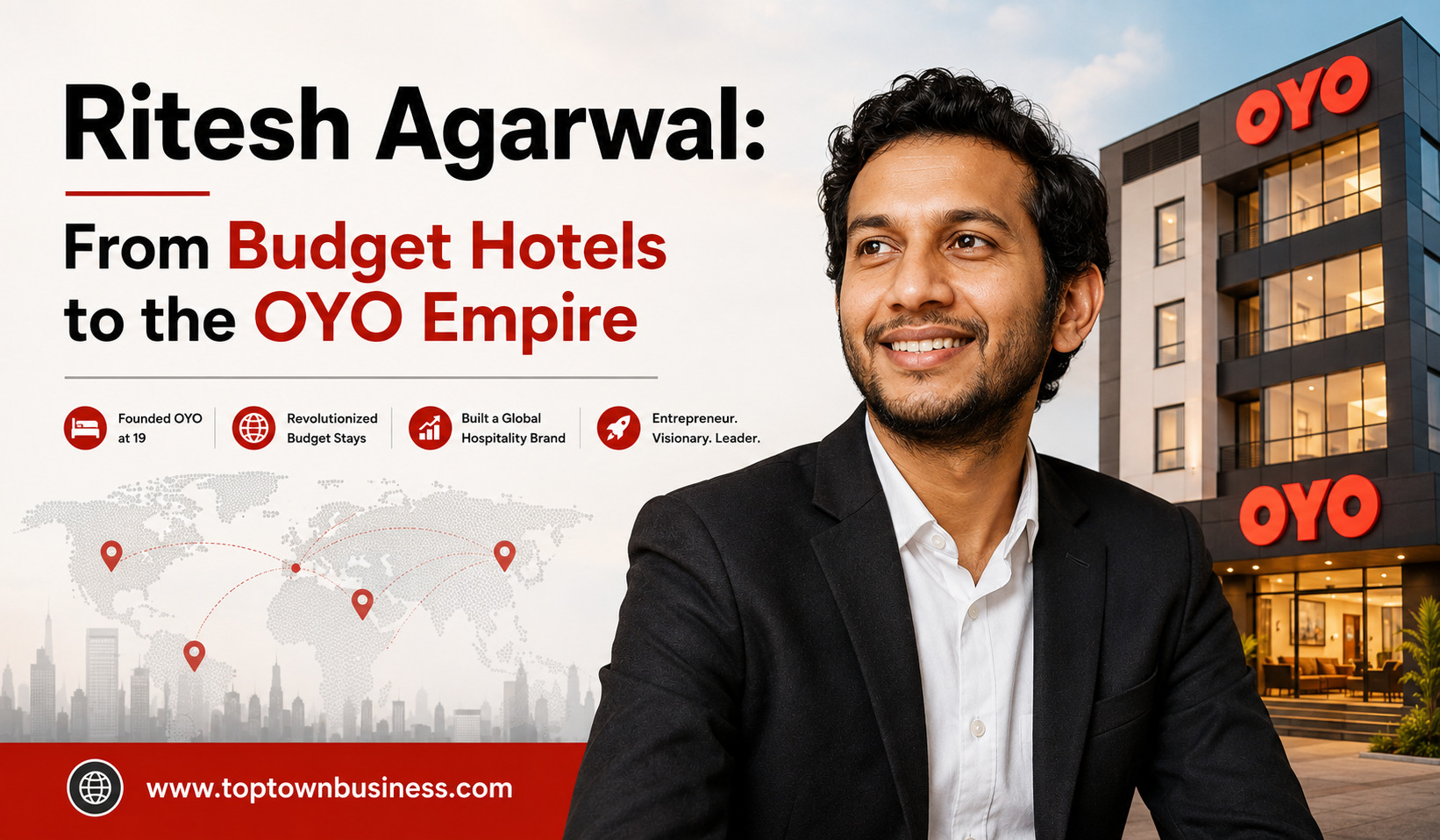
India’s startup ecosystem has produced entrepreneurs who have transformed traditional industries through technology, and Ritesh Agarwal is one of the most recognizable names in that journey. His story is closely connected with OYO, the hospitality company that changed how many travelers discovered and booked budget accommodation.
What began as an attempt to solve a simple problem—finding reliable and affordable hotel rooms—eventually developed into a global hospitality business. Ritesh Agarwal’s journey from a young entrepreneur to the founder of OYO is a story of ambition, experimentation, setbacks, and persistence.
The rise of OYO also shows how technology can reshape an old-fashioned industry. Hotels existed long before smartphones and online booking platforms, but OYO attempted to create a more standardized experience by bringing independent properties into a recognizable network.
The Early Journey of Ritesh Agarwal
Ritesh Agarwal was born in Odisha and developed an interest in entrepreneurship at a relatively young age. Instead of following a conventional career path, he became interested in building businesses and exploring opportunities in India’s growing startup ecosystem.
One of his early entrepreneurial experiments was Oravel Stays, a platform designed to help travelers find affordable accommodation. The idea emerged from his own observations of the challenges faced by budget travelers.
Finding an inexpensive hotel was not necessarily difficult. Finding one that offered consistent quality, convenient booking, and a predictable experience was much harder.
This gap presented an opportunity.
Agarwal realized that travelers wanted more than just a cheap room. They wanted basic standards, clean accommodation, transparent pricing, and a booking process they could trust.
That insight eventually became central to OYO’s business model.
How OYO Started
In 2013, OYO Rooms was launched with a focus on budget hotels and standardized accommodation.
The idea was different from simply creating another hotel-booking website. Instead, OYO worked with existing hotels and attempted to bring them into a common brand and operating system.
The company could help property owners improve aspects of their operations while giving customers a more recognizable experience.
For travelers, the OYO name promised a certain level of consistency. For hotel owners, the platform offered access to technology, marketing, bookings, and a larger customer base.
This created a model in which OYO did not necessarily need to build hotels from scratch. Instead, it could work with existing properties and transform them into part of a larger hospitality network.
Why the OYO Model Was Attractive
India has a huge hospitality market made up of hotels, guesthouses, lodges, and independently operated properties.
Many of these businesses had limited digital presence and lacked the marketing resources of large hotel chains. At the same time, millions of travelers were looking for affordable accommodation.
OYO attempted to connect these two sides.
Its technology platform could help customers discover and book rooms, while participating hotels could potentially receive more visibility and bookings.
Standardization became another important part of the proposition.
If a customer booked an OYO property in one city, the expectation was that the room would meet certain basic standards. Creating that level of consistency across independently operated properties was difficult, but it was also one of the company’s biggest opportunities.
The Importance of Technology
Technology played a major role in OYO’s expansion.
Traditional hotel businesses often depended heavily on walk-in customers, travel agents, phone bookings, or local reputation. Digital platforms changed this model by allowing travelers to compare properties and make reservations through smartphones.
OYO used technology to connect customers, hotel owners, and its own operations.
The company could use digital systems to manage bookings, track property performance, communicate with customers, and support hotel partners.
This approach helped demonstrate how technology could become an important layer between traditional businesses and modern consumers.
For Ritesh Agarwal, technology was not simply a tool for selling hotel rooms. It was a way of organizing a fragmented hospitality market.
Rapid Expansion Across India
OYO expanded rapidly across Indian cities.
Its recognizable branding helped turn individual budget hotels into part of a larger network. As more properties joined, customers had more choices, while the growing customer base made the platform increasingly attractive to hotel operators.
This created a network effect.
More hotels could attract more customers, and more customers could make the platform more valuable to participating hotels.
The company also targeted different categories of accommodation over time, attempting to expand beyond its original budget-hotel identity.
This aggressive growth strategy helped OYO become one of the most talked-about startups in India’s technology ecosystem.
OYO Goes Global
Ritesh Agarwal’s ambition extended beyond India.
OYO expanded into international markets, including countries in Asia, Europe, and other regions. The company’s international ambitions reflected the belief that the underlying problem it was trying to solve was not limited to India.
Many countries have fragmented hotel markets where independent properties compete with large hospitality chains.
OYO attempted to apply elements of its model to these markets, although international expansion brought its own challenges.
Each country has different consumer preferences, regulations, hotel standards, competitive environments, and economic conditions. A model that works in one market cannot simply be copied everywhere without adjustments.
OYO’s global journey therefore became an important learning experience for the company.
Challenges Behind the Rapid Growth
OYO’s rise was impressive, but rapid expansion also created significant challenges.
Managing thousands of properties across different locations is complicated. Maintaining consistent quality, keeping hotel partners satisfied, managing customer expectations, and controlling costs can become increasingly difficult as a company grows.
The hospitality business is also operationally different from many software startups.
A technology platform can scale its digital product relatively quickly, but hotel operations depend on physical rooms, employees, cleanliness, maintenance, customer service, and property management.
This meant OYO had to deal with problems that went beyond technology.
The company faced criticism and business challenges in different markets, forcing it to rethink parts of its strategy and focus more strongly on efficiency and sustainable growth.
Ritesh Agarwal’s Leadership Journey
Ritesh Agarwal’s leadership story is unusual partly because of how young he was when he entered the startup world.
His willingness to take risks became a defining feature of his entrepreneurial journey. However, building a large company also required learning how to manage teams, investors, partners, customers, and complex operations.
The OYO story shows that entrepreneurship is not simply about starting quickly. It is also about learning from mistakes and adapting when the original strategy encounters difficulties.
Agarwal’s journey demonstrates the difference between creating a startup and building a durable organization.
OYO and the Changing Indian Travel Market
OYO benefited from several major changes in India.
Internet access became more widespread, smartphone adoption increased, and online payments became easier. Domestic travel also expanded as more Indians began using digital platforms to plan trips and book accommodation.
Younger travelers in particular became comfortable booking hotels through apps rather than relying exclusively on traditional travel agencies.
This created favorable conditions for digital hospitality platforms.
OYO was positioned at the intersection of these trends. It combined affordable accommodation with online discovery and booking, making it easier for customers to compare and reserve rooms.
The OYO IPO and the Next Phase
As OYO matured, the company began moving toward becoming a more structured and financially disciplined business.
The company eventually pursued plans to enter the public markets, drawing attention to its financial performance, business model, profitability, and long-term prospects.
This represented another stage in OYO’s evolution.
For a startup founder, attracting investment and achieving rapid growth can be an important milestone. But building a sustainable company requires a different focus: improving margins, strengthening operations, retaining customers, and creating long-term value.
OYO’s evolution reflects this shift from growth at any cost toward a greater emphasis on business sustainability.
What Entrepreneurs Can Learn From Ritesh Agarwal
Ritesh Agarwal’s journey offers several valuable lessons for aspiring entrepreneurs.
The first is to identify a real problem. OYO did not invent the need for hotels. Instead, it focused on the gap between affordable accommodation and reliable customer experience.
The second lesson is to look for opportunities in fragmented industries. India’s hotel market had thousands of independent properties, creating an opportunity for a platform that could organize and connect them.
The third lesson is adaptability. OYO’s business model has changed significantly over the years as market conditions, competition, and customer expectations evolved.
Perhaps the most important lesson is that rapid growth comes with responsibility. Expansion can create visibility and market share, but sustainable businesses must eventually build strong systems behind that growth.
The Future of OYO
The hospitality industry continues to change as travelers become more comfortable with online bookings and expect greater convenience.
OYO’s future will depend on how effectively it can balance technology with hospitality operations. Customer trust, property quality, partner relationships, pricing, and profitability will remain important factors.
The company also has an opportunity to benefit from India’s expanding domestic travel market and the continued digitization of hospitality.
For Ritesh Agarwal, the challenge is no longer simply proving that a young entrepreneur can build a successful startup. The bigger challenge is helping OYO become a durable hospitality business capable of adapting to changing markets.
Conclusion
Ritesh Agarwal’s journey from budget hotels to the OYO empire is one of India’s most interesting entrepreneurial stories. He identified a common problem faced by travelers and attempted to solve it by combining affordable accommodation, standardization, branding, and technology.
OYO’s growth was rapid, ambitious, and sometimes challenging. Its story demonstrates that transforming a traditional industry requires more than a good app or strong marketing. It requires operational discipline, customer trust, effective partnerships, and the ability to learn from setbacks.
From a small hospitality idea to a company with ambitions beyond India, OYO reflects the possibilities and difficulties of building a large technology-driven business.
For aspiring entrepreneurs, Ritesh Agarwal’s story is a reminder that successful businesses often begin by asking a simple question: What problem can be solved better than it is being solved today?