
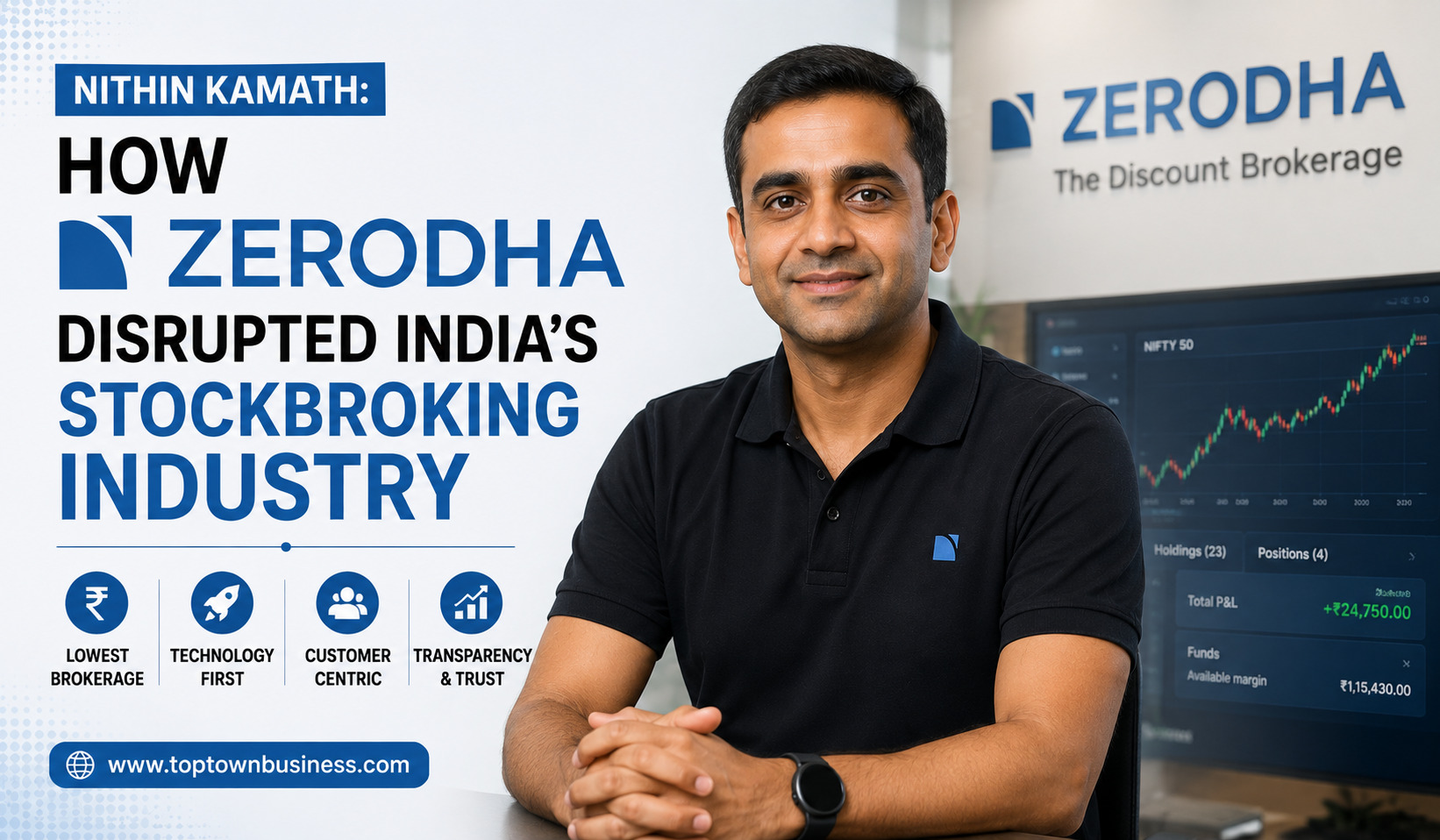
India’s stock market has changed dramatically over the last decade. Investing, once associated with complicated paperwork, high brokerage charges, and traditional financial institutions, has become much more accessible through smartphones and online platforms. One company that played a major role in this transformation is Zerodha, founded by entrepreneur Nithin Kamath and his brother Nikhil Kamath.
Zerodha’s rise is an important Indian business success story because it challenged the traditional stockbroking model without following the typical startup playbook. Instead of building its business around aggressive advertising and heavy outside funding, Zerodha focused on lower costs, technology, transparency, and a simple customer experience.
The result was a major shift in how millions of Indians approached investing and trading.
Who Is Nithin Kamath?
Nithin Kamath is the founder and CEO of Zerodha. His entrepreneurial journey began before Zerodha, when he became interested in financial markets and trading.
Unlike the traditional path into finance, Kamath learned much of the practical side of trading through personal experience. Over time, he developed a deep understanding of the difficulties faced by retail traders, including high costs, complicated platforms, and limited access to useful financial information.
That experience eventually became the foundation for Zerodha.
Kamath recognized that the stockbroking industry was ready for disruption. Technology was becoming more accessible, internet connectivity was improving, and a new generation of Indian investors was becoming interested in financial markets.
The question was how to make investing simpler and cheaper.
The Birth of Zerodha
Nithin and Nikhil Kamath launched Zerodha in 2010.
The name “Zerodha” combines the idea of zero and “rodha,” a Sanskrit-derived term associated with barriers. The concept reflected the company’s broader mission: reduce the barriers that prevented ordinary Indians from participating in financial markets.
At the time, traditional brokers commonly charged commissions based on transaction values. For active traders and investors, these costs could become significant.
Zerodha introduced a different approach.
Instead of relying primarily on percentage-based brokerage, the company built a discount-broking model with a transparent fee structure. This helped make trading more affordable, particularly for retail investors.
The company did not initially have the marketing power of established financial institutions. Its growth depended heavily on its product and customer experience.
Why Zerodha Was Different
Zerodha’s biggest innovation was not simply charging less. Its broader achievement was combining low-cost investing with technology.
The company developed online platforms that allowed customers to open accounts, monitor markets, place orders, and manage investments digitally.
This removed much of the friction associated with traditional stockbroking.
Customers did not necessarily need to visit an office or depend on a broker for every transaction. Much of the process could be handled through an online interface.
This became particularly powerful as smartphones and affordable internet access spread across India.
Investing was increasingly moving from brokerage offices to people’s phones.
The Power of Low-Cost Broking
Price was central to Zerodha’s strategy.
The company challenged the assumption that a stockbroker needed to charge customers high commissions to operate a successful business.
Its transparent pricing attracted traders who were sensitive to transaction costs.
For long-term investors, lower costs could also be meaningful because brokerage and other charges can affect investment returns over time.
Zerodha therefore positioned itself around a simple value proposition: provide reliable technology and market access without unnecessary costs.
This approach helped create a new category of discount brokers in India.
Kite: Making Trading Simpler
One of Zerodha’s most important products is Kite, its trading platform.
The platform was designed around simplicity and usability. Rather than overwhelming customers with unnecessary complexity, Zerodha attempted to create a clean interface through which users could monitor markets and execute trades.
This was particularly important for younger investors who were comfortable using mobile applications but did not necessarily understand traditional brokerage systems.
Kite helped demonstrate that financial technology could make a complicated activity feel more accessible.
The company’s technology-first approach also allowed Zerodha to serve a large number of customers without needing a traditional branch network of the same scale.
Building an Investor Education Ecosystem
Zerodha’s influence went beyond trading.
The company also invested in financial education through Varsity, an extensive learning platform designed to help people understand markets and investing.
This was an important strategic decision.
Stock-market participation can increase when people feel more confident about financial concepts. By providing educational material, Zerodha helped create a stronger connection between financial knowledge and its investing platform.
The approach also reflected Nithin Kamath’s broader belief that customers should understand what they are doing rather than simply follow trading recommendations.
Financial education became part of the company’s identity.
Why Zerodha Did Not Follow the Typical Startup Model
Perhaps one of the most interesting aspects of Zerodha’s success is its approach to funding.
The company became successful without relying on the enormous venture-capital investments that became common among Indian technology startups.
This gave Zerodha considerable independence.
Rather than focusing primarily on maximizing user numbers or raising larger funding rounds, the company could concentrate on revenue, profitability, product development, and customer satisfaction.
This approach also influenced its culture.
Zerodha became an example of a technology company that could achieve significant scale without following the traditional “growth at any cost” model.
For entrepreneurs, this was an important message: a startup does not necessarily have to burn large amounts of capital to build a major business.
Zerodha and the Rise of Retail Investors
Zerodha emerged at a time when India’s retail investment landscape was changing.
Internet access expanded rapidly. Smartphones became cheaper. Digital payments became easier. Young Indians increasingly began exploring stocks, mutual funds, exchange-traded funds, and other investment products.
Zerodha benefited from these trends, but it also helped accelerate them.
By making account opening and trading more convenient, the company lowered some of the practical barriers that had discouraged potential investors.
The rise of online investing platforms also contributed to a broader cultural shift.
The stock market increasingly became part of mainstream financial conversations rather than something reserved for wealthy investors or professional traders.
Competition Transformed the Industry
Zerodha’s success changed the competitive landscape.
Traditional brokers faced growing pressure from technology-driven companies offering simpler interfaces and lower fees. New-age brokerage platforms entered the market, and established financial companies began improving their digital services.
This competition benefited consumers.
Investors gained more choices, better technology, easier account-opening processes, and increasingly transparent pricing.
Zerodha therefore disrupted the industry not only by gaining customers but by changing customer expectations.
Once investors became accustomed to simple digital interfaces and lower brokerage costs, traditional models became harder to justify.
Nithin Kamath’s Leadership Philosophy
Nithin Kamath has often emphasized sustainable growth rather than rapid expansion.
His approach has been closely associated with keeping the company financially disciplined and avoiding unnecessary complexity.
This philosophy is visible in Zerodha’s relatively restrained marketing compared with many consumer internet companies.
The company has instead relied heavily on its products, word of mouth, educational initiatives, and reputation among investors.
Kamath’s journey also demonstrates the value of deeply understanding the problem a business is trying to solve.
He was not entering stockbroking as an outsider looking for a trendy market. His own experience as a trader gave him insight into the frustrations of customers.
That practical understanding helped shape Zerodha’s product strategy.
Challenges Facing Zerodha
Despite its success, Zerodha operates in a highly regulated and competitive industry.
Financial markets can change quickly, while regulatory requirements continue to evolve. Technology platforms must also maintain high reliability because even short periods of disruption can affect customers during active market hours.
Cybersecurity is another major concern for financial technology companies.
As more customers use digital platforms for investments, companies must protect sensitive information and maintain strong security systems.
Zerodha must also continue innovating as competitors introduce new products and technologies.
The company’s early advantage came from simplicity and low costs, but maintaining that advantage requires continuous improvement.
What Entrepreneurs Can Learn From Nithin Kamath
The Zerodha story offers several powerful lessons.
First, find a problem you understand deeply. Kamath’s own experience with trading helped him identify weaknesses in the traditional brokerage industry.
Second, simplicity can be a competitive advantage. Zerodha did not need to make investing more complicated. It focused on reducing friction.
Third, low prices can work when supported by efficient technology. Zerodha demonstrated that a company can serve a large customer base while keeping costs under control.
Finally, entrepreneurs should not assume that every successful startup needs huge amounts of venture capital. Zerodha’s journey shows that profitability and disciplined growth can also create a powerful foundation.
The Future of Zerodha
India’s investment ecosystem continues to evolve. More people are becoming interested in equities, mutual funds, retirement planning, and other financial products.
Technology will remain central to this transformation.
For Zerodha, the challenge will be to maintain its reputation for simplicity and reliability while expanding its services and responding to changing customer needs.
The company will also need to navigate increased competition and evolving financial regulations.
Its future success will depend on whether it can continue doing what helped make it successful in the first place: understanding customers and removing unnecessary barriers.
Conclusion
Nithin Kamath’s Zerodha success story is one of the clearest examples of fintech disruption in India.
By combining technology, transparent pricing, simple platforms, and financial education, Zerodha challenged a stockbroking industry that had traditionally been expensive and difficult for many retail investors to navigate.
The company’s rise also changed consumer expectations. Investors began demanding better technology, lower costs, and greater control over their financial decisions.
More than a brokerage platform, Zerodha became part of India’s broader shift toward digital investing.
Nithin Kamath’s journey demonstrates that disruption does not always require massive funding or flashy expansion. Sometimes, it comes from understanding a frustrating problem, building a simpler solution, and staying focused on customers for the long term.