

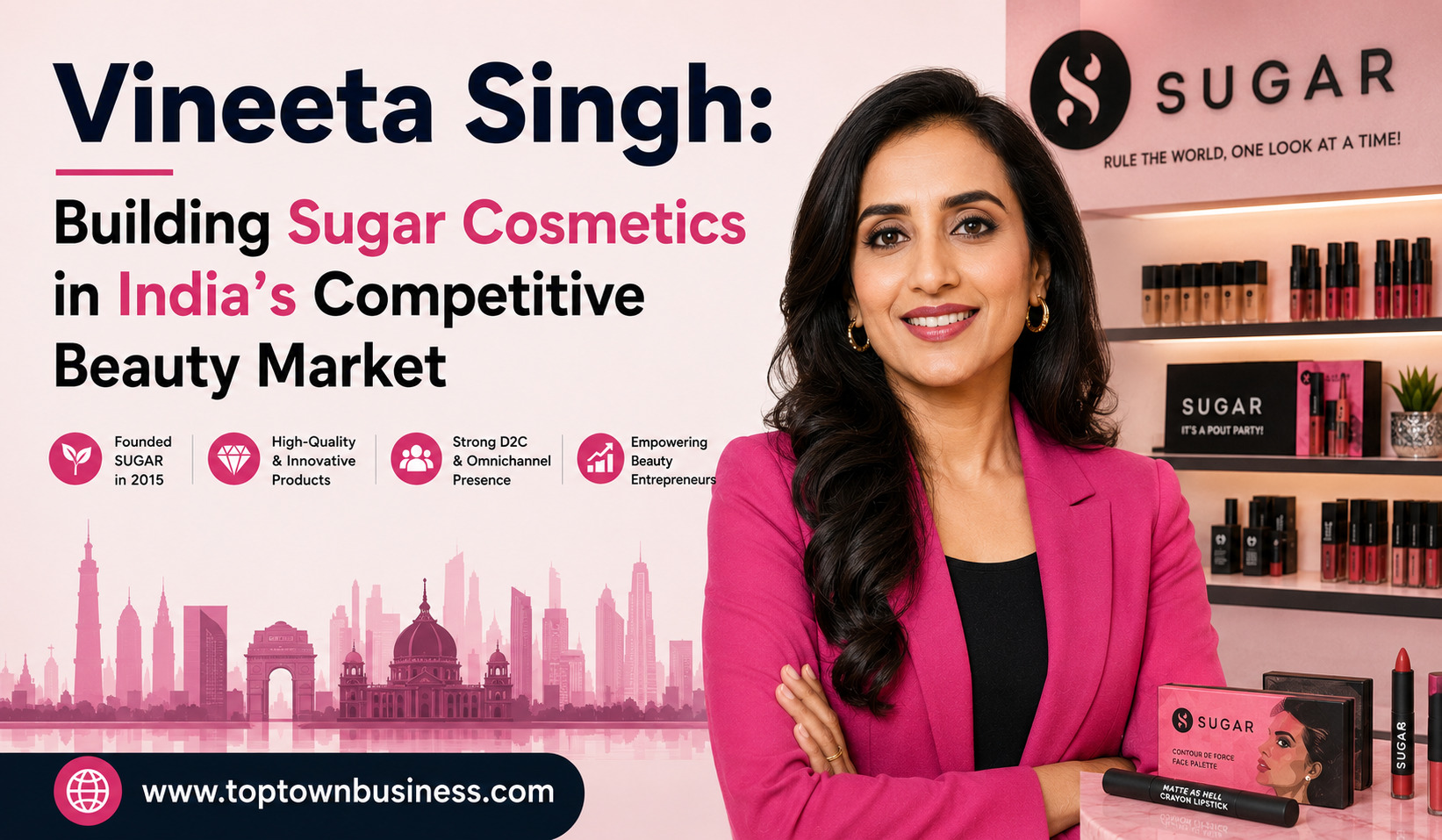
India’s beauty and cosmetics industry has changed significantly in recent years. Consumers today have access to thousands of products, international brands, online beauty stores, social media influencers, and direct-to-consumer companies. In this crowded market, building a recognizable Indian beauty brand is not easy.
Yet Vineeta Singh, co-founder and CEO of SUGAR Cosmetics, managed to create a brand that connected strongly with young Indian consumers. Her journey is particularly interesting because SUGAR was not built overnight. It emerged from years of experimentation, customer feedback, failed ventures, and a deep understanding of what Indian women wanted from makeup products.
The story of Vineeta Singh and SUGAR Cosmetics shows how identifying an overlooked customer problem can become the foundation of a powerful consumer brand.
Who Is Vineeta Singh?
Vineeta Singh is an entrepreneur and the co-founder and CEO of SUGAR Cosmetics. An IIT and IIM Ahmedabad alumna, Singh decided early in her career that entrepreneurship was the path she wanted to pursue. She famously turned down a high-paying investment banking opportunity because she wanted to build her own company.
However, entrepreneurship did not immediately bring success.
Before SUGAR Cosmetics, Singh was involved in other business ventures that did not work as planned. Rather than treating these failures as the end of her entrepreneurial journey, she used them as learning experiences.
One of the most important steps came in 2012, when Singh and her husband and business partner, Kaushik Mukherjee, launched Fab Bag, a beauty subscription business.
That company would eventually provide the consumer insights that led to SUGAR.
How Fab Bag Helped Discover a Market Gap
Fab Bag gave Singh an opportunity to interact directly with thousands of beauty consumers.
Instead of simply guessing what customers wanted, the founders could observe their preferences, complaints, and purchasing behavior. Over time, they noticed a significant gap in the Indian cosmetics market.
Many products available at the time were not designed specifically around Indian skin tones, weather conditions, and everyday lifestyles.
Indian consumers often dealt with heat, humidity, pollution, and long commutes. Makeup that performed well in cooler or less humid environments did not necessarily provide the same experience in Indian conditions.
Singh realized that this problem represented a much bigger business opportunity.
The insight eventually became the foundation for SUGAR Cosmetics.
The Birth of SUGAR Cosmetics
SUGAR Cosmetics was launched in 2015 by Vineeta Singh and Kaushik Mukherjee.
The company’s core idea was straightforward: create beauty products that better suited Indian consumers.
Instead of trying to imitate established international brands, SUGAR focused on developing products around the needs of its target audience.
Long-lasting makeup became an important part of the brand’s identity. Products were designed with Indian weather and deeper skin tones in mind, helping SUGAR differentiate itself in a market where multinational brands had traditionally held strong positions.
This customer-focused positioning gave the company a clear identity.
SUGAR was not simply selling lipstick, eyeliner, foundation, or other cosmetics. It was selling the idea that Indian consumers deserved products designed with their realities in mind.
Starting With Limited Resources
The early days of SUGAR were far from easy.
The founders had to convince manufacturers, investors, and customers that there was a large enough market for their idea. According to YourStory, the company initially struggled even to finance the import of its first lipstick batch, which was manufactured in Germany.
Funding was another challenge.
At the time, the Indian direct-to-consumer beauty ecosystem was still developing, and investors were not necessarily convinced that a young Indian cosmetics company could compete successfully against established global brands.
SUGAR eventually received early backing from India Quotient, helping the founders bring their products to market.
The long funding journey forced the company to remain focused on its products and customers rather than simply relying on large amounts of capital.
Why SUGAR Focused on Indian Consumers
One of SUGAR’s biggest competitive advantages was its understanding of the Indian customer.
The company focused on products that could handle Indian conditions while offering shades and formats that appealed to local consumers.
This approach helped SUGAR create a strong position among younger customers who wanted makeup that was practical, modern, and suited to their lifestyles.
For example, highly pigmented and long-lasting products became closely associated with the brand.
This was an important lesson in consumer business: sometimes the best opportunity is not to create something completely new but to improve an existing product for a specific audience.
SUGAR took a global product category and adapted it to Indian needs.
From Digital-First to Omnichannel
SUGAR initially followed a digital-first strategy.
This made sense because younger consumers were increasingly discovering beauty products through social media, e-commerce websites, YouTube, and other digital platforms.
But the founders quickly recognized that India’s beauty market could not be conquered online alone.
A large part of beauty shopping still happened offline, where customers could physically see, test, and compare products.
SUGAR therefore expanded its physical distribution and developed an omnichannel business model combining online and offline sales. YourStory reported that the company moved strongly into retail because the Indian beauty market remained heavily offline.
This was a crucial decision.
Instead of forcing consumers to choose between digital and physical shopping, SUGAR made its products available across multiple channels.
By 2024, Business Today reported that SUGAR had expanded to more than 45,000 retail outlets across more than 550 cities, while Invest India has also highlighted the company’s extensive retail footprint and brand-owned stores.
The Power of Social Media and Content
Beauty is a highly visual industry, making social media particularly valuable for brands.
SUGAR understood that selling makeup was not only about showing a product. Consumers also needed to understand how to use it.
How should someone apply eyeliner? Which lipstick shade works for a particular skin tone? How can a customer create a complete makeup look?
Content could answer these questions while simultaneously promoting products.
The company used platforms such as Instagram and YouTube to combine education, entertainment, and commerce. This helped SUGAR build a community around makeup rather than depending entirely on traditional advertising.
This approach was especially relevant for younger consumers who discovered beauty trends online.
Building a Brand Without Depending on Heavy Discounts
E-commerce businesses often use discounts to attract customers. SUGAR took a relatively different approach.
Vineeta Singh has discussed the company’s effort to avoid excessive discounting and instead focus on product quality and brand-building.
This strategy matters because constant discounts can train customers to wait for sales instead of buying because they genuinely value the brand.
SUGAR attempted to create demand through product differentiation, content, retail visibility, and customer loyalty.
The goal was to make consumers choose SUGAR because they wanted the product—not simply because it was cheaper.
Competing in a Crowded Beauty Market
SUGAR operates in one of India’s most competitive consumer markets.
It competes not only with established international companies but also with Indian brands, celebrity-backed businesses, online-first startups, and large e-commerce platforms.
In such an environment, simply launching another lipstick brand is not enough.
SUGAR’s differentiation has come from its focus on Indian consumers, distinctive branding, product innovation, and omnichannel distribution.
Its growth demonstrates the importance of having a clear reason for customers to remember a brand.
Learning From Failure
One of the most inspiring parts of Vineeta Singh’s story is that SUGAR was not her first entrepreneurial attempt.
Her earlier ventures did not produce the success she wanted. However, those experiences gave her a deeper understanding of business, customers, fundraising, and persistence.
Fab Bag was especially important because it allowed Singh and Mukherjee to interact closely with beauty consumers before launching their own cosmetics brand.
This meant SUGAR was not created purely from theory. It was built on years of direct customer learning.
That is one of the biggest lessons entrepreneurs can take from her journey: failure can become valuable when it produces knowledge that improves the next business decision.
Vineeta Singh’s Leadership Philosophy
Singh’s leadership journey also highlights the importance of persistence.
Building a consumer brand requires patience because customers do not automatically become loyal after seeing one advertisement.
A company must consistently deliver products people want, maintain quality, create awareness, manage distribution, and adapt to changing trends.
SUGAR’s journey from a digital-first startup to a large omnichannel beauty brand demonstrates this gradual process.
Singh has also emphasized the importance of listening to customers and continuing to innovate rather than taking shortcuts simply to increase sales.
What Entrepreneurs Can Learn From SUGAR Cosmetics
The SUGAR Cosmetics story offers several valuable lessons for aspiring entrepreneurs.
First, customer research can reveal opportunities that larger competitors overlook. Singh’s experience with Fab Bag helped her identify problems involving Indian skin tones and climate.
Second, a startup does not always need to compete by being the cheapest. A strong product and clear positioning can create customer loyalty without relying heavily on discounts.
Third, online and offline strategies can complement each other. SUGAR’s transition from a digital-first company to an omnichannel brand demonstrates the importance of understanding how customers actually shop.
Most importantly, entrepreneurship requires resilience. Singh’s earlier failures did not prevent her from eventually building one of India’s recognizable beauty brands.
The Future of SUGAR Cosmetics
India’s beauty market continues to expand as consumers become more interested in skincare, makeup, personal care, and premium products.
For SUGAR, the opportunity lies in continuing to develop products that appeal to India’s diverse customer base while strengthening its retail and digital presence.
The company has also explored international markets and expanded its product portfolio, showing that its ambitions extend beyond its original makeup categories. Business Today reported that the company has expanded into markets including the UAE, Russia, and Nepal, while also working to develop its broader beauty portfolio.
The challenge will be maintaining product quality and brand relevance while competing with an increasing number of beauty companies.
Conclusion
Vineeta Singh’s journey with SUGAR Cosmetics is a powerful example of how understanding consumers can create a successful Indian brand.
SUGAR did not emerge simply because cosmetics were a growing category. It emerged because Singh and her team identified a specific gap: Indian consumers needed beauty products that better suited their skin tones, climate, lifestyles, and expectations.
Starting from the lessons of Fab Bag, the founders built SUGAR into a digital-first brand and then expanded into a powerful omnichannel business.
The company’s journey demonstrates that successful entrepreneurship is often about paying attention to details that others overlook. Vineeta Singh saw an opportunity in an industry dominated by established players and built a brand around the belief that Indian consumers deserved products designed specifically for them.
Her story is therefore not only about cosmetics. It is about resilience, customer understanding, product innovation, and the courage to build something different.