

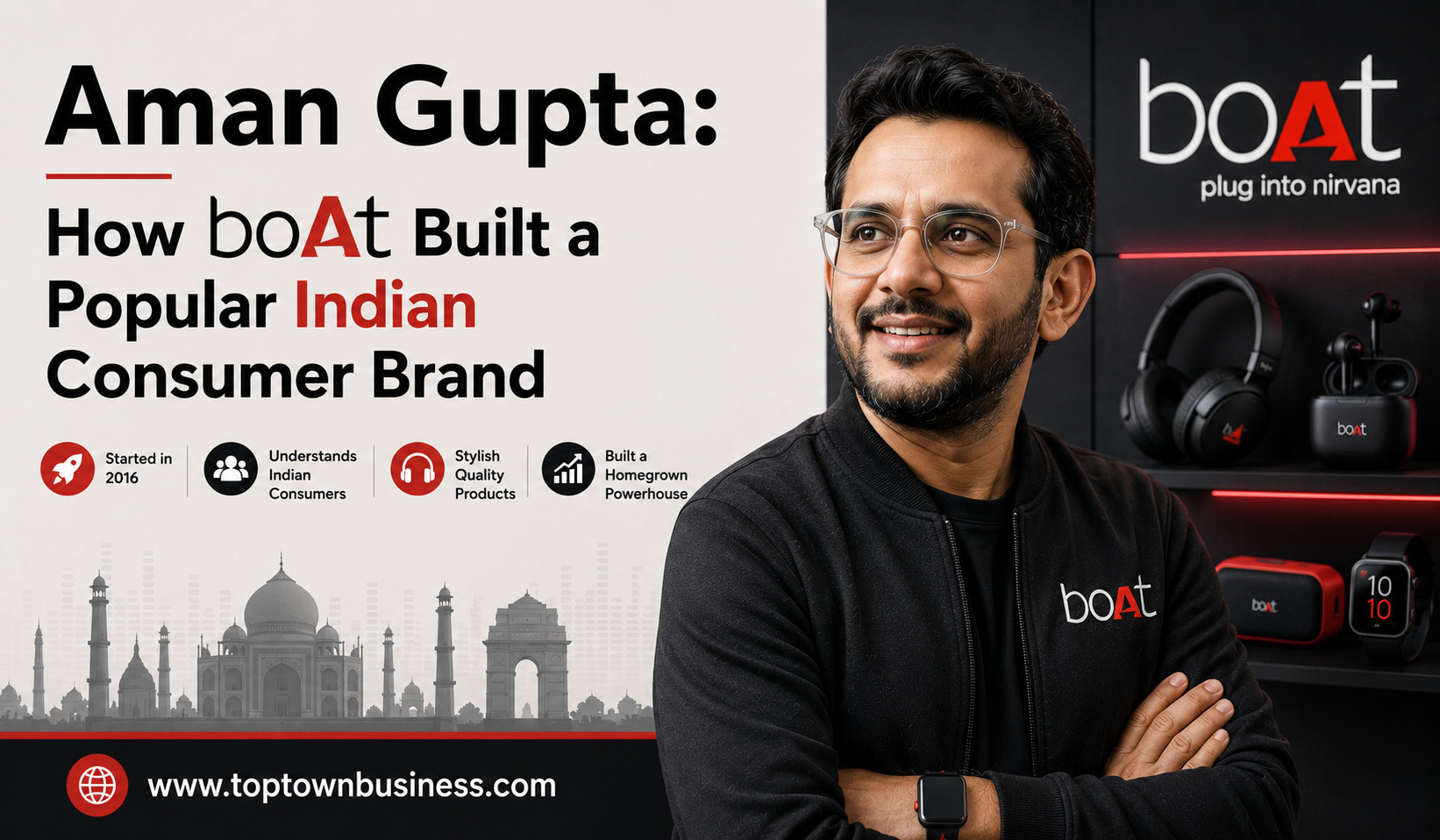
India’s consumer electronics market has changed dramatically over the past decade. Earphones, headphones, smartwatches, speakers, and other gadgets were once dominated by international brands, but a new generation of Indian companies has successfully entered the market with affordable products, aggressive branding, and a strong understanding of young consumers.
One of the most recognizable names in this transformation is boAt, co-founded by Aman Gupta and Sameer Mehta. From a relatively small consumer electronics business, boAt grew into one of India’s most visible homegrown lifestyle technology brands.
The story of Aman Gupta and boAt is not simply about selling headphones and smartwatches. It is about understanding a new generation of Indian consumers, creating an aspirational brand at accessible prices, and using digital marketing and celebrity partnerships to build mass awareness.
Who Is Aman Gupta?
Aman Gupta is an entrepreneur and the co-founder of boAt. Before building the brand, he gained experience in finance, consulting, and consumer businesses.
Gupta studied at Delhi University and later completed an MBA at the Indian School of Business. He also worked with several organizations before moving deeper into entrepreneurship.
His professional background gave him exposure to finance and business management, but his entrepreneurial journey eventually moved toward consumer electronics.
The opportunity came at a time when India’s smartphone market was expanding rapidly.
Millions of consumers were buying smartphones, and that naturally created demand for accessories such as charging cables, earphones, headphones, and speakers.
Gupta and Sameer Mehta saw an opportunity to build an Indian brand around these products.
The Beginning of boAt
boAt was founded in 2016.
The company’s early products included charging cables and other mobile accessories. However, it soon found a stronger opportunity in audio products.
Instead of competing directly with premium international brands on expensive technology, boAt focused on a combination of affordability, style, functionality, and strong branding.
This was a powerful strategy for India’s young population.
Consumers wanted products that looked modern and fashionable but were also affordable enough for students and young professionals.
boAt positioned itself directly in that space.
The brand’s products were designed to be accessible while still giving consumers the feeling that they were buying something trendy.
Understanding the Indian Consumer
One of the biggest reasons behind boAt’s success was its understanding of its target audience.
Traditional consumer electronics advertising often focused heavily on technical specifications.
boAt approached the market differently.
Instead of talking only about battery capacity, connectivity, or hardware specifications, the company connected its products with lifestyle, music, fitness, travel, fashion, and entertainment.
This helped turn ordinary electronics into lifestyle accessories.
For young customers, headphones were not simply devices for listening to music. They were part of their personal style.
Smartwatches were not only about displaying the time. They could represent fitness, fashion, and technology.
boAt understood this shift and built its brand around it.
The Power of Affordable Premium
One of boAt’s most important strategies was its positioning between low-cost generic products and expensive international brands.
The company offered products at prices accessible to a large section of Indian consumers while emphasizing design and lifestyle appeal.
This created an attractive proposition.
Customers did not necessarily have to spend a large amount of money to own a product that looked modern and felt aspirational.
This “affordable premium” approach helped boAt reach a broad audience.
It also allowed the company to benefit from India’s growing middle class and expanding consumer spending.
Digital Marketing Became a Major Advantage
boAt’s rise coincided with the explosion of social media in India.
Platforms such as Instagram, YouTube, and other digital channels gave brands new ways to reach younger consumers.
boAt became highly active in digital marketing and used social media to create a youthful brand identity.
Instead of relying entirely on traditional advertising, the company connected itself with music, sports, entertainment, and popular culture.
This made boAt more than an electronics seller.
It became a recognizable lifestyle brand.
Celebrity Endorsements and Sports Partnerships
Celebrity marketing became another important part of boAt’s strategy.
The company partnered with actors, musicians, athletes, and other public figures to increase brand visibility.
Sports played a particularly important role because cricket and other major sporting events provide access to enormous audiences in India.
By associating the boAt name with popular personalities and sporting culture, the company was able to increase recognition rapidly.
This strategy was especially effective because the target audience was highly influenced by entertainment and social media.
A consumer who saw a favorite celebrity wearing boAt headphones could become curious about the product.
Brand awareness could then translate into online searches and purchases.
E-Commerce Helped boAt Scale
Another major advantage was the growth of online shopping in India.
Platforms such as Amazon and Flipkart made it easier for young brands to reach customers across the country without building thousands of physical stores.
boAt used e-commerce aggressively.
Its products could be displayed alongside international brands, while competitive pricing and strong digital marketing helped attract customers.
This reduced some of the traditional barriers to building a consumer electronics company.
A startup did not necessarily need a huge retail network from the beginning. It could build awareness online, sell through e-commerce platforms, collect customer feedback, and gradually expand into physical retail.
boAt followed this broader trend as its business grew.
From Accessories to a Lifestyle Portfolio
boAt did not remain focused only on wired earphones and cables.
As consumer demand changed, the company expanded into wireless audio, headphones, speakers, smartwatches, earbuds, and other connected devices.
This diversification was strategically important.
If a customer trusted boAt for earphones, the company could potentially sell that customer additional products.
The result was a broader ecosystem of affordable technology products.
The company also benefited from India’s rapid shift toward wireless devices.
Bluetooth earbuds and smartwatches became increasingly popular, creating new categories for brands to target.
Building an Indian Brand Against Global Competition
boAt’s biggest achievement was not simply selling affordable gadgets.
It proved that an Indian consumer brand could compete for attention in a market dominated by international names.
Companies such as Sony, JBL, Samsung, Apple, Xiaomi, and other established players already had strong recognition.
boAt could not simply copy them.
Instead, it developed a distinctive Indian identity centered around youth, entertainment, affordability, and fashion.
This helped the company create an emotional connection with consumers.
The lesson is important for Indian startups: competing with global companies does not always require copying their strategies. A local understanding of customers can become a major competitive advantage.
Aman Gupta and the Shark Tank Effect
Aman Gupta became even more widely known after appearing as a judge on Shark Tank India.
His presence on the show turned him into a recognizable business personality beyond the consumer electronics industry.
He became associated with entrepreneurship, marketing, branding, and startup investing.
For boAt, Gupta’s public profile also contributed to broader awareness of the brand.
However, it is important to distinguish between personal popularity and the company’s underlying business success. boAt had already established itself as a major consumer brand before Gupta became widely recognized through television.
His Shark Tank appearance simply gave him another platform to discuss entrepreneurship and connect with India’s growing startup audience.
The Importance of Brand Identity
One of boAt’s biggest lessons is the importance of brand identity.
Consumer electronics can become a highly competitive commodity market. Many products have similar basic features, making it difficult for companies to compete only on technology.
Branding provides another way to differentiate.
boAt built a clear identity around youth, energy, music, fashion, and accessible technology.
Its distinctive name, packaging, advertising, celebrity partnerships, and social media presence all reinforced that identity.
This helped customers remember the brand even when competing products were available at similar prices.
Challenges Facing boAt
The consumer electronics market is highly competitive and constantly changing.
New brands can enter the market quickly, while established international companies have significant resources, technology, and distribution networks.
Price competition can also affect margins.
boAt must therefore continue balancing affordability with product quality, innovation, and profitability.
Another challenge is changing consumer expectations.
Customers increasingly expect better audio quality, longer battery life, improved design, stronger connectivity, and additional smart features.
The company must continue investing in product development to remain relevant.
Brand loyalty also cannot be taken for granted.
Consumers can easily switch between electronics brands if another company offers better features or pricing.
What Entrepreneurs Can Learn From Aman Gupta
The boAt story offers several lessons for entrepreneurs.
First, understanding the customer can be more valuable than simply copying established competitors. boAt recognized that young Indians wanted technology that was affordable and stylish.
Second, branding can transform ordinary products into lifestyle products.
Third, digital channels can help young companies compete with much larger businesses. E-commerce and social media reduced some of the barriers traditionally associated with building a nationwide consumer brand.
Finally, entrepreneurs should recognize the importance of timing.
boAt entered the market when smartphones, online shopping, digital payments, social media, and affordable wireless technology were all growing rapidly.
The company positioned itself at the intersection of these trends.
The Future of boAt
India’s electronics market continues to expand, and consumers are increasingly interested in connected devices.
For boAt, the future could involve greater innovation in audio technology, smartwatches, wearables, gaming products, and other consumer electronics categories.
The company will need to maintain its strong brand identity while improving technology and product quality.
It will also have to compete against both Indian startups and global technology giants.
The challenge for Aman Gupta and the boAt leadership team is to ensure that the company remains more than a successful affordable electronics brand.
The long-term opportunity is to turn boAt into a globally recognized consumer technology company with Indian roots.
Conclusion
Aman Gupta’s journey with boAt is one of India’s most interesting modern consumer-brand success stories.
The company identified a growing demand for affordable technology and combined it with powerful branding, digital marketing, celebrity partnerships, e-commerce, and a deep understanding of India’s young consumers.
boAt did not invent earphones, headphones, or smartwatches. Its achievement was making these products feel more accessible, fashionable, and relevant to a new generation of Indian buyers.
That is what makes the company’s story particularly valuable for entrepreneurs.
In a crowded market, success does not always come from creating a completely new product. Sometimes it comes from understanding customers better, building a stronger brand, choosing the right price, and delivering the product through channels where people already shop.
Aman Gupta and boAt demonstrated how an Indian company could turn everyday consumer electronics into a powerful lifestyle brand—and challenge established global names along the way.