

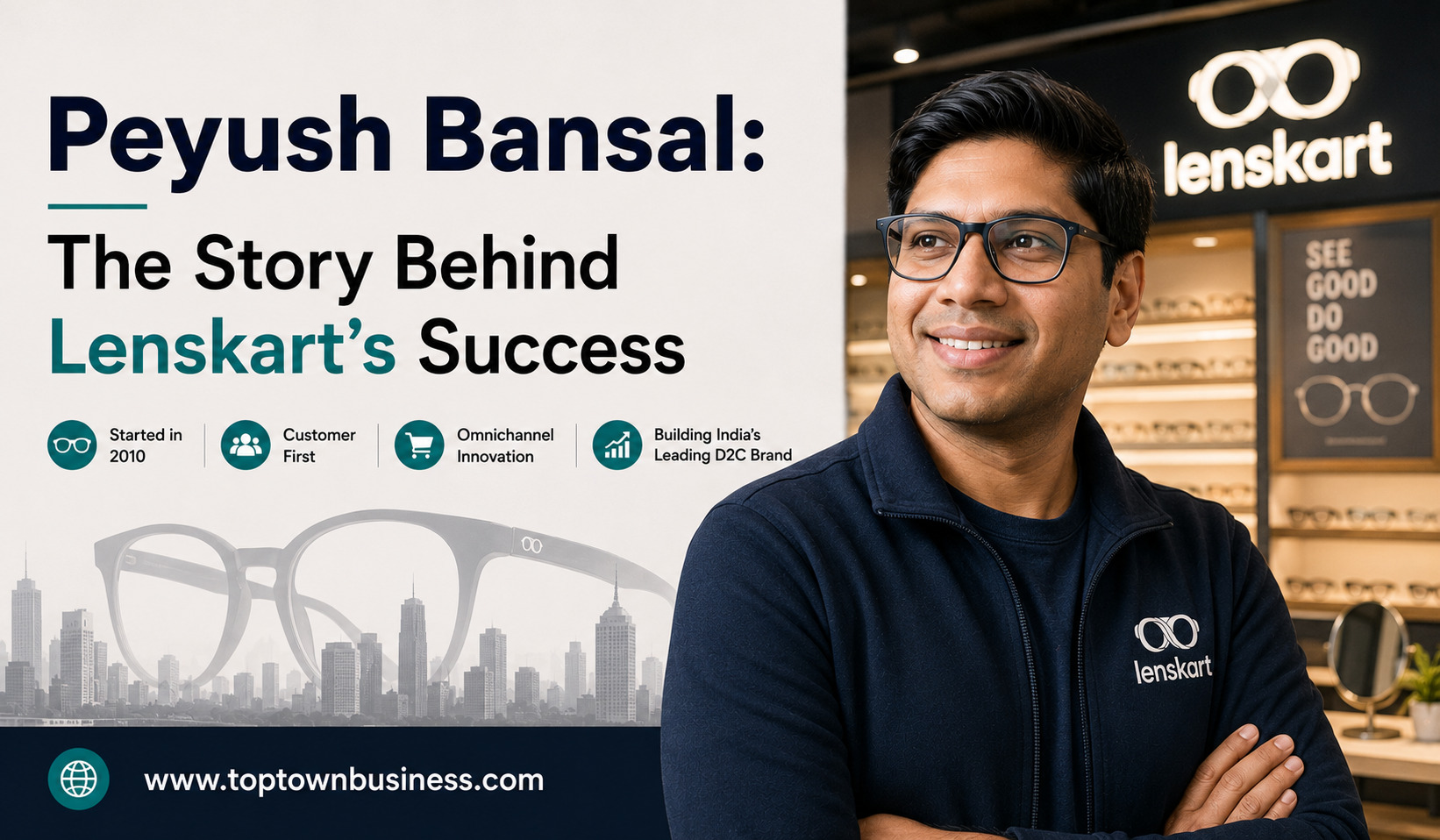
India’s eyewear industry was once largely dominated by local optical shops and a handful of established brands. Buying spectacles often meant visiting a store, getting an eye test, choosing from a limited range of frames, and paying prices that could vary significantly from one retailer to another.
Then came Peyush Bansal and Lenskart.
What started as an online eyewear business gradually evolved into one of India’s most recognizable optical brands. Lenskart combined technology, affordable pricing, home services, manufacturing, and physical stores to change how Indians buy eyewear.
The Peyush Bansal success story is particularly interesting because Lenskart did not remain a traditional e-commerce company. Instead, it built an omnichannel model that connected digital convenience with the experience of physical stores.
Who Is Peyush Bansal?
Peyush Bansal is the founder, CEO, and a key force behind Lenskart. Before becoming an entrepreneur, Bansal worked at Microsoft in the United States. His experience in technology influenced the way he approached business and customer problems. EY describes his decision to leave Microsoft and return to India as an important turning point in his entrepreneurial journey.
Bansal’s entrepreneurial journey actually began before Lenskart. He experimented with businesses including SearchMyCampus, a platform aimed at helping students find useful services and information.
These early experiences taught him an important lesson: technology could be used to solve everyday consumer problems.
That idea would later become central to Lenskart.
How Lenskart Started
Lenskart’s corporate history goes back to 2008, when the company was incorporated as Valyoo Technologies. Its operations in India began as an online business in 2010.
The original idea was relatively simple: make eyewear easier to access through the internet.
Lenskart initially focused on contact lenses before expanding into eyeglasses and sunglasses. At a time when online shopping was still developing in India, selling prescription eyewear online was a bold idea.
Customers naturally had concerns.
Would the glasses fit properly? Could they trust the prescription? Would the product look good? What if they wanted to return it?
These questions made eyewear a much more complicated category than ordinary e-commerce products.
Bansal and his team had to build customer trust while simultaneously proving that eyewear could be purchased through a digital platform.
Identifying a Gap in India’s Eyewear Market
The opportunity behind Lenskart was much bigger than simply selling glasses online.
India had a large population requiring vision correction, but access to quality eyewear and eye-care services was not always convenient. The market was also fragmented, with many independent optical retailers.
Lenskart saw an opportunity to make eyewear more accessible, affordable, and standardized.
The company’s stated purpose is to make quality eyewear accessible and affordable, with its broader vision centered around “Eyewear for All.”
This gave the business a clear purpose beyond e-commerce.
Instead of asking only, “How can we sell more glasses?”, the company was addressing a larger question: How can technology make eye care and eyewear easier for more people?
The Challenge of Selling Glasses Online
Selling eyewear online came with a major obstacle: customers often wanted to physically try glasses before buying them.
Unlike books or electronics, spectacles sit directly on a person’s face. Style, comfort, size, and fit all matter.
Lenskart experimented with ways to overcome this challenge.
It offered customer support and return policies, while also developing services that could bring parts of the optical-store experience into customers’ homes.
The company introduced home eye-check services and other technology-driven solutions to reduce the friction associated with online eyewear purchases.
This customer-focused approach helped Lenskart gradually build confidence among consumers.
Why Lenskart Opened Physical Stores
One of the most important decisions in Lenskart’s journey was moving from an online-only model to an omnichannel business.
Lenskart opened its first retail store in New Delhi in 2013, according to the company’s official history. It subsequently expanded through both online and offline channels.
This was not simply a move away from e-commerce.
Instead, Lenskart realized that online and offline shopping could work together.
A customer might discover a frame on the app, visit a store to try it, complete an eye test, and later order online. Another customer might first visit a store and then use the website or app for future purchases.
This flexibility became a major part of Lenskart’s business model.
Business Standard highlighted how Lenskart moved from an online model toward an omnichannel approach involving stores, high streets, malls, hospitals, and home services.
The Omnichannel Strategy Became a Competitive Advantage
Lenskart’s biggest strategic insight was that the future of retail was not necessarily online versus offline.
It could be both.
This was particularly useful in eyewear because customers needed physical services such as eye testing, fitting, frame adjustments, and sometimes expert assistance.
The stores also became marketing and trust-building tools.
Customers could see the products in person, interact with staff, and experience the brand before making a purchase.
Meanwhile, the website and app provided convenience and a much broader selection.
This combination helped Lenskart create a retail experience that traditional optical stores and pure-play e-commerce companies could find difficult to replicate.
Building Its Own Manufacturing Capabilities
Another important part of Lenskart’s strategy has been vertical integration.
Rather than depending entirely on external manufacturers, the company invested in its own manufacturing and technology capabilities.
Lenskart says its model includes high-quality manufacturing and robotic lens production, with technology used to improve precision and quality control.
Vertical integration can provide several advantages.
It can give a company greater control over product quality, inventory, production, pricing, and delivery.
For an eyewear business, this control can be particularly valuable because prescription lenses require accuracy and customization.
Lenskart’s manufacturing approach therefore became an important part of its attempt to standardize the customer experience.
Creating Affordable Eyewear
Price has always been an important part of Lenskart’s positioning.
The company wanted quality eyewear to be available to a wider section of Indian consumers.
Its technology-led model helped it experiment with different price points while building its own brands and product categories.
The strategy was not simply to offer cheap glasses.
Lenskart aimed to make eyewear both accessible and fashionable.
That distinction helped transform spectacles from something people bought only when necessary into something that could also be treated as a lifestyle product.
Frames became a part of personal style, while sunglasses and other products expanded the market beyond prescription needs.
From One Brand to a Larger Eyewear Ecosystem
Lenskart gradually expanded its product portfolio and developed multiple brands and categories.
This gave customers more options across different price ranges and styles.
The company also expanded beyond India into selected international markets, including Japan, Southeast Asia, and the Middle East, according to its official corporate information.
This international expansion reflects the larger ambition behind the company.
Lenskart is no longer simply trying to become a large Indian online eyewear retailer. It is attempting to build an international eyewear platform with technology and manufacturing at its core.
Technology as the Foundation
Technology has remained central to the Lenskart business model.
The company uses digital platforms for product discovery, ordering, customer engagement, and other parts of the shopping experience.
It has also experimented with technology that helps customers visualize products and access eye-care services more conveniently.
The broader goal is to reduce the friction involved in buying eyewear.
This is important because successful technology businesses do not necessarily need to eliminate physical experiences. Sometimes the best use of technology is to make those physical experiences more efficient.
Lenskart’s evolution is a good example of this principle.
Peyush Bansal’s Customer-First Approach
One recurring theme in Bansal’s entrepreneurial journey is the importance of understanding customers.
His time at Microsoft helped reinforce the idea of starting with the customer problem and working backward toward a solution. Fortune India described the company’s approach as focusing on individual problems in eyewear and solving them one by one.
This philosophy can be seen throughout Lenskart’s history.
The company addressed several customer frustrations:
- Difficulty finding stylish eyewear
- Limited choices in traditional stores
- Concerns about affordability
- The inconvenience of eye testing
- The difficulty of buying glasses online
- Lack of consistent customer experience
Rather than solving only one of these problems, Lenskart gradually built a broader ecosystem around them.
The Shark Tank India Effect
Peyush Bansal became even more recognizable across India after appearing as a judge on Shark Tank India.
His direct communication style, business insights, and investment decisions made him one of the show’s most recognizable entrepreneurs.
The program introduced Bansal to an audience far beyond the eyewear industry.
However, Lenskart’s growth began years before his television appearance. The company had already developed its online platform, physical retail network, manufacturing capabilities, and brand portfolio.
Shark Tank increased Bansal’s public profile, but the company’s underlying success came from years of execution.
What Entrepreneurs Can Learn From Lenskart
The Lenskart story provides several valuable lessons.
First, an industry does not have to be new for disruption to happen. Eyewear was an established category, but Lenskart changed how customers discovered, purchased, and experienced it.
Second, online and offline businesses do not always need to compete against each other. Combining both can create a stronger customer experience when the product requires physical interaction.
Third, controlling important parts of the supply chain can create long-term advantages. Lenskart’s investment in manufacturing and technology gave it greater control over quality and operations.
Most importantly, Bansal’s journey shows the importance of solving customer problems continuously rather than searching for one magical innovation.
The Future of Lenskart
The eyewear industry continues to evolve as technology, fashion, healthcare, and retail increasingly overlap.
Lenskart is also exploring newer areas such as smart eyewear and data-driven technology. In a recent company filing, Bansal described the company’s smart-eyewear initiative as an early step toward a broader technology and data-focused direction, while emphasizing that the near-term focus remains on learning and building the ecosystem.
This could open a new chapter for the company.
The future of eyewear may involve more than prescription lenses and frames. Smart glasses, artificial intelligence, digital eye testing, personalized recommendations, and connected devices could reshape the category.
Lenskart’s existing retail, eye-testing, manufacturing, and digital infrastructure could provide a foundation for participating in this evolution.
Conclusion
Peyush Bansal’s Lenskart success story is a powerful example of how technology can transform a traditional industry.
Lenskart began as an online eyewear business when many people were skeptical about buying glasses through the internet. Instead of stopping at e-commerce, the company listened to customers and developed an omnichannel model combining websites, apps, stores, home services, technology, and manufacturing.
Its success came from solving multiple problems at once: accessibility, affordability, convenience, product variety, eye testing, and customer trust.
Peyush Bansal’s journey demonstrates that disruption does not always mean inventing a completely new product. Sometimes, it means taking an existing industry and rebuilding the customer experience from the ground up.
From a small online venture to a major Indian eyewear company with international ambitions, Lenskart’s story shows how customer focus, technology, persistence, and an ability to adapt can turn a simple idea into a powerful consumer brand.