
Introduction
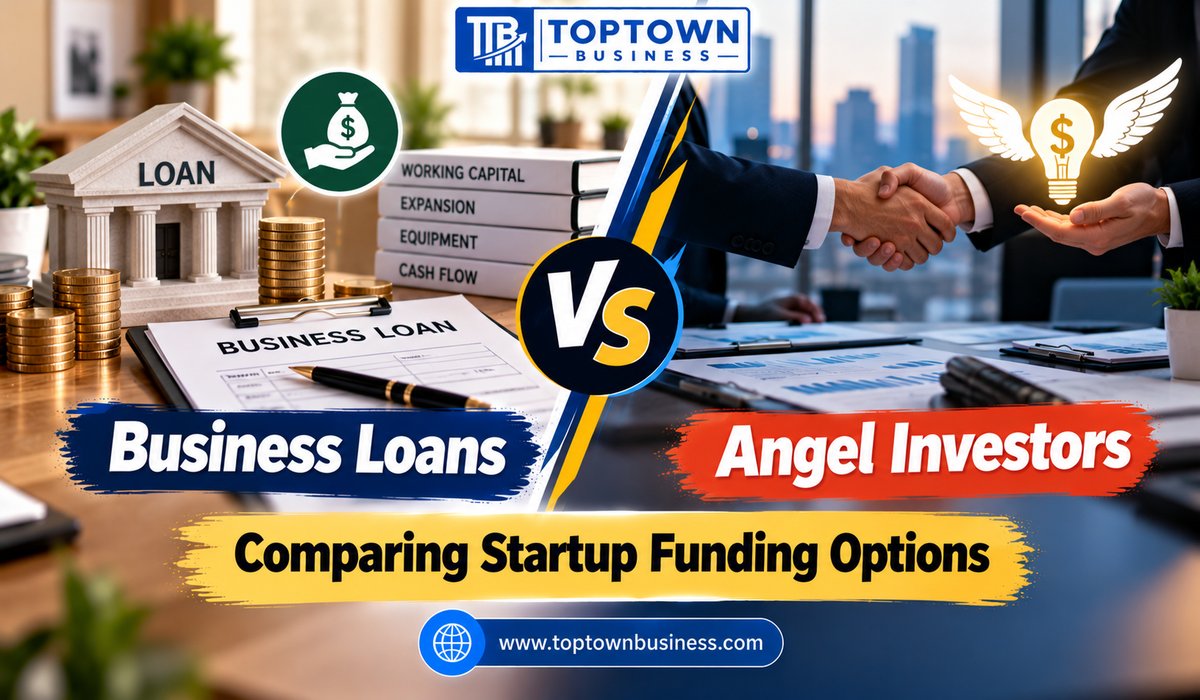
Choosing the right funding source is one of the most important decisions you will make when starting a business. You need enough money to develop products, hire employees, attract customers, and manage daily expenses. However, the funding method you select can also affect your ownership, financial responsibilities, and long-term growth. Understanding business loans vs angel investors can help you choose an option that fits your startup’s needs.
A business loan allows you to borrow money from a bank or financial institution and repay it according to agreed terms, usually with interest. In contrast, an angel investor provides capital in exchange for an ownership stake or through another agreed investment arrangement. Some angel investors also offer industry knowledge, business connections, and guidance.
Both options have advantages and disadvantages. A business loan can help you retain ownership, but repayments can put pressure on cash flow. Angel investment can provide funding without scheduled loan repayments, although you may need to share ownership and certain business decisions.
In this guide, you will learn how business loans and angel investments work, compare their costs and risks, and discover how to choose the right funding option for your startup in India.
What Is a Business Loan?
A business loan is money borrowed from a financial institution or another lender to support business activities. Depending on the lender and loan product, you may use the funds to purchase equipment, maintain inventory, hire employees, expand operations, or manage working capital.
Unlike equity investment, a business loan does not normally require you to sell shares in your company. However, you must meet the repayment conditions specified in your loan agreement.
How Business Loans Work
When you apply for a business loan, the lender evaluates your application to determine whether you can repay the borrowed amount.
Depending on the loan product, the lender may review:
- Your business plan and funding requirements
- Business revenue and cash flow
- Credit history and repayment record
- Existing loans and financial obligations
- Business registration and financial documents
- Available collateral or personal guarantees, where required
After assessing your application, the lender may approve a specific loan amount, interest rate, repayment period, and other conditions.
You then receive the funds and repay the loan according to the agreed schedule. Depending on the arrangement, repayments may include principal and interest through regular instalments.
For example, a small manufacturing business might borrow money to purchase equipment that increases production capacity. If the additional production generates enough revenue to cover operating costs and loan repayments, the investment may support business growth.
However, if sales remain below expectations, the business must still meet its repayment obligations.
Types of Business Loans in India
Indian entrepreneurs can explore different types of business financing depending on their requirements and eligibility.
- Term loans: These provide a specific amount of money that you repay over an agreed period.
- Working capital loans: These help manage short-term operating expenses, inventory purchases, and cash flow gaps.
- Equipment financing: This supports the purchase of machinery, computers, vehicles, or other business equipment.
- Overdraft facilities: These allow eligible borrowers to withdraw funds within an approved limit, subject to the facility’s terms.
- Government-supported loan options: Eligible businesses may explore schemes such as MUDRA or financing supported by applicable credit guarantee programmes.
Each option has different eligibility requirements, costs, and conditions. Therefore, compare the terms carefully instead of assuming that every loan product suits a new startup.
What Are Angel Investors?
Angel investors are individuals who invest their own money in businesses with growth potential. They often support early-stage startups that need capital to develop products, validate demand, hire employees, or expand operations.
In exchange, angel investors may receive equity shares or use another permitted investment structure. The precise arrangement depends on the company, the investor, and the applicable legal framework.
Unlike lenders, angel investors generally do not expect fixed monthly loan repayments when they make a straightforward equity investment. Instead, they aim to earn a return if the company’s value increases and they can eventually realize their investment.
How Angel Investment Works
Raising angel investment typically involves several steps.
- Prepare your business plan: Explain the problem your startup solves, its target customers, revenue model, and growth strategy.
- Identify suitable investors: Look for investors who understand your industry, business stage, and funding requirements.
- Present your opportunity: Share your product, market research, financial projections, and plans for using the investment.
- Complete due diligence: Interested investors may examine your financial records, ownership structure, business model, and legal documents.
- Negotiate investment terms: Discuss valuation, ownership, investor rights, and other conditions.
- Complete the investment: Finalize the necessary agreements and legal formalities before receiving the funds.
The process can take time, and there is no guarantee that an investor will accept your proposal.
What Angel Investors Offer Beyond Money
Some angel investors contribute more than financial capital. Their experience and professional networks can help founders navigate early business challenges.
Depending on the investor, additional support may include:
- Advice on business strategy and pricing
- Introductions to potential customers and partners
- Recruitment assistance
- Industry knowledge and market insights
- Guidance on future fundraising
- Help identifying expansion opportunities
Nevertheless, this support varies considerably. Before accepting an investment, evaluate the investor’s experience, availability, expectations, and working style.
Business Loans vs Angel Investors: Key Differences
Although both funding options provide money for business growth, they work differently. The main distinction is that a loan creates a repayment obligation, while an equity investment generally exchanges ownership for capital.
| Comparison factor | Business loan | Angel investor |
| Funding type | Debt financing | Usually equity financing or another investment arrangement |
| Ownership | Normally remains with the founder | May be diluted when shares are issued |
| Repayment | Requires repayment according to the agreement | Straightforward equity investment has no scheduled loan repayments |
| Interest | Usually charged on borrowed funds | No loan interest on a standard equity investment |
| Control | Lender typically does not manage daily operations | Investor may receive certain decision-making or governance rights |
| Eligibility | Depends on lender criteria and repayment capacity | Depends on investor interest, business potential, and investment terms |
| Financial pressure | Regular repayments can strain cash flow | Growth and investor expectations may create pressure |
| Additional support | Depends on the lender and loan product | May include mentoring and business connections |
| Main risk | Repayment difficulties and possible collateral enforcement | Ownership dilution and disagreements over business decisions |
| Suitable situation | Businesses with a credible repayment plan | Startups seeking growth capital and potentially strategic guidance |
Neither option is automatically better. The right choice depends on your startup’s financial position, growth plans, risk tolerance, and willingness to share ownership.
Advantages of Business Loans for Startups
Business loans can be useful when you need capital but want to maintain ownership of your company.
1. Retain Your Ownership
One of the main advantages of borrowing is that you generally do not need to issue shares to a lender.
You can retain your ownership percentage while using the borrowed funds to develop products, purchase equipment, or expand operations.
However, ownership retention does not eliminate financial risk. You remain responsible for the loan according to its terms.
2. Maintain Greater Business Independence
Traditional lenders usually focus on repayment rather than participating in your everyday business decisions.
Consequently, you can generally decide how to manage employees, develop products, and approach customers, provided you comply with your loan agreement and other legal obligations.
This arrangement may appeal to founders who prefer to operate independently.
3. Plan Repayments in Advance
A loan agreement normally specifies the interest rate, repayment schedule, tenure, and applicable fees.
These details help you forecast future financial commitments and plan your cash flow.
For example, if you borrow money to purchase equipment that produces predictable revenue, you can estimate whether the expected cash flow will cover the instalments and other operating expenses.
4. Build a Financial Track Record
Managing a business loan responsibly may help establish a positive repayment history, depending on how the lender reports the facility and how credit reporting rules apply.
A stronger credit profile can be useful when applying for eligible financing in the future.
However, late payments and excessive borrowing can damage your financial position rather than improve it.
Disadvantages of Business Loans
Despite their benefits, loans can create financial pressure, particularly when a startup has unpredictable revenue.
1. Regular Repayments Can Strain Cash Flow
Your business must meet its repayment obligations even when sales decline.
For example, a new online store may generate strong sales during its launch month but experience weaker demand later. The loan instalments still fall due according to the agreement.
Therefore, prepare a realistic cash flow forecast before borrowing money.
2. Approval May Be Difficult for New Businesses
Startups often lack a long trading history, consistent revenue, or established credit records.
As a result, some lenders may require additional documentation, collateral, personal guarantees, or other assurances. Requirements vary by lender and loan product.
A promising business idea alone may not establish your ability to repay a loan.
3. Interest and Fees Increase the Total Cost
The amount you repay may exceed the principal you borrowed because of interest and applicable charges.
Before accepting an offer, compare the total repayment amount, processing fees, prepayment conditions, and other costs.
Do not choose a loan solely because it advertises a low starting interest rate.
4. Personal and Business Assets May Face Risk
Depending on the loan structure, lenders may seek security over business assets or require personal guarantees.
If the business cannot repay, the lender may enforce its contractual rights. A personal guarantee can expose the founder’s personal finances to additional risk.
Therefore, read the loan agreement carefully and understand the consequences of default before signing.
Advantages of Angel Investors
Angel investment can be particularly useful for startups that need capital before they can generate enough revenue to support regular debt repayments.
1. No Scheduled Loan Repayments for Equity Funding
When an angel investor makes a straightforward equity investment, the company generally does not repay the investment through fixed monthly instalments.
This can provide valuable financial flexibility during product development and early customer acquisition.
However, investment agreements may contain other rights and obligations, so founders should examine the complete terms.
2. Access to Business Expertise
An experienced investor may help you make better decisions about pricing, recruitment, partnerships, and expansion.
For example, an angel investor with experience in retail may help a new consumer brand understand distribution channels and negotiate introductions to potential partners.
The value depends on the investor’s actual knowledge and willingness to contribute.
3. Support for Early-Stage Businesses
Some startups need funding before they have a reliable income stream.
Angel investors may consider a promising product, capable founding team, and substantial market opportunity even when the company has limited revenue.
However, investors still assess risks, and not every startup will qualify for investment.
4. Potential Access to Future Funding
A successful relationship with an angel investor may help a startup build connections with other investors.
An angel may introduce the company to additional funding sources or help prepare it for a future investment round.
Nevertheless, future investment is never guaranteed. The startup must continue to demonstrate progress and satisfy the expectations of potential investors.
Disadvantages of Angel Investors
Angel investment can reduce immediate repayment pressure, but it introduces different challenges.
1. You Give Up Part of Your Ownership
When you issue equity to an investor, your ownership percentage generally decreases.
For example, suppose you own 100% of your startup and issue shares representing 15% of the company to an angel investor. Under a simple ownership structure, you would own 85% after the investment.
Future funding rounds may reduce your percentage further. However, dilution does not automatically mean you receive a worse financial outcome because the company’s value may increase.
2. Investors May Influence Major Decisions
Angel investors may negotiate board representation, voting rights, information rights, or approval rights over certain decisions.
These rights depend on the investment agreement and company structure.
Although an experienced investor can provide valuable guidance, disagreements may arise over pricing, hiring, spending, or expansion plans.
3. Finding the Right Investor Takes Time
Entrepreneurs often need to contact several investors, prepare presentations, answer questions, and negotiate terms before securing funding.
This process can distract founders from product development and customer acquisition.
Moreover, investors may decline an opportunity because of their preferred industry, investment stage, available funds, or risk assessment.
4. Growth Expectations Can Create Pressure
Some angel investors expect the startup to grow significantly and deliver a return within a reasonable investment horizon.
Consequently, they may encourage expansion or additional fundraising rather than a slower strategy focused on steady profits.
Before accepting investment, make sure your goals align with the investor’s expectations.
How to Choose the Right Funding Option for Your Startup
The best funding source depends on how much money you need, how your business generates revenue, and what financial risks you can manage.
1. Evaluate Your Current Business Stage
If your startup is still developing a prototype and has little revenue, an angel investor may be more suitable than a conventional loan, particularly if you lack the resources to make repayments.
In contrast, a business with established customers and predictable cash flow may be better positioned to consider borrowing.
However, eligibility depends on the lender’s requirements and the company’s actual financial position.
2. Calculate Your Repayment Capacity
Before applying for a business loan, estimate your monthly income, operating expenses, taxes, and existing financial obligations.
Then calculate how much cash remains available for loan repayments.
For example, if your business generates ₹1,50,000 in monthly revenue and incurs ₹1,10,000 in operating expenses, the remaining ₹40,000 is not automatically available for loan repayments. You must also account for taxes, working capital needs, capital purchases, and other obligations.
Borrow only when your cash flow forecast supports the repayment schedule under reasonable downside assumptions.
3. Consider Your Ownership Preferences
If retaining ownership is a priority, a business loan may be attractive, provided you can manage the financial obligations.
Alternatively, you may prefer angel investment if your startup requires capital before it can generate sufficient cash flow.
Compare the long-term cost of interest and repayments with the potential value of the ownership stake you would give up.
4. Determine What the Money Will Achieve
Define the specific purpose of the funding before approaching a lender or investor.
For example, you may need ₹5 lakh to purchase equipment, ₹3 lakh to maintain inventory, or ₹8 lakh to develop a new product and hire employees.
These are illustrative amounts, not recommended funding levels.
A clear funding plan makes it easier to compare financing options and explain how the money will support measurable business goals.
5. Review the Full Cost and Terms
For a loan, examine the interest rate, fees, tenure, instalments, collateral requirements, and default conditions.
For angel investment, examine the company valuation, ownership dilution, investor rights, future fundraising implications, and exit provisions.
Seek qualified legal and financial advice when the terms are complex. The headline amount offered does not tell you the complete cost of financing.
Can You Combine Business Loans and Angel Investment?
Yes. Some startups use both debt and equity financing at different stages of their development.
For example, a founder may raise angel investment to develop a product, hire an initial team, and establish market demand. Once the business generates more predictable revenue, the company may consider a loan to purchase equipment or finance inventory.
This approach can help founders use equity for early-stage uncertainty and debt for specific expenses that the business can reasonably repay.
However, combining funding sources also increases complexity. Investors may have expectations about additional borrowing, while lenders may impose conditions that affect the company’s financial flexibility.
Before using both options, consider the following:
- Prepare a cash flow forecast that includes all loan repayments.
- Confirm whether investor agreements restrict additional borrowing.
- Avoid taking on debt simply because a lender offers it.
- Define how each funding source will support a specific business objective.
- Maintain enough working capital to manage delayed payments or weaker sales.
- Review your company’s financial position regularly.
The goal is to create a sustainable funding structure rather than maximize the amount of money raised.
Frequently Asked Questions
1. Is a business loan better than an angel investor for a startup?
A business loan may suit a startup with sufficient repayment capacity that wants to retain ownership, while an angel investor may suit a company that needs equity capital and potentially strategic support.
2. Do angel investors charge interest?
Angel investors do not normally charge loan interest on a straightforward equity investment, although convertible instruments or other financing arrangements may have different terms.
3. Can a new startup get a business loan in India?
Yes, some lenders and government-supported programmes offer financing options for eligible new businesses, although approval depends on the applicable scheme requirements, documentation, credit assessment, and other conditions.
4. How much equity should a startup offer an angel investor?
The appropriate ownership percentage depends on the company’s valuation, investment amount, negotiation, and legal terms, so founders should assess the complete offer rather than follow a universal percentage.
5. Can a startup use both a business loan and angel investment?
Yes, a startup can combine debt and equity financing when the arrangements permit it and the company can manage its repayment obligations, ownership structure, and investor requirements.