
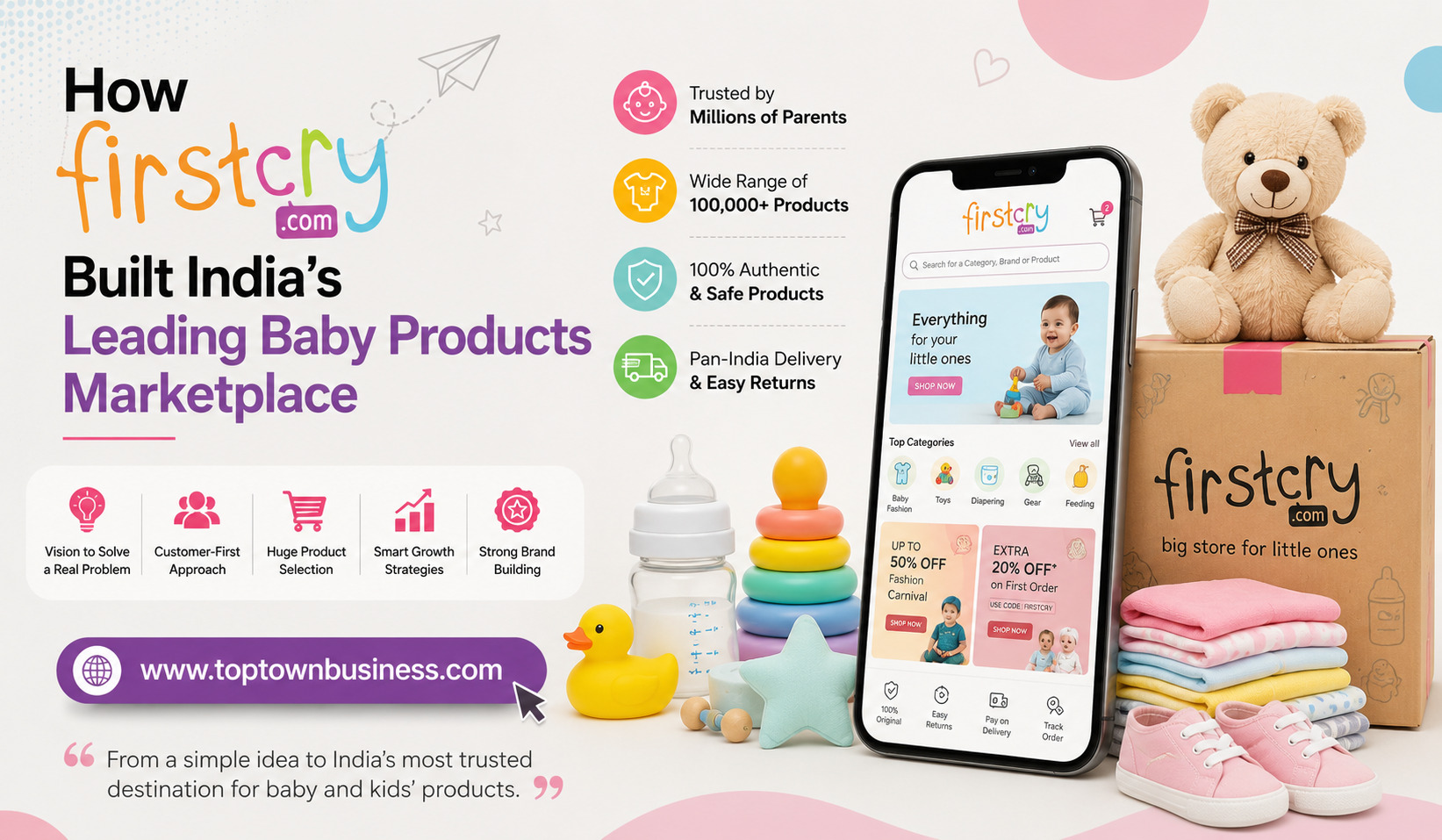
FirstCry has transformed the way millions of Indian parents shop for baby, maternity and children’s products. What began in 2010 as an online store focused on a relatively narrow category eventually developed into a large omnichannel retail business with an online marketplace, physical stores, private-label brands and international operations.
The story of FirstCry is particularly interesting because the company did not try to compete with general e-commerce platforms by selling everything to everyone. Instead, it focused deeply on mothers, babies and children and built an ecosystem around their changing needs. That category-focused strategy became one of the biggest reasons behind its growth.
Today, FirstCry operates under Brainbees Solutions Limited and describes itself as India’s largest multi-channel retailing platform for mothers’, babies’ and kids’ products by GMV for the year ended December 2022, according to RedSeer data cited by the company.
The Problem That Inspired FirstCry
FirstCry was founded in 2010 by Supam Maheshwari and Amitava Saha. Before starting FirstCry, Maheshwari had already built an entrepreneurial career through Brainvisa Technologies.
The founders identified a problem in India’s baby-products market. Parents often had difficulty finding a wide selection of reliable baby and children’s products in one place. The market was fragmented, and shopping for everything from diapers and clothing to toys, nursery products and maternity essentials could require visiting multiple stores.
The founders saw an opportunity to create a dedicated platform where parents could find a much broader range of products.
Instead of building another general e-commerce website, they decided to concentrate on a specific customer group: parents and children.
That decision became the foundation of FirstCry’s business model.
Starting as an Online Baby Products Store
FirstCry launched its online platform in 2010. Its objective was straightforward: create a one-stop destination for parenting-related shopping.
The company gradually expanded its product selection beyond basic baby care. Parents could find clothing, footwear, diapers, toys, nursery products, personal care items, maternity products, books and other children’s essentials.
This category specialization gave FirstCry an important advantage. A general marketplace might offer baby products as one category among thousands, but FirstCry could build its entire shopping experience around parents.
The company says its broader vision was not limited to commerce. It aimed to combine commerce with content, community engagement and education, creating a longer-term relationship with parents as their children grew.
Why FirstCry Went Offline
One of FirstCry’s most important strategic decisions was moving beyond the internet.
At a time when many Indian startups were primarily focused on online commerce, FirstCry recognized that parents still valued physical stores. Baby products are often products consumers want to see, touch and compare before buying.
The company opened its first physical store in 2011 and continued developing an omnichannel model.
This approach allowed FirstCry to combine the convenience of online shopping with the familiarity of traditional retail.
A parent could discover a product online, visit a nearby store, compare alternatives and then choose whichever purchasing method was most convenient.
This strategy became especially important in India’s diverse retail market, where online adoption varies significantly between cities and regions.
The Acquisition That Strengthened FirstCry
A major turning point came in 2016 when FirstCry acquired BabyOye, the baby-care business associated with the Mahindra Group. The deal strengthened FirstCry’s offline presence and expanded its retail footprint.
The acquisition was strategically important because FirstCry was no longer operating simply as an online startup. It was becoming a broader retail platform.
This combination of digital and physical infrastructure became one of the company’s strongest competitive advantages.
Rather than seeing online and offline retail as competing channels, FirstCry treated them as parts of the same customer journey.
Building a Marketplace With Thousands of Products
Another major reason behind FirstCry’s growth was the depth of its product catalogue.
The company brought together Indian brands, international brands and its own private-label products. According to its IPO-era disclosures, FirstCry had more than 1.5 million SKUs from over 7,500 brands as of December 31, 2023.
Such a wide selection helped solve one of the biggest problems faced by parents: convenience.
Instead of visiting separate websites for clothing, toys, diapers, feeding products and nursery items, consumers could potentially purchase many of these products through one platform.
The company also benefited from the recurring nature of the category. Children quickly outgrow clothes and footwear, while products such as diapers, personal-care items and other essentials need regular replacement. FirstCry has described this as an opportunity to build a long-term relationship with families as children grow.
The Rise of BabyHug
FirstCry did not remain dependent only on third-party brands.
It developed its own private-label portfolio, with BabyHug becoming one of its most important home brands.
Private labels can provide retailers with greater control over product design, pricing, assortment and margins. For FirstCry, they also offered a way to create products based on the purchasing data and preferences gathered from its customer base.
The company says BabyHug became the largest multi-category mothers’, babies’ and kids’ products brand in India by GMV for the year ended December 2022, according to RedSeer.
This was a significant development because it changed FirstCry from simply being a marketplace into a brand creator as well.
Creating More Than an E-Commerce Website
FirstCry’s business model goes beyond selling products.
The company has also invested in parenting content and community engagement. Its online platform includes a parenting community designed to help parents find information and answers to common parenting questions.
This approach can create an important marketing advantage.
Parents do not visit a parenting platform only when they want to purchase something. They may search for information about pregnancy, newborn care, feeding, clothing, schooling or children’s development.
By becoming part of that broader journey, FirstCry has opportunities to engage with consumers before they make a purchase.
In other words, the company attempted to build a relationship around parenting rather than simply a transaction around a product.
Using an Omnichannel Strategy to Build Trust
Trust is particularly important in the baby-products market.
Parents are often careful about the products they purchase for their children. Product quality, brand reputation, safety and reliability can influence buying decisions.
FirstCry’s combination of recognized brands, private labels, physical stores and online reviews helped create a more complete shopping experience.
Its physical stores also gave customers an opportunity to interact with products directly, while the online platform offered greater assortment and convenience.
This omnichannel model became one of FirstCry’s most important competitive strengths.
Expanding Beyond India
After establishing its position in India, FirstCry began exploring international markets.
The company entered the UAE in 2019 and Saudi Arabia in 2022. It says it aims to replicate its India strategy in these markets.
International expansion provides FirstCry with another potential source of growth while allowing the company to apply its experience in specialized children’s retail to markets with similar consumer needs.
However, international markets also bring different customer preferences, regulations and competitive environments, making localization important.
From Startup to Stock Market Listing
FirstCry’s journey reached another major milestone in 2024 when its parent company, Brainbees Solutions Limited, went public.
The company’s IPO attracted strong investor interest, with bids reaching around $3.36 billion for an offering of approximately $501 million.
FirstCry subsequently listed on Indian stock exchanges in August 2024. Its shares opened at a significant premium to the issue price, marking an important moment for the company and India’s specialized retail sector.
The IPO also represented a transition from startup to publicly listed consumer business.
By this stage, FirstCry had developed multiple sources of revenue and growth: online retail, physical stores, private labels, distribution and international operations.
FirstCry’s Growth Strategy in a Changing Market
FirstCry’s success has been built around several connected strategies rather than one single innovation.
The first was category specialization. Instead of entering general e-commerce, FirstCry focused on a large but underserved customer segment.
The second was omnichannel retail. The company combined websites and apps with physical stores and other distribution channels.
The third was private-label development. Brands such as BabyHug allowed FirstCry to participate directly in product creation rather than simply selling products made by others.
The fourth was customer engagement. Content and community features helped the company build relationships with parents beyond individual transactions.
Finally, FirstCry invested in scale. Its growing assortment, retail network and brand portfolio made the platform increasingly useful to consumers looking for a comprehensive parenting-shopping destination.
What Entrepreneurs Can Learn From FirstCry
The FirstCry story offers an important lesson for entrepreneurs: a niche market can become a massive business when the underlying customer need is large and recurring.
The founders did not attempt to defeat every major e-commerce company across every category. They focused on understanding parents and building a business around their specific needs.
The company also demonstrated why India’s e-commerce future cannot always be separated from physical retail. For many categories, especially products for children, customers want both digital convenience and physical interaction.
Another lesson is the importance of building an ecosystem. FirstCry combined marketplace products, private labels, stores, content and community rather than relying on a single sales channel.
Conclusion
The rise of FirstCry is one of India’s most interesting e-commerce success stories. Founded in 2010 by Supam Maheshwari and Amitava Saha, the company identified a fragmented baby-products market and built a specialized platform around parents and children.
Its journey from an online retailer to an omnichannel marketplace shows how focused category expertise can become a powerful competitive advantage. The addition of physical stores, BabyHug and other private labels, parenting content, international operations and a large product catalogue helped FirstCry develop into a much broader consumer business.
The company’s 2024 stock-market listing marked another chapter in that journey. Yet the fundamental idea behind FirstCry remains simple: make parenting-related shopping easier by bringing products, information and convenience together in one ecosystem.
For entrepreneurs looking to build the next major Indian consumer brand, FirstCry’s story demonstrates that solving one specific customer problem exceptionally well can be the beginning of something much bigger.