
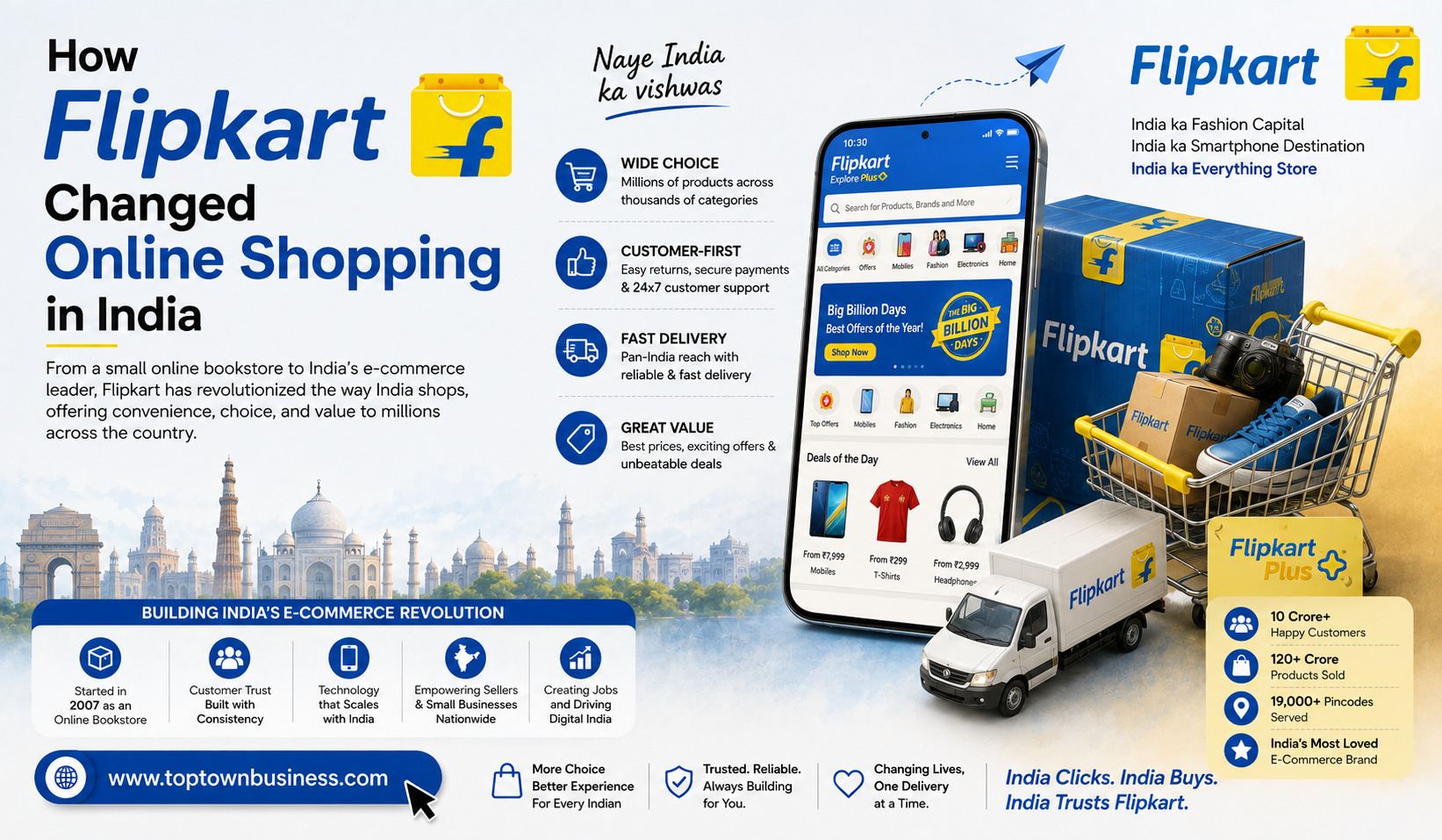
Flipkart is one of the companies that played a major role in changing how Indians shop. When the platform was launched in 2007, online shopping was still a relatively unfamiliar concept for most Indian consumers. Internet connections were slower, online payments were less common and many customers preferred buying products from neighborhood stores.
Flipkart helped change that behavior.
Starting as a small online bookstore, the company gradually expanded into electronics, fashion, groceries, home products and other categories. More importantly, it worked to solve some of the practical problems that made e-commerce difficult in India, including payment trust, delivery infrastructure, product availability and customer convenience.
Its journey from a small startup to one of India’s biggest e-commerce companies is therefore more than a business success story. It is part of the story of India’s digital transformation.
How Flipkart Started
Flipkart was founded in 2007 by Sachin Bansal and Binny Bansal, two former Amazon employees. The company initially focused on selling books online.
The choice of books was strategic.
Books were relatively easy to catalogue, store and ship compared with many other products. Customers also knew what they were purchasing, making books a practical category for an early e-commerce business.
The founders began the company with a small team and initially operated from an apartment in Bengaluru.
At the time, convincing Indian consumers to buy products online was a major challenge.
Many people were uncomfortable entering card details on websites. Others were concerned about whether products would actually arrive after making a payment.
Flipkart therefore had to solve the trust problem before it could build a large customer base.
The Importance of Cash on Delivery
One of Flipkart’s most important innovations was not a piece of technology. It was cash on delivery (COD).
The company introduced COD as a way to reduce customers’ hesitation about online shopping. Instead of paying before receiving the product, customers could pay when the order arrived.
This was particularly important in India, where online payments were still developing.
Cash on delivery changed the psychology of online shopping.
A customer who was uncertain about an unfamiliar website could place an order without immediately risking money. Once the product arrived successfully, confidence in the platform increased.
The model became widely adopted across India’s e-commerce industry and helped accelerate online shopping.
Building Trust With Customers
COD solved one part of the problem, but Flipkart still needed to convince customers that online shopping was reliable.
The company invested heavily in customer service, delivery and returns.
These details were extremely important.
When consumers buy from a physical store, they can see the product before paying. Online shopping removes that advantage. Customers therefore need confidence that the product will match the description and that they can seek help if something goes wrong.
Flipkart built its reputation around convenience and customer-focused policies.
Easy returns, order tracking and responsive customer service helped make online shopping feel less risky.
Over time, these practices became standard expectations across Indian e-commerce.
Expanding Beyond Books
Books gave Flipkart its starting point, but the company quickly recognized that India’s e-commerce opportunity was much larger.
It expanded into categories such as electronics, mobile phones, appliances, fashion, furniture and other consumer products.
This transformed Flipkart from an online bookstore into a general marketplace.
The expansion also created a powerful network effect.
The more products available on the platform, the more reasons customers had to visit it. More customers attracted more sellers, and more sellers increased the product selection.
This created a cycle that helped the platform grow.
Solving India’s Delivery Challenge
E-commerce depends on logistics.
A website can attract millions of customers, but if products cannot reach them reliably, the business cannot succeed.
India’s logistics environment was particularly challenging because of its huge geography, diverse addresses and varying levels of infrastructure.
Flipkart therefore invested heavily in its supply-chain capabilities.
The company developed warehouses, fulfillment centers and delivery networks designed specifically for e-commerce.
It also built logistics capabilities through eKart, which became an important part of the group’s operations.
This allowed Flipkart to gain greater control over delivery speed and reliability.
The company later expanded its fulfillment and logistics infrastructure across India, supporting deliveries to a very large customer base.
The Big Billion Days Revolution
Another major development in Flipkart’s growth was the Big Billion Days sale.
First launched in 2014, the event became one of India’s biggest online shopping festivals.
The idea was inspired partly by large-scale shopping events in international markets but adapted to Indian consumers.
Big discounts, limited-time offers and major product launches created excitement around online shopping.
More importantly, the event helped change shopping behavior.
Consumers who might normally shop only during traditional festivals began considering online platforms as destinations for major purchases.
The sale also demonstrated how e-commerce companies could use technology, pricing and marketing together to create huge spikes in demand.
The success of Big Billion Days eventually encouraged competitors to launch their own large shopping events.
Making Smartphones an E-Commerce Driver
Flipkart also played an important role in India’s smartphone revolution.
As smartphones became more affordable and mobile internet expanded, consumers increasingly used their phones to browse and purchase products.
Flipkart invested heavily in its mobile experience and became a major platform for smartphone sales.
Exclusive launches also became an important part of its strategy.
The company worked with smartphone manufacturers to launch new devices on its platform, helping create a relationship between e-commerce and India’s rapidly expanding mobile market.
This was mutually beneficial.
Smartphone companies gained access to millions of online consumers, while Flipkart attracted customers looking for new devices.
The Importance of Private Labels
As Flipkart became larger, it also developed private-label brands and products.
Private labels gave the company greater control over product selection, pricing and customer experience.
Instead of depending entirely on external brands, Flipkart could develop products around specific consumer requirements.
This strategy also helped the company participate more deeply in the value chain.
The broader trend reflected a shift in Indian e-commerce. Marketplaces were no longer simply connecting buyers and sellers; they were increasingly becoming product developers and consumer brands themselves.
Walmart’s Investment in Flipkart
One of the biggest milestones in Flipkart’s history came in 2018 when Walmart acquired a 77% stake in the company for approximately $16 billion.
The deal provided Flipkart with access to Walmart’s global retail experience and financial resources.
It also demonstrated how valuable India’s e-commerce market had become.
A company that started by selling books from Bengaluru had become valuable enough to attract one of the world’s largest retailers.
Competing in India’s E-Commerce Market
Flipkart’s growth did not happen without intense competition.
Amazon entered India in 2013 and quickly became one of Flipkart’s biggest competitors.
The two companies competed across pricing, product selection, delivery, customer service, technology and seller relationships.
This competition benefited consumers.
Both companies had strong incentives to improve delivery times, expand product selection and develop better shopping experiences.
The rivalry also accelerated investment in India’s e-commerce infrastructure.
Flipkart’s Role in India’s Seller Economy
Flipkart’s impact extends beyond consumers.
The platform created opportunities for thousands of businesses, manufacturers, brands and small sellers to reach customers across India.
For a small business, selling online can provide access to customers far beyond its local market.
A seller in one city can potentially reach consumers in another state without opening physical stores everywhere.
This changed the economics of retail for many businesses.
The rise of marketplace platforms also encouraged traditional brands to develop online strategies and improve their digital presence.
Bringing E-Commerce to Smaller Cities
One of Flipkart’s most important contributions was helping take online shopping beyond India’s largest metropolitan areas.
The company invested in delivery networks and seller partnerships that allowed products to reach consumers in smaller cities and towns.
This was essential because India’s long-term e-commerce opportunity was never limited to Mumbai, Delhi, Bengaluru or other major cities.
The larger opportunity involved millions of consumers outside the biggest urban centers.
As internet access and digital payments expanded, these consumers became increasingly important to online retailers.
The Growth of Digital Payments
India’s payment ecosystem has changed dramatically since Flipkart launched.
When the company began, cash on delivery was essential because digital payments were not yet trusted or widely used.
Today, consumers can pay through UPI, cards, wallets, net banking and other digital methods.
This change has made online shopping faster and more convenient.
Flipkart benefited from the transformation but also contributed to it by giving millions of consumers a reason to become comfortable with digital commerce.
The evolution illustrates how e-commerce and digital payments have grown together in India.
Technology at the Center of Flipkart
Technology has always been central to Flipkart’s operations.
Behind every online order are complex systems handling product searches, recommendations, payments, inventory, fraud detection, logistics and customer support.
As the company scaled, it invested in artificial intelligence, machine learning, data analytics and automation.
These technologies help platforms understand customer preferences, optimize inventory and improve delivery operations.
The result is that online shopping can become increasingly personalized and efficient as the platform grows.
Flipkart’s Wider Business Ecosystem
Over time, Flipkart has developed a broader ecosystem around e-commerce.
The group includes businesses such as Myntra, which focuses on fashion, and Flipkart Wholesale, which serves business customers.
The group also operates Cleartrip, expanding its presence into travel.
These businesses allow Flipkart to participate in multiple areas of India’s digital consumer economy.
Instead of relying entirely on general merchandise, the group has created specialized platforms for different customer needs.
What Entrepreneurs Can Learn From Flipkart
Flipkart’s journey provides several important lessons for entrepreneurs.
The first is to solve local problems instead of simply copying foreign models. Online shopping existed internationally, but Flipkart adapted the model to Indian conditions through cash on delivery, localized logistics and customer-friendly policies.
Second, trust is a product feature. Customers needed to believe that online shopping was safe before the industry could grow.
Third, infrastructure matters. A successful digital business cannot rely only on a good website. Delivery, payments, inventory and customer service are equally important.
Finally, markets evolve. Flipkart started with books but expanded as consumer behavior changed. Its ability to move into electronics, fashion, smartphones and other categories helped it remain competitive.
Conclusion
Flipkart changed online shopping in India by making e-commerce more accessible, convenient and trustworthy.
More than a marketplace, Flipkart became part of India’s digital retail infrastructure. It helped consumers become comfortable with buying products online, gave sellers access to nationwide demand and encouraged investment in logistics, payments and technology.
The company’s story shows that successful e-commerce is not simply about putting products on a website. It is about solving the practical problems that stand between consumers and the convenience they want and adapting continuously as those consumers change.