
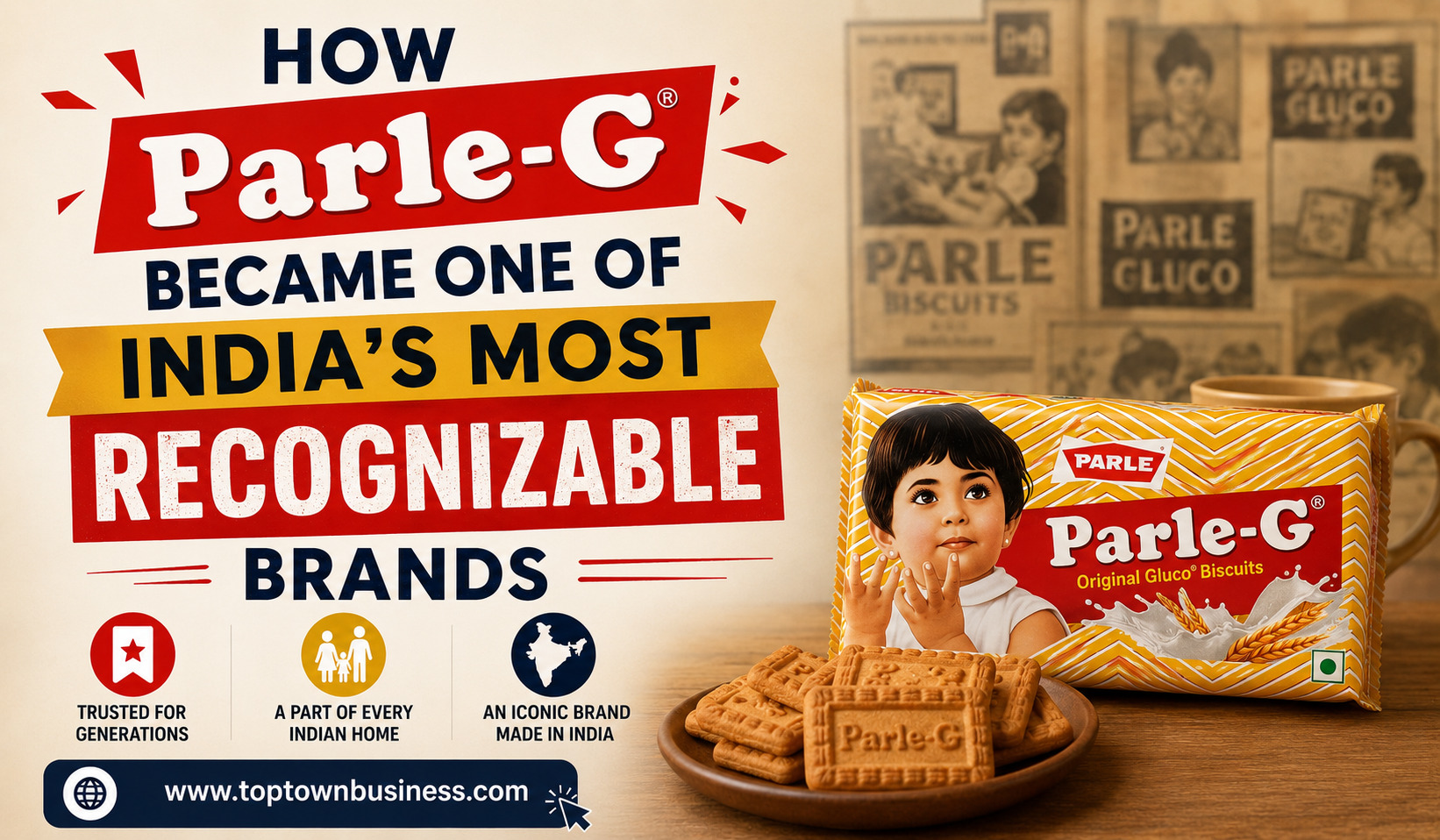
Few Indian food brands have achieved the level of familiarity enjoyed by Parle-G. For generations, the simple glucose biscuit has been part of school tiffins, railway journeys, family kitchens, roadside tea stalls and everyday snacks. Its blue-and-yellow packaging and instantly recognizable child illustration have become deeply associated with Indian consumer culture.
But Parle-G did not become a household name overnight. Its journey began with a small confectionery business in Mumbai and gradually developed through affordable pricing, mass distribution, consistent quality, memorable advertising and a deep understanding of Indian consumers.
Today, Parle-G is more than a biscuit. It is a powerful example of how an everyday product can become a long-lasting consumer brand.
The Beginning of Parle
The story of Parle Products goes back to 1929, when Mohanlal Dayal established the business in Vile Parle, Mumbai. The company’s first factory had only 12 employees and initially focused on confectionery.
The company eventually expanded into biscuits, entering the category in 1939 with a product called Parle Gluco. At the time, biscuits were not as widely consumed across Indian society as they are today. Imported biscuits were often expensive, which limited their accessibility.
Parle saw an opportunity to create a biscuit that could reach a much larger section of the population.
The idea was straightforward but powerful: offer a good-quality biscuit at a price ordinary Indian consumers could afford.
That value-focused approach would eventually become one of the most important reasons behind Parle-G’s success.
The Birth of Parle Gluco
In 1939, Parle baked its first biscuit, Parle Gluco, which later became Parle-G.
The timing was significant. India was still under British rule, and many consumer products available in the country were imported.
Parle Gluco gave consumers an Indian-made alternative.
The biscuit was designed around accessibility rather than luxury. It did not depend on expensive ingredients, elaborate packaging or a premium image. Its appeal came from its familiar taste, affordability and simplicity.
This positioning allowed the product to reach consumers far beyond the wealthy urban population.
Over time, Parle Gluco became increasingly associated with everyday consumption, helping establish the foundation for what would become one of India’s best-known biscuit brands.
How Parle-G Became a Mass-Market Product
One of the biggest advantages Parle-G had was its ability to reach consumers across different income groups.
The company understood that affordability was not simply a pricing strategy. It was a way to make the product relevant to millions of people.
A consumer did not need to wait for a special occasion to buy Parle-G. It could be purchased for a quick snack, served with tea or kept at home for unexpected hunger.
This everyday usefulness made the biscuit part of people’s routines.
Parle’s understanding of the Indian consumer also became an important part of its broader business philosophy. The company says its knowledge of Indian consumer preferences has helped shape its value-for-money positioning and product strategy.
The Power of Simple Packaging
Parle-G’s packaging is one of the most recognizable elements of the brand.
The distinctive blue-and-yellow design helped the biscuit stand out in shops where numerous glucose biscuits competed for customers’ attention.
The packaging also featured the famous illustration of a young girl, which became closely associated with the brand.
Rather than constantly changing its visual identity to follow short-term trends, Parle-G maintained a familiar appearance that consumers could recognize immediately.
That consistency became a branding advantage.
For someone looking for Parle-G in a crowded shop, the packaging itself could act as a shortcut. Customers did not necessarily need to read the entire product name. The colours and image were enough to identify it.
This is an important lesson in consumer branding: sometimes consistency can be more powerful than constant reinvention.
Why the Name Changed to Parle-G
Parle Gluco was eventually renamed Parle-G.
Parle’s own history records that Parle Gluco was rechristened Parle-G, with the “G” originally referring to “Gluco.”
The change helped the company establish a more distinctive brand identity at a time when numerous glucose biscuit products were appearing in the market.
The shorter name was easier to remember and became strongly connected with the product itself.
Over the years, advertising also associated the letter “G” with ideas such as “G for Genius,” helping the brand develop a broader identity beyond the original glucose positioning.
Advertising Helped Build an Emotional Connection
Parle-G’s success was not based only on price and distribution.
Advertising played a major role in turning the biscuit into a recognizable household brand.
The company began television advertising for Parle-G in 1982, helping it reach a rapidly expanding television audience.
Its advertising often focused on children, families, energy, intelligence and everyday life.
Instead of presenting the biscuit as an exclusive or sophisticated product, Parle-G built an image around familiarity and accessibility.
This approach made the brand feel like part of ordinary Indian life.
Over the years, Parle-G campaigns continued to evolve while retaining the central idea that the biscuit was for everyone.
The Connection With Childhood
One of the most powerful aspects of the Parle-G brand is nostalgia.
For many Indians, the product is connected with childhood memories: opening a packet after school, eating biscuits with tea or milk, carrying them while travelling or sharing them with friends.
This emotional connection is difficult for competitors to copy.
A new biscuit brand can imitate a flavour, price point or package size, but it cannot easily recreate decades of memories.
Parle-G benefited from being present across generations. Parents who grew up eating the biscuit could introduce it to their children, creating a cycle of familiarity.
This helped turn the product from an ordinary snack into a cultural symbol.
Distribution Was a Major Secret Behind the Success
A strong product cannot become a national brand unless consumers can easily find it.
Parle invested heavily in building a distribution network capable of reaching different parts of India.
The brand became available not only in supermarkets and large urban stores but also through small neighbourhood shops, roadside retailers and outlets in smaller towns and rural areas.
This extensive availability became a major competitive advantage.
Economic Times has highlighted the scale of Parle’s distribution network, reporting that the company had thousands of distributors and a retail footprint reaching millions of outlets across India.
For an everyday product, availability is crucial.
If a consumer wants a particular biscuit and can find it almost everywhere, that repeated exposure strengthens the brand.
Keeping the Product Simple
Another reason for Parle-G’s long-term success is its simplicity.
The biscuit does not depend on complicated flavours or premium ingredients to attract consumers.
Its basic proposition is easy to understand: a familiar, lightly sweet biscuit that can be eaten at different times of the day.
That simplicity has allowed the product to remain relevant as food trends have changed.
While the market has seen the arrival of cream biscuits, chocolate cookies, premium crackers and health-oriented snacks, Parle-G has continued to occupy its own space.
It does not necessarily compete by being the most luxurious biscuit. Instead, it competes through familiarity, affordability and consistency.
Parle-G and Indian Tea Culture
The relationship between Parle-G and tea has become particularly strong.
For millions of Indians, biscuits and chai are a familiar combination. Parle-G became one of the products most closely associated with this routine.
Its size and texture make it convenient to eat with tea, while its affordable price makes it suitable for everyday consumption.
This connection helped the biscuit become part of ordinary social moments.
A packet could be opened when guests arrived, shared during a conversation or served as a simple snack at home.
The product therefore became integrated into daily habits rather than being limited to occasional consumption.
Becoming a Global Brand
Although Parle-G is deeply associated with India, the brand has also developed an international presence.
Parle Products has expanded its business beyond India, offering its products to consumers in international markets. The company describes its goal as providing products within India and across the globe.
For Indians living abroad, Parle-G can also have an emotional significance because of its connection to home.
This gives the brand an advantage that goes beyond taste. It can represent familiarity and nostalgia for consumers who have moved away from India.
A Landmark in India’s FMCG Industry
Parle-G’s scale has made it an important case study in India’s fast-moving consumer goods industry.
In 2012, retail sales of Parle-G reportedly crossed ₹5,000 crore, making it the first Indian FMCG brand to reach that level, according to Economic Times.
The achievement demonstrated the enormous commercial potential of a product built around mass affordability.
Parle-G showed that a relatively inexpensive product can generate enormous business value when it reaches a huge number of consumers repeatedly.
This is one of the defining characteristics of successful FMCG businesses: small individual purchases can become a massive business when distribution and consumer penetration are strong.
What Made Parle-G So Successful?
Several factors came together to create Parle-G’s extraordinary journey.
The first was affordability. The product was designed to be accessible to a broad section of Indian society.
The second was consistency. Consumers knew what they were getting every time they bought a packet.
The third was distribution. Parle-G became available across urban and rural markets, making it one of the easiest biscuits to find.
The fourth was branding. Its distinctive packaging, advertising and familiar identity made the product easy to recognize.
Finally, there was emotional connection. Parle-G became associated with childhood, family, travel, tea breaks and everyday Indian life.
Together, these factors created a brand that was much larger than its individual product features.
Lessons Businesses Can Learn From Parle-G
The Parle-G story offers valuable lessons for entrepreneurs and marketers.
One of the biggest lessons is that businesses do not always need a complicated product to succeed. Sometimes a simple product that solves an everyday need can have enormous potential.
Another lesson is the importance of affordability. Understanding what customers can comfortably pay can be just as important as understanding what they want.
Distribution is equally important. A brand cannot become a household name if customers struggle to find it.
Parle-G also demonstrates the value of consistency. While many brands frequently change their packaging and positioning, Parle-G maintained a recognizable identity for decades.
Most importantly, the brand shows how businesses can create emotional value around an ordinary product.
The Future of Parle-G
The Indian biscuit market continues to change. Consumers today have access to a wider variety of products than ever before, including premium cookies, health-focused biscuits and international brands.
Despite these changes, Parle-G retains a unique position because of its extraordinary familiarity and mass-market reach.
The challenge for the brand will be to remain relevant to younger consumers while protecting the qualities that made it successful.
That could mean adapting communication, exploring new product formats and responding to changing consumer preferences without losing the identity that consumers already recognize.
Conclusion
Parle-G’s journey from Parle Gluco in 1939 to one of India’s most recognizable biscuit brands is a remarkable story of Indian FMCG success.
The brand did not become famous because it was complicated or luxurious. Its strength came from doing simple things exceptionally well: maintaining an affordable price, delivering consistent taste, building an enormous distribution network and creating a memorable identity.
Over the decades, Parle-G became much more than a biscuit. It became part of India’s everyday life and a symbol of childhood, simplicity and familiarity.
The biggest lesson from the Parle-G success story is that a brand does not always need to chase every trend to remain relevant. Sometimes, understanding the consumer, staying consistent and being available everywhere can create something far more powerful—a product that becomes part of people’s memories and continues to be recognized across generations.