
For years, investing in the Indian stock market was often seen as something meant for experienced traders, wealthy individuals, or people with a strong understanding of finance. High brokerage charges, complicated processes and limited access to reliable financial education created barriers for many ordinary Indians.
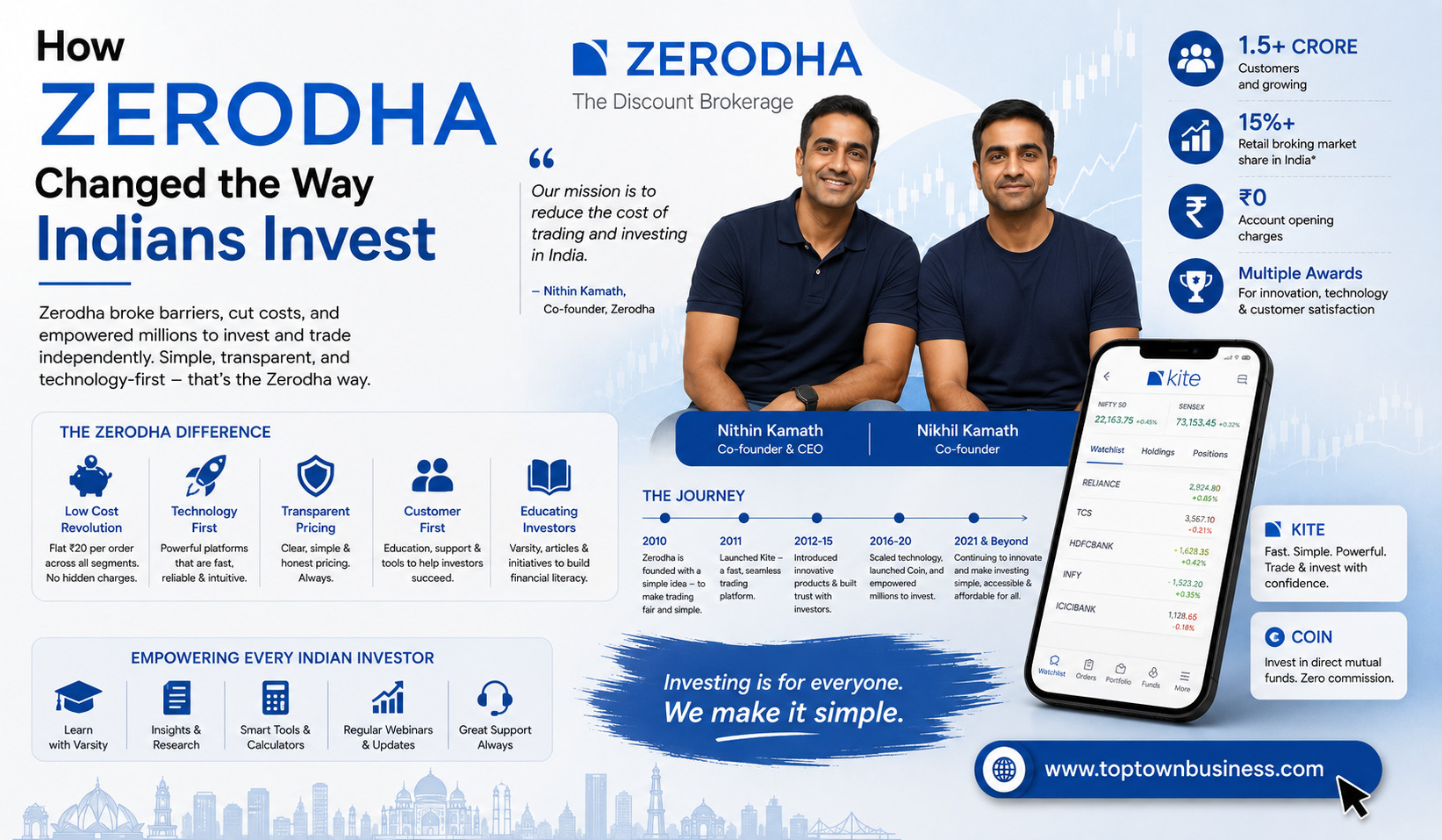
Then came Zerodha. Founded by Nithin Kamath and Nikhil Kamath, Zerodha started operations in 2010 with a simple idea: make investing more accessible by reducing costs and using technology to simplify the experience. The company says it pioneered the discount-broking model in India and has grown to more than 1.6 crore clients.
Zerodha did more than launch another stock-trading platform. It helped change how Indians think about investing, brokerage fees, financial education and digital wealth creation.
From Traditional Broking to Discount Broking
Before discount brokers became popular, investors typically dealt with traditional brokerage firms that could charge commissions based on the value of transactions. For frequent traders and small investors, these costs could become a significant part of their investment experience.
Zerodha challenged this model with a simpler pricing structure. Its current pricing page lists zero brokerage for equity delivery investments and direct mutual funds, while intraday and futures trades are charged at 0.03% or ₹20 per executed order, whichever is lower, and options are charged at a flat ₹20 per executed order. Other statutory and transaction-related charges can still apply.
This approach helped make the cost of participating in the stock market more transparent.
The larger impact was psychological. Investors could now compare brokerage charges more easily and understand that investing did not necessarily require a relationship with a traditional full-service broker.
Technology Made Investing More Accessible
One of Zerodha’s biggest contributions was bringing the stock-market experience firmly into the digital age.
Its Kite platform allows users to trade and invest through web and mobile interfaces. Instead of relying heavily on physical paperwork or calling a broker for every transaction, investors could manage their portfolios themselves.
This shift reflected a broader change in Indian consumer behaviour. As smartphones, digital payments and internet access became more widespread, financial services increasingly moved online.
Zerodha built its business around that transformation. The company says its technology and pricing model have helped it become India’s largest stock broker by client numbers, with customers investing across stocks, derivatives, mutual funds, ETFs, bonds and other products.
The result was a more self-directed investing experience.
Zerodha Helped Bring Young Investors Into the Market
Another important change was the growing participation of younger Indians.
Digital platforms made it easier for people who were comfortable using smartphones and online services to explore investing. A young professional did not necessarily need to visit a brokerage office or depend entirely on a financial intermediary to place an order.
However, easier access also created a need for better financial awareness. Zerodha responded to this challenge through education rather than simply focusing on transactions.
Its Varsity platform offers free and openly accessible lessons covering topics ranging from basic financial concepts to advanced market subjects. The company says Varsity was launched in 2014 and does not require a paid subscription or mandatory signup.
This educational approach became an important part of Zerodha’s identity.
Varsity Changed the Role of Financial Education
One of the biggest reasons Zerodha stands out is that it did not treat financial education only as a marketing tool.
Varsity provides structured lessons on stock markets, investing, taxation, technical analysis, derivatives and other financial topics. It is designed to help users understand concepts before making financial decisions.
For beginners, this can be particularly valuable. Instead of learning exclusively from social-media tips or informal advice, investors have access to educational material that explains market concepts in a systematic way.
Zerodha also operates TradingQ&A, a community where users can discuss trading and investing-related questions.
Together, these initiatives contributed to a broader shift: the stock broker was no longer simply a company that executed trades. It could also become an education and information platform.
Transparency Became a Competitive Advantage
Zerodha also pushed the idea that brokerage pricing should be easy to understand.
The company says its brokerage calculator, introduced in 2011, was part of its early focus on price transparency.
This mattered because investors increasingly wanted to know what they were paying and why.
Clear pricing also helped create a new competitive environment. Traditional and newer brokers had to pay greater attention to pricing, technology and user experience as customers became more comfortable comparing financial platforms.
In this way, Zerodha’s influence extended beyond its own customer base.
A Business Model Built Around Simplicity
Zerodha’s growth story is also unusual because the company built its brand around simplicity rather than aggressive advertising.
According to Zerodha, the business was bootstrapped and its growth was driven significantly by word-of-mouth referrals. The company also says it avoids unnecessary cross-selling and focuses on customer interests, transparency and product quality.
That philosophy helped create a different kind of financial brand.
Instead of making investing appear complicated or exclusive, Zerodha’s approach was largely based on giving customers digital tools and allowing them to make their own decisions.
The Rise of DIY Investing in India
Perhaps Zerodha’s most important impact has been the rise of do-it-yourself investing.
Investors today can research companies, monitor market movements, place orders, review reports and manage investments through digital platforms. Zerodha was one of the companies that helped make this behaviour mainstream.
This does not mean every investor became successful simply because investing became easier. In fact, easier access can also increase the risk of impulsive trading. Financial markets remain risky, and technology cannot eliminate investment losses.
But the relationship between Indians and the stock market changed.
Investing increasingly became something that ordinary individuals could explore directly rather than an activity reserved for a relatively small group of experienced market participants.
Zerodha’s Wider Impact on India’s Fintech Industry
Zerodha’s success also influenced India’s broader fintech ecosystem.
Its combination of low-cost services, digital onboarding, technology and financial education demonstrated that a financial-services company could compete by simplifying the customer experience.
The company also created Rainmatter, a fintech fund and incubator that invests in financial technology businesses. Zerodha says Rainmatter has invested in several fintech startups with the aim of supporting India’s capital-market ecosystem.
This means Zerodha’s influence extends beyond stock broking. Its approach has become part of a larger transformation in India’s digital financial-services industry.
What Zerodha Changed for Indian Investors
Zerodha changed investing in India in several interconnected ways. It helped popularise discount broking, made digital investing easier, encouraged greater price transparency and expanded access to financial education.
More importantly, it changed expectations.
Investors began expecting brokerage platforms to provide fast technology, simple interfaces, transparent charges and useful educational resources. The competition that followed pushed the wider industry to improve its digital offerings.
Today, Zerodha describes itself as serving more than 1.6 crore customers and contributing more than 15% of daily retail exchange volumes in India.
Conclusion
The story of Zerodha is ultimately about more than a stock-trading app. It represents a major shift in how Indians access financial markets.
By combining technology, lower-cost pricing, transparent communication and free financial education, Zerodha helped make investing feel more accessible to a much wider audience.
Its biggest contribution may be the change in mindset it encouraged: investing does not have to be complicated, expensive or dependent entirely on traditional intermediaries.
As India’s digital economy continues to grow, Zerodha’s journey offers an important lesson for the financial-services industry: when technology is combined with simplicity and customer-focused products, it can fundamentally change how people interact with money.