

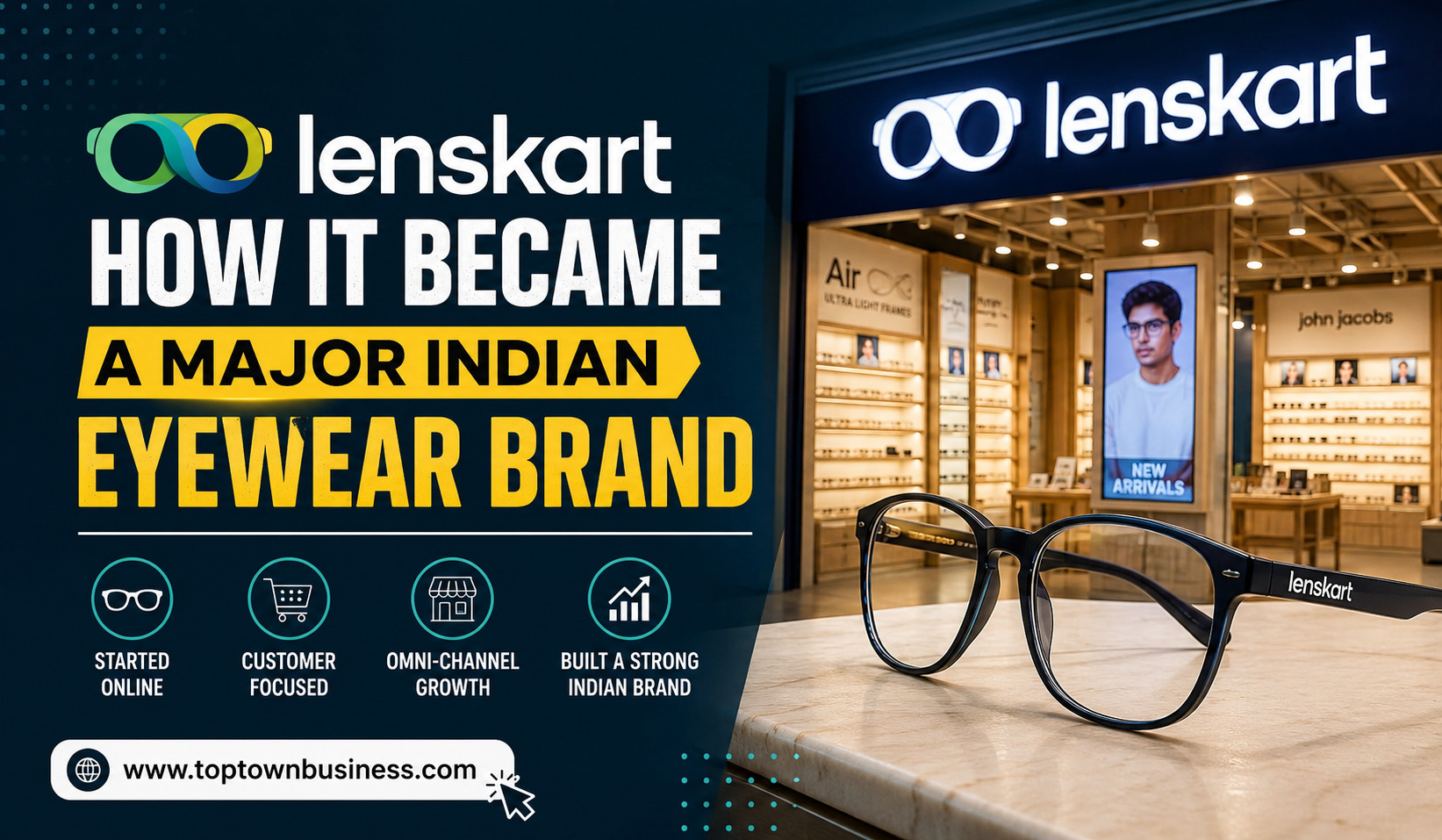
Buying spectacles in India was once a fairly traditional experience. Customers usually visited a nearby optical store, selected from the available frames and relied on the shopkeeper for advice about lenses, pricing and fitting. Over the years, however, the eyewear industry has changed dramatically, and Lenskart has played a major role in that transformation.
What started as an online eyewear business gradually developed into one of India’s most recognized eyewear brands. By combining e-commerce, physical stores, technology, manufacturing and customer-focused services, Lenskart created a new way for Indians to discover and purchase eyewear.
The Lenskart success story is also an example of how a startup can enter a traditional industry, identify gaps in the customer experience and use technology to build a large consumer brand.
The Beginning of Lenskart
Lenskart’s journey began in 2008 with the founding of Valyoo Technologies. The company entered India’s online eyewear market in 2010, when online shopping was still developing in the country.
The company was founded by Peyush Bansal along with Neha Bansal, Amit Chaudhary and Sumeet Kapahi. The founders saw an opportunity to make eyewear more accessible while giving customers greater choice and convenience.
At the time, buying spectacles online was still an unfamiliar concept for many Indian consumers. People generally preferred visiting optical stores because they wanted to try different frames, get their eyes tested and receive guidance from professionals.
Lenskart understood that simply putting spectacles on a website would not be enough. It needed to make online shopping convenient while also addressing the concerns customers had about buying eyewear digitally.
Changing the Way Indians Shop for Eyewear
One of Lenskart’s biggest achievements was changing the perception of eyewear shopping.
Traditional optical stores often had a limited number of frames because of physical space. An online platform, however, could display a much larger range of products. Lenskart used this advantage to give customers access to different styles, designs and price points.
The company also helped change the perception of spectacles. Instead of being viewed only as a medical necessity, eyewear increasingly became a fashion and lifestyle product.
Customers could select frames based on their appearance, personality and preferences. This approach helped make eyewear more appealing to younger consumers who were already comfortable shopping for fashion products online.
Lenskart’s focus was therefore not simply on selling glasses. It was about making the entire eyewear-shopping experience easier, more convenient and more engaging.
From an Online Business to Physical Stores
Why Lenskart Expanded Offline
Although Lenskart began as an online-first company, physical stores eventually became an important part of its growth strategy.
Eyewear is different from many other e-commerce products. Customers often want to try frames before buying them. They may also require an eye examination, professional advice or adjustments to make sure their spectacles fit properly.
Lenskart opened its first physical store in New Delhi in 2013. This allowed the company to combine the convenience of online shopping with the personal experience of an optical store.
Instead of treating online and offline channels as separate businesses, Lenskart developed an omnichannel approach.
A customer could browse frames online, visit a nearby store to try them and then complete the purchase. Another customer could discover a product in a store and later use the company’s digital platform for another purchase.
This combination helped Lenskart build greater trust among customers while continuing to benefit from its digital-first origins.
Technology Became a Major Competitive Advantage
Technology has remained at the center of Lenskart’s business strategy.
The company has invested in technology across areas such as manufacturing, inventory management, supply chains, store operations and eye-testing services.
Its digital platform allows customers to browse and compare products, while its physical stores provide services that are difficult to reproduce completely through an online platform.
Lenskart has also used technology and data to support decisions about store locations and customer demand. This allows the company to expand its retail network based on market opportunities rather than relying only on traditional retail methods.
Technology has therefore become much more than a tool for online sales. It supports many different parts of Lenskart’s business.
Manufacturing Helped Lenskart Scale
Another important part of the Lenskart business model is its focus on manufacturing and supply-chain capabilities.
Controlling more parts of the production and distribution process can give an eyewear company greater control over product availability, quality and pricing.
Lenskart has invested in automated and technology-driven manufacturing facilities to produce eyewear at scale. This approach allows the company to respond more efficiently to changing consumer preferences and manage a large product portfolio.
Its manufacturing capabilities also support the company’s broader strategy of connecting product development, production, distribution and retail.
This level of control has helped Lenskart move beyond the traditional optical-store model and develop a more integrated business.
Making Eyewear More Affordable and Fashionable
Price has also been an important part of Lenskart’s appeal.
For many Indian consumers, buying spectacles can be a significant expense, particularly when frames and lenses are purchased separately. Lenskart attempted to make eyewear more accessible by offering products across different price ranges.
At the same time, it focused heavily on design.
The company offered a broad selection of frames and sunglasses, giving customers more opportunities to find products that matched their individual style.
This combination of affordability, variety and fashion helped Lenskart appeal to a wider audience.
It also contributed to a broader change in India’s eyewear market, where consumers increasingly began to see glasses as an accessory rather than simply something they needed for better vision.
Building a Strong Brand
Lenskart’s growth has not depended only on its products. Building a recognizable consumer brand has been another important part of its success.
The company invested heavily in digital marketing, advertising, celebrity associations and memorable campaigns to make Lenskart familiar to Indian consumers.
Its brand communication has generally focused on convenience, style, technology and affordability.
This helped Lenskart stand apart from many traditional optical retailers, whose businesses were often strongly connected to individual stores and local customer relationships.
Lenskart instead created a national brand that customers could recognize across cities.
Expanding Beyond India’s Major Cities
Lenskart initially benefited from India’s growing urban and digital consumer base, but its expansion eventually moved beyond major metropolitan areas.
Smaller cities and towns represent an important opportunity because awareness of eye care and demand for fashionable eyewear continue to grow across India.
The company’s physical-store strategy has allowed it to reach consumers who may not have been regular online shoppers.
At the same time, its digital platforms allow the brand to reach customers across a much larger geographic area.
This combination of online reach and offline presence has become one of Lenskart’s strongest advantages.
Lenskart’s International Ambitions
Lenskart has also moved beyond India as it attempts to become a global eyewear company.
The brand has expanded into international markets, including parts of Southeast Asia, the Middle East and Japan.
International expansion gives Lenskart an opportunity to test its business model in different markets and reach new customer groups.
The company’s acquisition of international eyewear businesses has also helped strengthen its presence outside India and broaden its product portfolio.
This represents a significant change from its early days as an Indian online eyewear startup.
The Role of Peyush Bansal
Peyush Bansal has become closely associated with Lenskart’s success story.
As a co-founder, he has played a key role in shaping the company’s strategy and its technology-focused approach to eyewear.
His public appearances, particularly through entrepreneurship-focused television programming, have also increased his visibility among Indian consumers.
However, Lenskart’s growth has been the result of a broader team and business system rather than a single individual. Technology, manufacturing, retail expansion, branding and customer experience have all contributed to the company’s development.
What Made Lenskart Successful?
Several factors explain why Lenskart became a major Indian eyewear brand.
First, it entered a large but fragmented industry and attempted to modernize the customer experience.
Second, it did not remain dependent on online sales. By developing physical stores, the company addressed the need for eye testing, fitting and personal interaction.
Third, it used technology throughout its business rather than limiting technology to its website or mobile application.
Fourth, Lenskart combined affordability with fashion, making eyewear attractive to a wider group of consumers.
Finally, the company continued expanding its products, stores, manufacturing capabilities and international operations.
The Future of Lenskart
Lenskart’s future growth is likely to depend on its ability to keep innovating while maintaining customer trust and product quality.
The eyewear industry itself is changing, with smart glasses, artificial intelligence and connected devices creating new possibilities beyond traditional spectacles and sunglasses.
Lenskart has already shown interest in smart eyewear and technology-enabled products, suggesting that the company sees eyewear as part of a much broader technology and lifestyle market.
International expansion will also remain important as the company attempts to establish itself as a global eyewear player.
However, increased competition means Lenskart will need to continue improving its products, pricing, technology and customer experience.
Conclusion
Lenskart’s journey from an online eyewear startup to a major Indian consumer brand is a strong example of how technology can transform a traditional industry.
The company did not simply create another website for buying spectacles. It changed the way customers discover eyewear, combined online shopping with physical retail, invested in manufacturing and technology, and made eyewear more fashionable and accessible.
Its success comes from bringing several elements together: digital convenience, physical stores, product variety, technology, manufacturing and strong branding.
As Lenskart continues expanding across India and international markets, its story demonstrates an important lesson for entrepreneurs: sometimes the biggest opportunities are found in traditional industries that are ready for a better customer experience.