
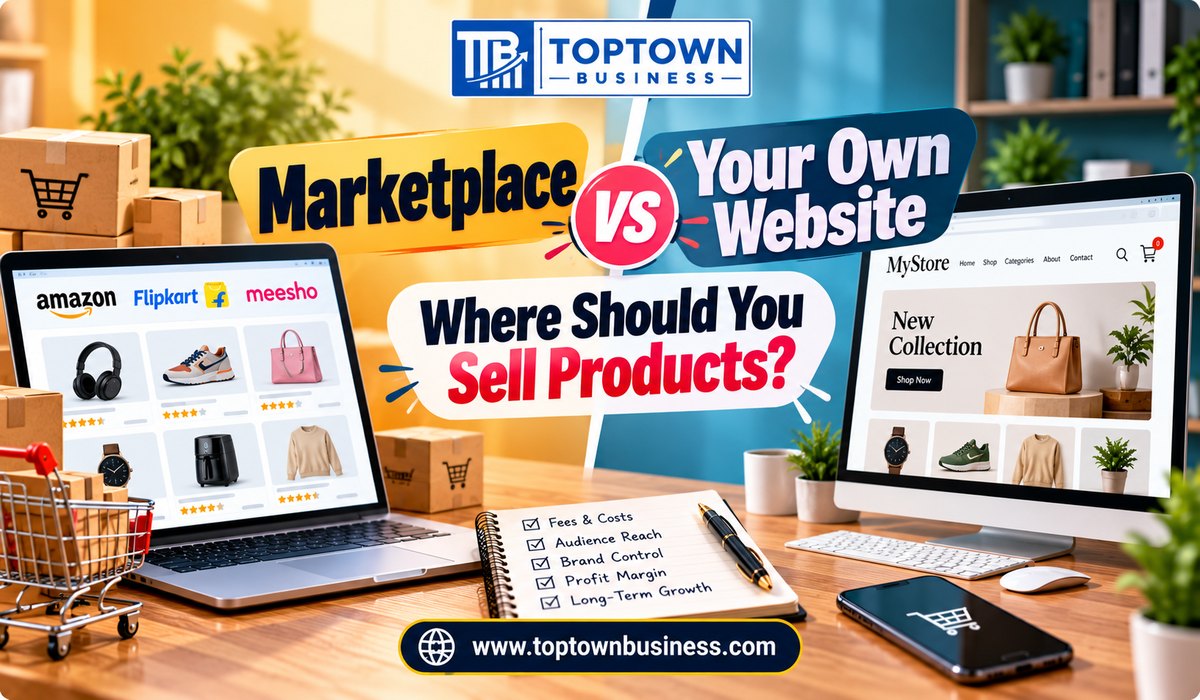
Choosing where to sell your products is an important decision when starting or growing an online business. Some entrepreneurs prefer online marketplaces because they provide access to existing shoppers. Others build their own e-commerce websites to control branding, customer experience, and business operations. Both options offer advantages, but they also come with costs and limitations.
Understanding marketplace vs your own website helps you choose a sales channel that fits your budget, products, target audience, and long-term goals. For example, a new seller may benefit from the visibility of an established marketplace, while a business with a loyal customer base may gain more control by selling through its own website.
However, you do not always need to choose only one option. Many businesses use marketplaces to reach new customers and their own websites to build lasting relationships. The right approach depends on how you want to attract buyers, manage costs, and grow your business.
What Is an Online Marketplace?
An online marketplace is a platform where multiple sellers offer products to customers through a shared website or application. The marketplace typically manages the shopping environment and may provide services such as payment processing, order management, advertising, and fulfillment.
Examples include Amazon, eBay, Etsy, and Flipkart. Each platform has its own rules, fees, seller requirements, and customer base.
When you sell through a marketplace, you generally create a seller account, publish product listings, set prices, and fulfil orders according to the platform’s requirements.
Advantages of Selling on a Marketplace
Marketplaces can help businesses start selling without building an entire e-commerce operation from scratch.
1. Access to existing shoppers
Established marketplaces attract people who already visit the platform to find products. This can give your listings exposure to potential customers without requiring you to build an audience entirely from zero.
2. Faster store setup
Many marketplaces provide listing tools, payment options, order management, and seller dashboards. Therefore, you can often begin selling more quickly than you could by building a customised website.
3. Customer confidence
Shoppers may already recognise the marketplace and feel comfortable using its payment and order-tracking systems. This familiarity can help reduce some concerns about purchasing from an unfamiliar seller.
4. Built-in selling tools
Depending on the platform, you may receive access to promotional campaigns, advertising options, analytics, customer messaging, and fulfilment services.
5. Opportunities to test products
A marketplace can help you test customer interest in a product category before investing heavily in a separate website. However, you should still calculate fees and fulfilment costs before expanding.
Disadvantages of Selling on a Marketplace
Although marketplaces offer convenience, you must operate within the platform’s rules and commercial structure.
- Selling fees: Commission, listing charges, payment fees, advertising expenses, or fulfilment charges can reduce your profit.
- Strong competition: Customers may compare similar products from many sellers on the same page.
- Limited branding: Your product presentation and customer experience must follow the platform’s design and policies.
- Restricted customer access: Marketplace rules may limit how you communicate with customers or use their information for marketing.
- Policy dependence: Changes to fees, ranking systems, eligibility requirements, or seller policies can affect your business.
- Account risk: Policy violations, disputes, or performance problems can result in listing restrictions or account suspension.
Consequently, marketplace sales can be useful, but your business remains dependent on an external platform.
What Is Your Own E-Commerce Website?
Your own e-commerce website is an online store that your business operates through a domain and a suitable website platform. You decide how to present products, organise categories, communicate your brand, and structure the shopping experience within the limits of your chosen tools and applicable laws.
You can build a store using hosted e-commerce platforms or open-source software. Your setup may include product pages, a shopping cart, payment processing, shipping integrations, customer accounts, and marketing tools.
Unlike a marketplace, your website does not automatically receive a large audience of shoppers. You must attract visitors through search engine optimisation, advertising, social media, email marketing, partnerships, or other channels.
Advantages of Your Own Website
1. Greater brand control
You can create a distinctive visual identity, develop your own product categories, and communicate what makes your business different. This is especially valuable when you want customers to recognise your brand rather than associate their entire experience with a marketplace.
2. More control over the customer experience
You can organise navigation, product descriptions, checkout, content, and customer support around your audience’s needs. You can also test changes to improve usability and sales.
3. Direct customer relationships
Subject to consent, privacy requirements, and applicable laws, you can build an email list, share useful content, and communicate with customers about relevant offers. These relationships may help encourage repeat purchases.
4. Flexible marketing and content
Your website can include buying guides, product comparisons, tutorials, frequently asked questions, and other useful content. This content can support search visibility and help customers make informed decisions.
5. More control over business strategy
You can decide how to position products, create bundles, design promotions, and develop loyalty programmes without relying entirely on a marketplace’s promotional format.
Disadvantages of Your Own Website
Running an independent store also creates responsibilities that marketplaces may handle for sellers.
- Setup and maintenance costs: You may need to pay for a domain, hosting, platform subscriptions, themes, applications, and technical support.
- Customer acquisition expenses: You must attract visitors and persuade them to purchase.
- Trust building: New customers may need more reassurance before buying from an unfamiliar website.
- Operational responsibility: You must coordinate payment processing, shipping, returns, customer support, and website maintenance.
- Security requirements: You need appropriate security measures, reliable integrations, and careful handling of customer information.
- Time to grow: Search visibility, brand awareness, and repeat purchasing often take time to develop.
An independent website provides greater control, but it does not guarantee more sales or higher profits.
Marketplace vs Your Own Website: Key Differences
Both channels can support online sales, but they serve different business needs.
| Factor | Online Marketplace | Your Own Website |
| Initial setup | Often quicker | Requires platform setup and configuration |
| Audience | Existing marketplace shoppers | Must attract your own visitors |
| Branding | Limited by platform rules | Greater control over presentation |
| Selling costs | Platform fees and possible advertising costs | Platform, payment, marketing, and operating costs |
| Customer relationships | Subject to marketplace restrictions | More direct, subject to privacy rules and consent |
| Competition | Often displayed alongside similar sellers | Mainly depends on search results, advertising, and competing websites |
| Customer trust | Benefits from marketplace familiarity | Must establish trust in your own brand |
| Marketing control | Depends on platform tools | Greater flexibility over marketing channels |
| Business dependence | Relies on marketplace policies | Relies on website providers, payment services, and traffic sources |
| Best potential use | Reaching shoppers and testing products | Building a distinct brand and direct customer relationships |
The table provides a general comparison. Actual costs, capabilities, and restrictions vary by marketplace and website platform.
Which Option Is More Affordable?
Cost is often a major concern for new entrepreneurs. However, comparing only the initial setup expense can lead to the wrong decision.
Marketplaces may allow you to begin selling with limited technical work, but transaction fees, advertising, fulfilment, and other charges can increase as sales grow.
An independent website may require more setup and marketing investment. Nevertheless, its economics may become attractive when you generate repeat purchases, attract organic traffic, or sell products with sufficient margins.
Calculate the Full Cost of Each Sales Channel
Before deciding, estimate the total cost of generating and fulfilling an order.
For a marketplace, include:
- Platform commissions and listing charges.
- Payment processing fees, where applicable.
- Marketplace advertising.
- Fulfilment, packaging, and shipping.
- Returns, refunds, and other seller-related expenses.
For your own website, include:
- Domain registration and hosting or platform subscriptions.
- Payment processing fees.
- Website applications and maintenance.
- Advertising and content production.
- Packaging, shipping, returns, and customer support.
Consider an illustrative example. Suppose you sell a product for ₹2,000 and incur ₹1,000 in product and fulfilment costs. If your marketplace fees and advertising total ₹300, your contribution before other overheads and taxes is ₹700.
If the same product sells through your own website, and payment fees, advertising, and allocated platform costs total ₹450 per order, the contribution would be ₹550 before other overheads and taxes.
In this example, the marketplace produces the higher contribution. However, the result could change if website traffic becomes less expensive or repeat customers place additional orders without requiring the same acquisition spending.
Therefore, compare actual costs rather than assuming that one channel always delivers better margins.
How to Choose the Right Sales Channel for Your Business
The best channel depends on your products, experience, budget, and business goals. Use the following factors to guide your decision.
Choose a Marketplace If You Need Faster Market Access
A marketplace may suit you if you are launching your first product, have a limited technical budget, or want to test customer demand before developing a standalone website.
It can also help sellers whose products match an established marketplace audience.
Consider this option when:
- You want to start selling without building a full website.
- Your target customers already shop on the platform.
- You need access to established order-management tools.
- You want to test a limited product range.
- You can remain profitable after platform fees and fulfilment costs.
However, review the seller agreement, prohibited-product rules, return policies, and fee structure before committing your business to the platform.
Choose Your Own Website If Brand Building Is a Priority
An independent website may be the better option if you want greater control over customer experience, content, product presentation, and repeat-purchase marketing.
It can be particularly useful for businesses with distinctive products, specialised audiences, or a clear brand identity.
Consider your own website when:
- You want to build a recognisable brand.
- Your products require detailed explanations or demonstrations.
- You want to publish content that attracts relevant search traffic.
- You have a plan for acquiring visitors.
- You want to develop direct customer relationships with appropriate consent.
Nevertheless, prepare a realistic marketing budget. A website that receives few relevant visitors will struggle to generate sales, regardless of how professional it looks.
Can You Sell on a Marketplace and Your Own Website?
Yes. Many businesses use both channels as part of a broader e-commerce strategy. This approach can help you reach marketplace shoppers while building an independent brand presence.
For example, a business selling home organisation products could list selected items on a marketplace while using its own website for detailed buying guides, product bundles, and brand information.
Use Each Channel for a Clear Purpose
Rather than copying every activity across both channels, define what each one should achieve.
Your marketplace could help you reach shoppers who are actively searching for products. Meanwhile, your website could support brand storytelling, educational content, and repeat purchasing.
You may also use marketplace sales to identify popular products and common customer questions. Those insights can guide your independent website’s product descriptions and content strategy, provided you follow the platform’s rules and respect customer privacy.
Keep Product Information and Inventory Consistent
Selling across multiple channels introduces operational complexity. Prices, stock levels, shipping estimates, and product specifications must remain accurate.
To manage this process:
- Use inventory tools that support your sales channels.
- Maintain consistent product identifiers and descriptions.
- Monitor orders across platforms.
- Establish clear fulfilment and return procedures.
- Review profit separately for each channel.
Be careful with marketplace policies governing customer communication, promotions, and attempts to redirect marketplace buyers elsewhere. Do not assume that you can use marketplace customer information for independent marketing.
How to Build Your Own Website That Converts Visitors Into Buyers
If you decide to create an independent store, focus on usability and customer confidence rather than visual design alone.
Create Clear Product Pages
Every product page should explain what the product does, whom it serves, and why a customer might choose it.
Include accurate product images, specifications, pricing, delivery estimates, and relevant care or usage instructions. Answer common questions before customers reach checkout.
Make Checkout Simple
Reduce unnecessary form fields and provide a clear order summary. Display shipping costs and other applicable charges before customers commit to payment.
Offer appropriate payment methods for your target audience and test the entire checkout process on mobile devices as well as desktop computers.
Build Trust With Useful Information
Make your contact details, shipping policy, return conditions, privacy information, and refund process easy to find.
You can also publish genuine customer reviews and clear product demonstrations. However, avoid fake testimonials, unsupported claims, or misleading delivery promises.
Attract Relevant Traffic
Use search engine optimisation, useful content, social media, email marketing, and paid advertising according to your audience and budget.
Track where visitors come from and which channels generate completed purchases. Over time, prioritise sources that produce profitable orders rather than simply generating large numbers of visits.
Common Mistakes to Avoid When Choosing a Sales Channel
Selecting a channel based only on convenience or popularity can create problems later. Avoid these common mistakes:
- Ignoring total selling costs: A low entry fee does not necessarily mean a low cost per order.
- Expecting instant website traffic: An independent website needs a practical customer acquisition strategy.
- Depending entirely on one marketplace: Policy changes or account restrictions can affect your revenue.
- Neglecting customer experience: Confusing product information, hidden charges, and difficult checkout processes can reduce conversions.
- Expanding across too many channels too soon: Managing multiple platforms can increase errors and operational costs.
- Failing to measure profitability: Revenue alone does not show how much money each channel contributes.
- Ignoring platform rules: Non-compliance can result in listing removal, account restrictions, or other consequences.
Instead, start with a channel that matches your resources and customer behaviour. Measure results, improve your processes, and expand when the evidence supports the additional effort.
Frequently Asked Questions
1. Is selling on a marketplace better than having your own website?
Neither option is universally better. Marketplaces can provide access to existing shoppers, while your own website offers greater control over branding and customer experience. Your choice should depend on costs, audience, and business goals.
2. Is it cheaper to sell products on your own website?
Not always. Your website may reduce some marketplace-related fees, but you must account for platform costs, payment processing, marketing, maintenance, and customer acquisition. Compare the total cost per order before deciding.
3. Can beginners sell products without creating a website?
Yes. Beginners can start through suitable marketplaces, provided they meet the platform’s requirements. However, they should understand the fees, seller policies, competition, and fulfilment responsibilities before listing products.
4. Can I sell the same products on a marketplace and my own website?
Often, yes, but you must follow each marketplace’s rules and maintain accurate inventory, pricing, and product information. Check any restrictions that apply to your products, fulfilment arrangements, and customer communications.
5. Which sales channel is better for long-term business growth?
A combination may be useful because it can diversify sales channels and support brand development. However, the right mix depends on profitability, customer acquisition costs, operational capacity, and your ability to manage each channel effectively.