

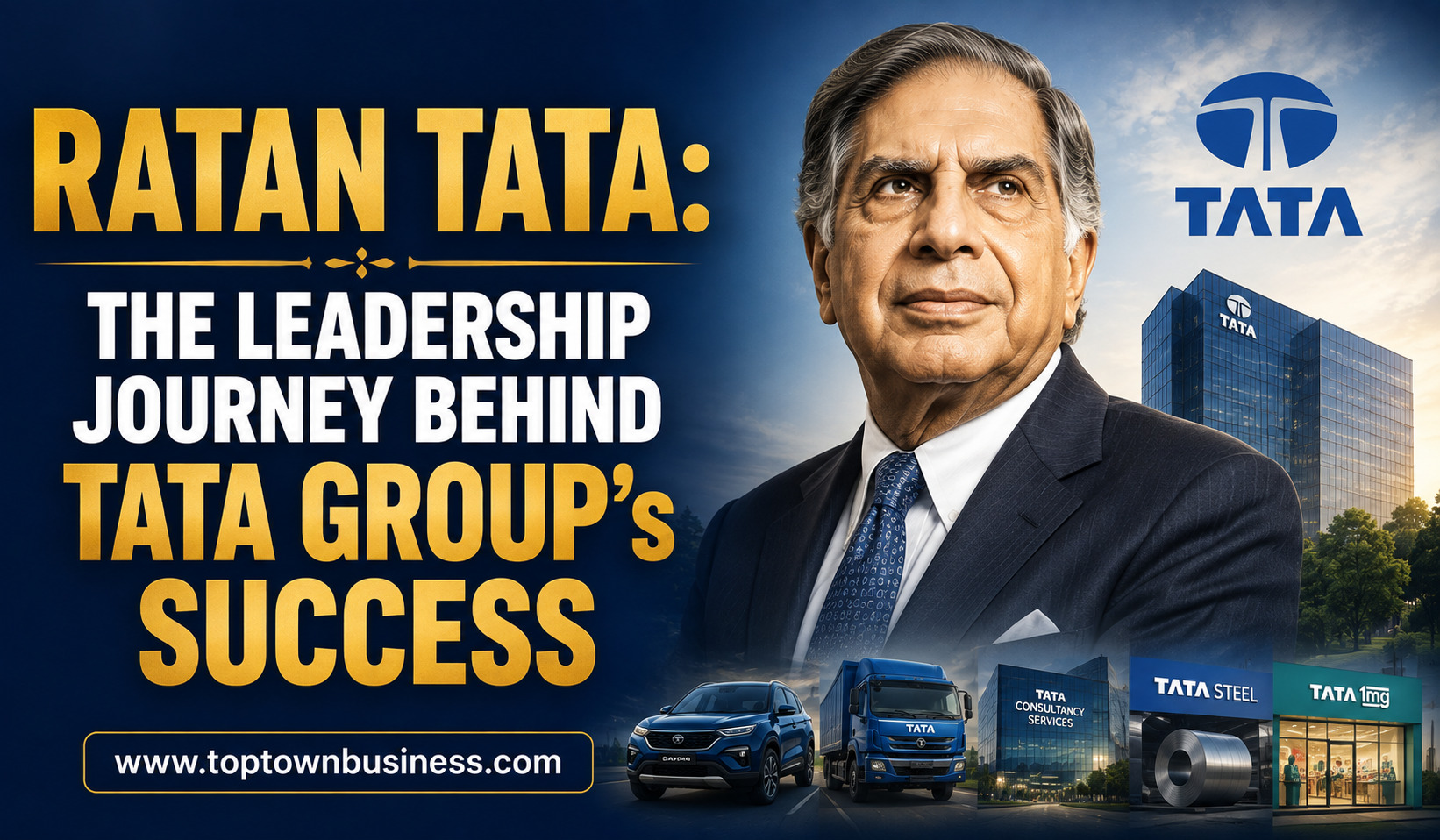
Ratan Tata is one of the most respected names in Indian business. During his decades of leadership, he helped transform the Tata Group into a globally recognised business conglomerate while maintaining a strong emphasis on trust, innovation and social responsibility. His journey was not simply about growing revenues or acquiring companies; it was also about redefining how an Indian business group could compete on the global stage.
From joining the Tata Group at the beginning of his professional career to becoming its chairman and guiding some of its biggest international moves, Ratan Tata’s leadership journey offers valuable lessons for entrepreneurs, managers and young business professionals.
Who Is Ratan Tata?
Ratan Naval Tata was born on December 28, 1937, in Bombay, now Mumbai. He is a member of the Tata family, which has been associated with the Tata business group for generations.
Unlike the image many people have of business heirs, Tata’s early professional journey involved working within different parts of the organisation. He joined the Tata Group in 1962 after completing his education and gained experience across various companies within the group.
His early years gave him an understanding of the organisation from the ground level. This experience became important when he eventually took on the group’s top leadership role.
Becoming Chairman of Tata Sons
Ratan Tata became chairman of Tata Sons in 1991, succeeding J.R.D. Tata. His appointment came at an important moment for India because the country’s economy was beginning a major transformation through economic liberalisation.
The business environment was changing rapidly. Indian companies were facing increased competition and new opportunities, while globalisation was becoming increasingly important.
Ratan Tata understood that the Tata Group needed to evolve. The group had a collection of companies operating with considerable independence, and one of his major challenges was to create a stronger sense of unity and a common strategic direction.
He encouraged Tata companies to work under a more consistent brand identity and pushed the group towards greater coordination.
Creating a More Unified Tata Brand
One of Ratan Tata’s significant leadership contributions was strengthening the Tata brand.
The Tata Group had businesses across sectors such as automobiles, steel, hotels, information technology, chemicals and consumer products. However, the companies did not always operate with a strongly unified identity.
Tata introduced changes that encouraged group companies to follow common brand principles and become more connected to the broader Tata identity.
This helped establish the Tata name as a symbol associated with reliability and ethical business practices in the minds of many consumers.
The challenge was significant: how could a huge collection of companies operating in different industries function as part of one global group?
Ratan Tata’s answer involved greater strategic coordination, stronger governance and a willingness to make difficult decisions.
Tata’s Global Expansion
Perhaps the most visible part of Ratan Tata’s leadership was the group’s international expansion.
During his tenure, Tata companies completed several major international acquisitions. These deals helped transform Tata from a predominantly Indian business group into a multinational organisation.
The acquisition of Tetley by Tata Tea in 2000 was an early landmark. It demonstrated that Indian companies could successfully acquire established international brands.
Tata Motors later acquired Jaguar Land Rover from Ford in 2008. The deal attracted enormous attention because Jaguar and Land Rover were iconic British automotive brands.
Rather than viewing the acquisition simply as an opportunity to purchase famous names, Tata Motors aimed to provide the businesses with resources and long-term support.
The Tata Group’s acquisition of Corus by Tata Steel in 2007 was another major international transaction. These moves demonstrated the group’s ambition to compete beyond India’s borders.
Ratan Tata and the Automobile Industry
Ratan Tata also played an important role in shaping Tata Motors’ passenger vehicle ambitions.
The Tata Indica, introduced in the late 1990s, became an important milestone because it was developed as an Indian passenger car for the domestic market.
The company later introduced the Tata Nano, which was promoted as an affordable car aimed at making four-wheel mobility accessible to more Indian families.
Although the Nano did not achieve the commercial success originally expected, the project demonstrated Tata’s willingness to attempt ambitious ideas and challenge conventional assumptions about the automobile market.
This willingness to experiment became an important characteristic of Ratan Tata’s leadership.
Innovation Beyond Traditional Business
Ratan Tata’s leadership was not limited to large acquisitions and established industries. He also encouraged innovation and entrepreneurship.
The Tata Group became increasingly interested in new technologies, startups and emerging business models. Tata’s personal interest in entrepreneurship also became visible through his investments and support for several young companies after his retirement as chairman.
His approach reflected an important change in the Indian business environment: established companies could not depend only on traditional industries if they wanted to remain relevant in a rapidly changing economy.
Leadership During Difficult Times
Ratan Tata’s leadership was also tested during periods of economic uncertainty and crisis.
The 2008 global financial crisis created challenges for businesses around the world. Tata companies, including Jaguar Land Rover, faced difficult market conditions.
Tata’s response demonstrated a long-term approach to business. Rather than focusing only on immediate difficulties, the group continued investing in businesses it believed could create value over time.
His leadership style was generally associated with calm decision-making rather than aggressive public confrontation. This helped reinforce his image as a thoughtful and measured business leader.
The Importance of Ethics and Trust
One of the strongest aspects of Ratan Tata’s reputation is his emphasis on ethics.
The Tata Group’s charitable trusts hold a significant stake in Tata Sons, and a substantial portion of the group’s philanthropic activities is connected to these institutions.
This structure has helped Tata companies maintain a strong connection between business success and social development.
For Ratan Tata, corporate leadership was not simply about creating wealth. It also involved contributing to society and maintaining public trust.
This philosophy has become one of the reasons the Tata name has such a strong reputation among Indian consumers.
Ratan Tata’s Leadership Style
Ratan Tata’s leadership style was different from that of many highly visible business leaders.
He was generally known for being reserved and relatively understated. Instead of constantly placing himself at the centre of attention, he often allowed the achievements of Tata companies and their leaders to speak for themselves.
At the same time, he was willing to make bold decisions when necessary.
His leadership combined patience with strategic ambition. International acquisitions, investments in automobiles and support for innovation all required significant confidence in the future.
This combination of humility and boldness became a defining part of his public image.
Lessons Entrepreneurs Can Learn From Ratan Tata
Ratan Tata’s career offers several lessons for modern entrepreneurs.
The first is that growth should be connected to a long-term vision. Tata’s international expansion was not simply about becoming larger; it was about creating companies capable of competing globally.
The second lesson is the importance of reputation. In a world where customers increasingly pay attention to corporate behaviour, trust can become a valuable business asset.
Another lesson is the importance of accepting failure. Projects such as the Tata Nano did not achieve the expected results, but experimentation remains essential for innovation.
Finally, Ratan Tata’s career demonstrates that leadership does not always require a loud personality. A leader can be quiet, thoughtful and approachable while still making decisions that transform an organisation.
Conclusion
Ratan Tata’s leadership journey is an important chapter in the story of modern Indian business. When he became chairman of Tata Sons in 1991, the Tata Group was already one of India’s most respected business organisations. During his tenure, however, the group expanded its international presence, strengthened its brand and entered new areas of opportunity.
His leadership was defined by a combination of global ambition, innovation, patience and social responsibility. The acquisitions of companies such as Tetley, Corus and Jaguar Land Rover demonstrated that Indian businesses could become global competitors.
More than the size of the Tata Group, however, Ratan Tata’s lasting legacy lies in the values associated with leadership: integrity, responsibility, courage and a willingness to think beyond immediate results.
For entrepreneurs and business leaders, his journey offers a powerful lesson: sustainable success is not built only through financial growth. It is built through vision, trust, adaptability and the ability to create value for both business and society.