

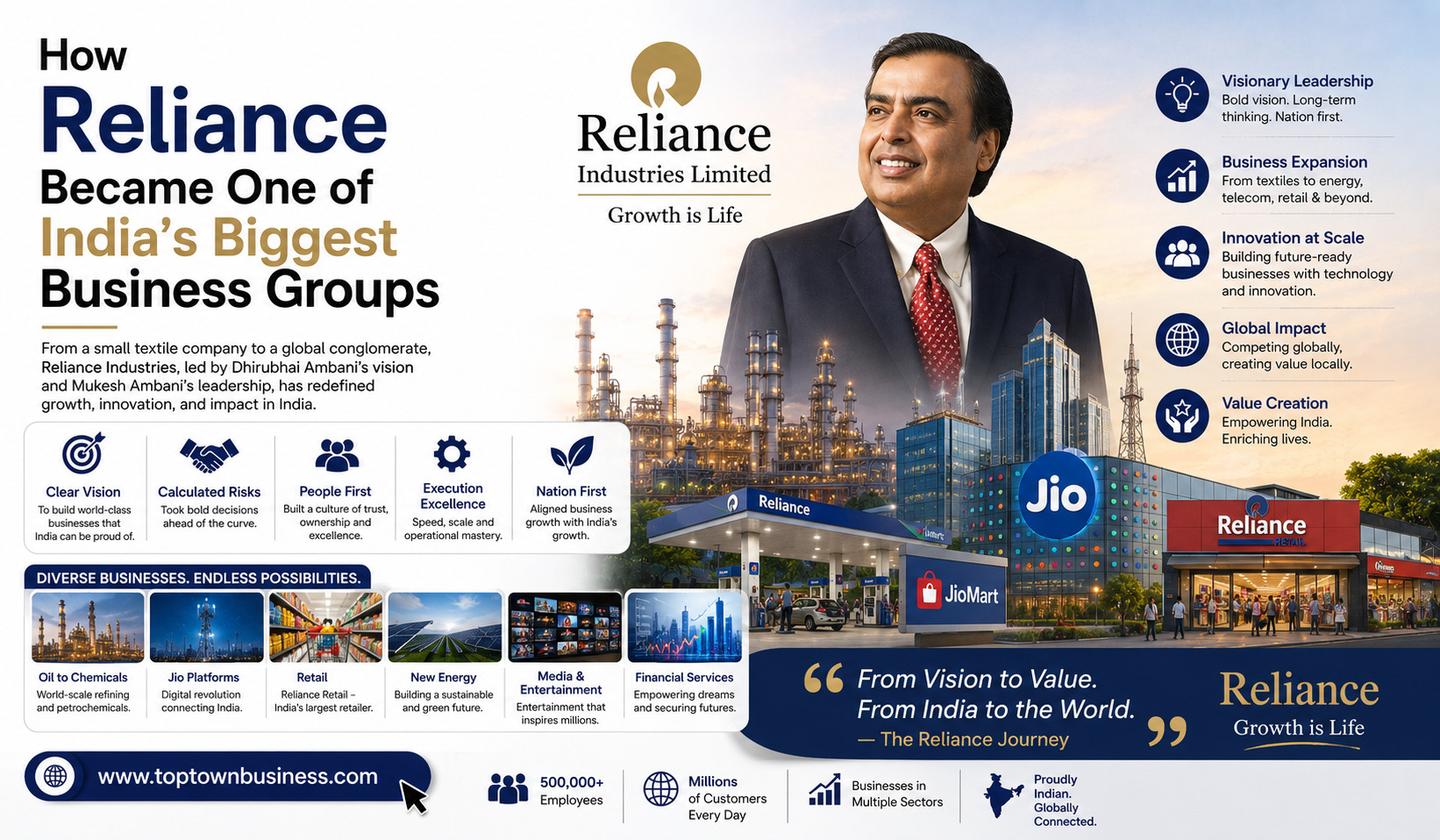
Reliance Business Groups
Reliance is one of the most remarkable business stories in modern India. What began with a small yarn-trading operation eventually developed into a diversified business empire spanning energy, petrochemicals, retail, telecommunications, digital services, media, financial services and new energy.
The story of Reliance is closely connected with the vision of its founder, Dhirubhai Ambani, and the later transformation led by his son Mukesh Ambani. Their strategies were different in many ways, but both focused on scale, aggressive expansion, technology and identifying industries that could shape India’s future.
Today, Reliance Industries Limited (RIL) describes itself as India’s largest private-sector corporation and a Fortune 500 company, with businesses ranging from energy and materials to retail, digital services, media and entertainment, green technologies and AI.
The Humble Beginning of Reliance
The Reliance story began long before the company became a major industrial group.
In 1957, Dhirubhai Ambani returned to India and started a yarn-trading business in Mumbai. He had a much bigger ambition than simply running a trading company: he wanted to build one of India’s largest businesses.
In 1966, Reliance established its first textile manufacturing unit at Naroda in Gujarat. The company eventually developed the Vimal textile brand, which became an important part of Reliance’s early consumer-facing identity.
The move from trading to manufacturing was crucial.
Instead of remaining dependent on other manufacturers, Reliance began controlling more of the production process itself. This approach would later become one of the defining features of the group’s growth strategy.
Dhirubhai Ambani and the Power of the Stock Market
One of Dhirubhai Ambani’s most significant contributions to Reliance was his approach to raising capital.
In 1977, Reliance Textile Industries went public. The IPO was reportedly oversubscribed seven times and attracted thousands of ordinary Indian investors.
This was important for two reasons.
First, it provided Reliance with capital to expand its operations. Second, it helped popularize equity investing among ordinary Indians.
Dhirubhai understood that a large business required large amounts of capital. Rather than depending entirely on traditional financing, he built a strong relationship with retail shareholders.
Reliance’s growing shareholder base became an important part of its identity.
The company’s approach helped demonstrate that ordinary Indian investors could participate in the growth of a major private-sector business.
From Textiles to Petrochemicals
Reliance’s next major transformation came through backward integration.
The company gradually moved from textiles into polyester and then petrochemicals.
This strategy was powerful because the businesses were connected. Instead of purchasing important inputs from external suppliers, Reliance could manufacture more of them internally.
The company established polyester and petrochemical facilities and eventually developed large integrated manufacturing complexes.
Reliance’s Patalganga plant was established in the early 1980s, followed by the Hazira complex in the early 1990s.
This vertical integration helped Reliance achieve greater control over its supply chain, production costs and capacity.
It also created the foundation for its later expansion into refining and energy.
Mukesh Ambani and the Next Phase of Expansion
Mukesh Ambani joined Reliance in 1981 and became closely involved in the group’s transformation.
Under his leadership, Reliance expanded its integrated business model from textiles and polyester into petrochemicals, refining and oil and gas exploration. The company’s own profile credits Mukesh Ambani with spearheading this backward-integration journey and the creation of major manufacturing facilities.
The strategy was based on scale.
Rather than building small facilities to serve limited markets, Reliance increasingly pursued very large projects designed to compete internationally.
This approach required enormous investment but also created the possibility of significant efficiencies.
The Jamnagar Refinery: A Major Turning Point
One of the most important milestones in Reliance’s history was the development of its refinery complex at Jamnagar, Gujarat.
Reliance commissioned its first Jamnagar refinery in 2000 after completing the project in just 36 months, according to the company’s history.
The refinery transformed Reliance’s position in the energy industry.
It was not simply a refinery. The Jamnagar complex integrated refining, petrochemicals, power generation, logistics and related infrastructure.
This integration allowed Reliance to operate across multiple stages of the energy and materials value chain.
The company describes Jamnagar as the world’s largest integrated single-location refining complex.
The project also demonstrated Reliance’s willingness to make enormous long-term investments in infrastructure.
Entering Oil and Gas Exploration
Reliance did not stop at refining.
The company moved upstream into oil and gas exploration and discovered significant gas resources in the Krishna-Godavari Basin.
In 2002, Reliance announced its deep-sea gas discovery in the KG-D6 block. Production later began in 2009.
This expanded Reliance’s presence across the energy value chain.
The company’s business model was becoming increasingly integrated: it could participate in exploration, production, refining, petrochemicals and marketing.
That diversification reduced its dependence on any single part of the energy industry.
The Telecom Revolution and the Birth of Jio
Reliance’s biggest transformation in the 21st century came when it entered telecommunications.
The company had already entered the telecom sector through Reliance Infocomm in the early 2000s. But the much larger disruption came with Jio.
Reliance launched commercial Jio services in 2016. The company describes the project as the world’s largest greenfield digital development project.
Jio’s strategy was different from simply becoming another telecom operator.
Reliance invested heavily in a nationwide 4G network and combined connectivity with digital services.
Affordable data plans and widespread network availability helped accelerate India’s mobile internet adoption.
The impact extended beyond telecommunications. Cheap and accessible data created new opportunities for video streaming, digital payments, online education, e-commerce, gaming and social media.
In this sense, Jio became an infrastructure platform for India’s digital economy.
How Jio Changed Reliance
Jio fundamentally changed the structure of Reliance.
The group was no longer primarily known for energy and petrochemicals. It had become a major technology and digital-services company as well.
Reliance Platforms attracted investment from several major global technology and investment companies. In 2020, Reliance announced strategic investments involving companies such as Meta, Google, Intel and Qualcomm.
These investments provided capital while also creating partnerships with some of the world’s leading technology companies.
Jio’s scale has continued to expand. Reliance reports that Jio had 524 million subscribers as of the fourth quarter of FY2026.
Building India’s Retail Giant
Another major pillar of Reliance’s growth has been retail.
Reliance Retail was launched in 2006, initially focusing on formats such as supermarkets and neighborhood stores.
The company gradually expanded into grocery, fashion, electronics, consumer brands and online commerce.
Reliance says its retail business crossed 1,000 stores within five years and $1 billion in annual sales within that period, eventually becoming India’s largest retailer by revenue.
The company later combined its physical retail network with digital platforms such as JioMart and AJIO.
This created an omnichannel model in which consumers could interact with Reliance through physical stores as well as smartphones.
By the fourth quarter of FY2026, Reliance reported a registered retail customer base of 387 million.
The Strategy of Scale
Scale has been one of the defining features of Reliance’s business strategy.
Whether it was petrochemicals, refining, telecommunications or retail, Reliance often entered industries with large investments and ambitious targets.
This approach has several advantages.
Large operations can lower unit costs, improve bargaining power and create strong distribution networks. Once the infrastructure is established, the company can serve a very large customer base.
Jio is perhaps the clearest example. Building a nationwide network required enormous investment, but once that network existed, Reliance could use it as a foundation for multiple digital services.
The same principle applies to retail. A large store network and customer base can support grocery, fashion, electronics, consumer products and digital commerce.
Diversification Without Losing Integration
Reliance has diversified enormously, but its businesses are not always isolated from one another.
Its energy and materials businesses are connected through an integrated value chain.
Its telecom network supports digital services.
Its digital ecosystem can support retail and entertainment.
Its retail network can distribute consumer products and brands.
This combination of diversification and integration has helped Reliance build multiple growth engines.
The company now operates across energy, petrochemicals, retail, digital services, media and entertainment, financial services and new energy.
Entering New Energy
Reliance is now pursuing another major transformation: moving toward new energy and advanced manufacturing.
The company has announced investments in areas including solar energy, batteries, green hydrogen and related technologies.
This reflects another characteristic of Reliance’s strategy: entering industries that it believes could become important to India’s future.
The transition from fossil fuels to cleaner energy could fundamentally reshape the global energy industry. Reliance is attempting to position itself for that transition rather than simply defending its traditional energy businesses.
Its current corporate strategy also emphasizes renewables, advanced materials, green technologies and AI.
Reliance and the Indian Consumer
One of the biggest reasons for Reliance’s success has been its ability to connect large-scale infrastructure with mass consumer demand.
The company has repeatedly targeted markets where millions of Indians have growing needs.
Textiles brought branded clothing to a wider consumer base.
Petrochemicals supported India’s industrial growth.
Telecommunications made mobile internet more affordable and accessible.
Retail created organized shopping networks across cities and towns.
Jio expanded digital connectivity.
This focus on the mass market has allowed Reliance to build businesses with enormous potential scale.
The Importance of Execution
Ambitious strategies require execution, and this has been another important part of Reliance’s story.
The Jamnagar refinery was completed on an exceptionally aggressive schedule. Jio required the construction of a nationwide telecommunications infrastructure. Reliance Retail required the development of a huge physical and digital distribution network.
These projects required capital, technology, supply-chain management and large workforces.
Reliance’s ability to execute projects at scale became one of its defining competitive advantages.
From Dhirubhai to Mukesh Ambani
The Reliance story is also a story of generational transformation.
Dhirubhai Ambani built the original business around textiles, manufacturing, capital markets and aggressive expansion.
Mukesh Ambani subsequently expanded the group into refining, oil and gas, retail and telecommunications.
The next phase is increasingly focused on digital services, artificial intelligence, new energy and consumer businesses.
The company’s current leadership has therefore inherited a business that is very different from the textile company created decades ago.
What Entrepreneurs Can Learn From Reliance
Reliance’s rise offers several lessons for entrepreneurs.
The first is think beyond the first business. Dhirubhai started in yarn trading but did not remain a trader. He moved into manufacturing and then petrochemicals.
The second is control important parts of the value chain. Backward integration helped Reliance reduce dependence on outside suppliers and build scale.
The third is invest for the long term. Projects such as Jamnagar and Jio required enormous investments before their full potential could be realized.
The fourth is watch changes in consumer behavior. Reliance’s move into telecom and digital services recognized that India’s next major growth opportunity would increasingly involve internet connectivity.
Finally, diversification works best when businesses can strengthen one another. Reliance’s combination of infrastructure, technology, retail and consumer services has created a broader ecosystem rather than simply a collection of unrelated businesses.
Conclusion
The story of how Reliance became one of India’s biggest business groups is ultimately a story of ambition, scale and reinvention.
Dhirubhai Ambani began with a modest trading business and gradually built a textile and petrochemical enterprise. His approach to capital markets helped bring ordinary Indians into the company’s growth story. Later, Mukesh Ambani expanded the business into refining, oil and gas, retail and telecommunications.
The launch of Jio marked another dramatic transformation, turning Reliance into a major digital company and helping accelerate India’s mobile internet revolution. Reliance Retail similarly established a huge presence in India’s consumer economy. Today, the group is moving into new areas such as renewable energy, advanced materials and AI.
Reliance’s journey shows that building a business empire is not simply about becoming successful in one industry. It requires the willingness to enter new markets, invest heavily in infrastructure, adapt to changing consumer needs and think several years ahead.
From a small yarn business to a global-scale conglomerate, Reliance has become one of the clearest examples of how an Indian company can repeatedly reinvent itself while pursuing the same underlying ambition: to grow with the opportunities created by a changing India.