Introduction
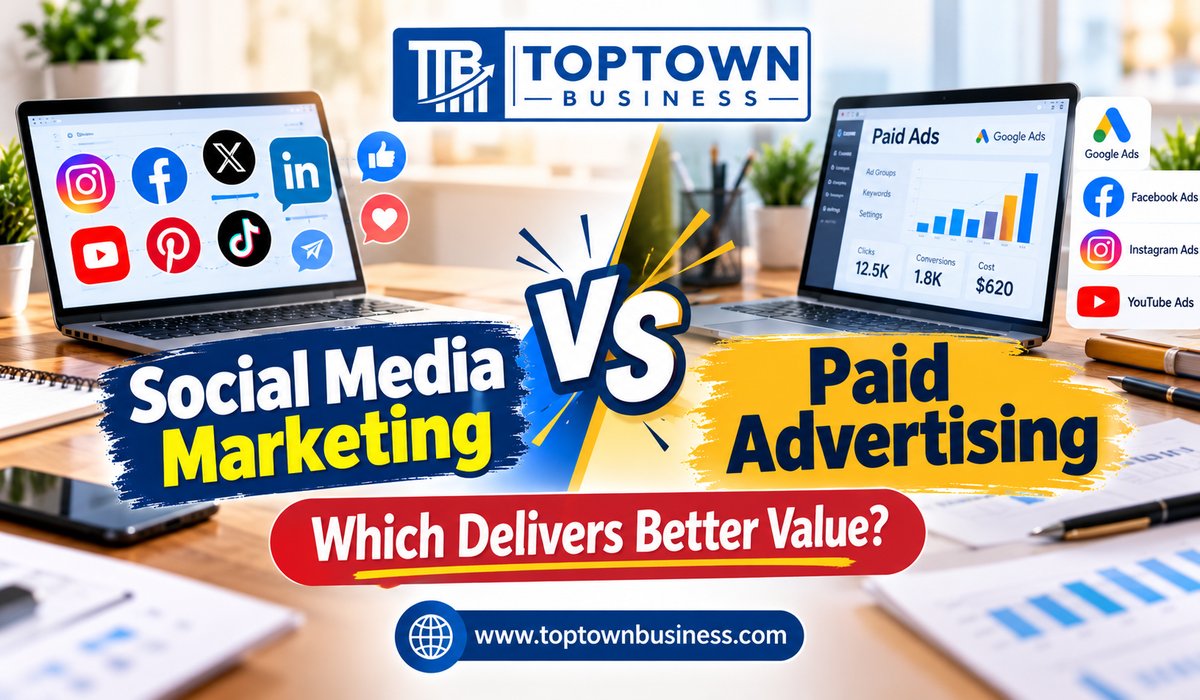
Small businesses need effective ways to reach customers, promote products, and increase sales without wasting their marketing budgets. However, choosing the right promotional approach can be challenging when several digital marketing options compete for attention. One common question is whether social media marketing or paid advertising delivers better value.
Both approaches help businesses reach potential customers, but they work differently. Social media marketing focuses on building an audience, sharing useful content, encouraging engagement, and developing customer relationships. Paid advertising involves paying platforms to display promotional messages to selected audiences, often to generate traffic, enquiries, or sales.
The right choice depends on your business goals, target audience, available budget, and the time you can invest. For example, a new local business may use organic social media content to build awareness while running targeted advertisements to attract customers who are ready to purchase.
Moreover, these approaches do not have to compete with each other. When planned carefully, social media marketing and paid advertising can support the same customer journey. Organic content helps establish credibility, while paid campaigns can increase the reach of specific offers or products.
This guide compares social media marketing vs paid advertising, explains their costs and benefits, and shows how small businesses can choose an approach that delivers measurable value.
What Is Social Media Marketing?
Social media marketing involves using platforms such as Facebook, Instagram, LinkedIn, TikTok, and other relevant networks to communicate with an audience. Businesses use these platforms to publish content, answer questions, introduce products, and build relationships with customers.
Social media marketing includes both organic activities and paid promotions. However, when comparing organic social media marketing with paid advertising, the focus is on content and engagement that do not require payment for each advertisement placement.
Common Social Media Marketing Activities
Businesses can use organic social media marketing to:
- Publish educational posts, images, and videos.
- Share product demonstrations and service updates.
- Respond to comments and customer questions.
- Participate in relevant community conversations.
- Share customer feedback with appropriate permission.
- Build brand recognition through consistent communication.
For example, a small bakery can publish photographs of its products, share preparation videos, and announce seasonal items. These activities help potential customers understand the business and give existing customers reasons to remain engaged.
However, organic reach is not guaranteed. Social platforms control how content appears in users’ feeds, and visibility can change depending on the platform, audience behaviour, and content performance.
Therefore, social media marketing requires a consistent approach and realistic expectations.
What Is Paid Advertising?
Paid advertising involves paying a platform or publisher to display promotional content to a chosen audience. In digital marketing, businesses commonly use paid search advertisements, social media ads, display ads, and sponsored placements.
Unlike organic social media content, paid advertising provides opportunities to purchase additional reach and target audiences using available campaign settings.
Common Types of Paid Advertising
Paid social media advertising: Businesses pay platforms such as Facebook, Instagram, or LinkedIn to promote products, services, and offers.
Search advertising: Advertisements appear alongside search results when people search for relevant products or services.
Display advertising: Visual advertisements appear on participating websites and applications.
Video advertising: Businesses pay to display promotional videos on supported platforms.
For example, a plumbing company can run search ads targeting people looking for emergency plumbing services in its service area. A clothing retailer may use social media advertisements to introduce a new collection to relevant audiences.
Paid advertising can generate visibility quickly once campaigns become eligible to serve. Nevertheless, performance depends on targeting, competition, creative quality, landing pages, and budget management.
Spending more money does not automatically produce better results.
Social Media Marketing vs Paid Advertising: Key Differences
Although both approaches can increase awareness and attract customers, they differ in cost structure, speed, targeting, and long-term value.
| Factor | Organic social media marketing | Paid advertising |
| Main cost | Content creation, staff time, and tools | Advertising spend plus campaign management and creative costs |
| Reach | Depends on platform distribution and audience engagement | Purchased reach based on campaign settings and available inventory |
| Speed | Usually requires consistent effort to build an audience | Can generate visibility relatively quickly after launch and approval |
| Audience building | Develops an audience through ongoing content and interactions | Reaches selected audiences while campaigns run |
| Targeting | Mainly relies on platform features and audience relevance | Often offers more specific paid targeting options |
| Long-term value | Useful content and audience relationships may continue providing value | Results often decline when campaigns stop, although some acquired customers may return |
| Measurement | Engagement, profile visits, enquiries, and conversions | Impressions, clicks, conversions, acquisition costs, and revenue |
| Main challenge | Maintaining consistency and earning organic reach | Managing costs and converting paid traffic into customers |
Neither option automatically delivers better value. The right choice depends on the outcomes your business needs and the resources available to achieve them.
Benefits of Social Media Marketing for Small Businesses
Social media marketing can be particularly useful for businesses that want to build awareness, develop customer relationships, and communicate regularly with their audience.
1. Builds Brand Recognition
Consistent content helps people become familiar with your business, products, and services. Over time, useful posts and clear communication can make your brand easier to recognize.
For instance, a fitness studio can share exercise demonstrations, training tips, and class updates. These posts introduce the business while helping potential customers understand its approach.
However, posting frequently without a clear purpose may not deliver meaningful results. Focus on content that reflects your brand and addresses customer needs.
2. Encourages Customer Engagement
Social media provides opportunities for two-way communication. Customers can ask questions, share feedback, and comment on your content.
By responding thoughtfully, you can learn more about customer preferences and identify common concerns. This information may also help improve your products or services.
Furthermore, public responses can show other potential customers that your business values communication and customer support.
3. Supports Long-Term Audience Development
A relevant social media audience can provide ongoing opportunities to introduce products, share updates, and encourage repeat purchases.
For example, a home decor business can publish room styling ideas and product care tips that remain relevant beyond a single promotional campaign.
Nevertheless, followers do not automatically become customers. Your content should include appropriate next steps, such as visiting your website, viewing a product catalogue, or contacting your business.
4. Offers a Flexible Starting Point
Organic social media marketing does not require payment for each post’s distribution. Small businesses can begin with a manageable publishing schedule and use existing resources to create content.
However, organic marketing is not completely free. Content planning, photography, editing, community management, and employee time all carry costs.
Businesses should account for these expenses when comparing social media marketing with paid advertising.
Benefits of Paid Advertising for Small Businesses
Paid advertising is useful when businesses want to reach specific audiences, promote particular offers, or generate measurable actions within a defined period.
1. Reaches Relevant Audiences
Advertising platforms provide targeting options that may include location, interests, search intent, and other permitted audience characteristics.
For example, a local cleaning company can target relevant service areas, while a business-to-business software provider may use suitable professional audience settings.
Targeting can reduce irrelevant exposure, although it cannot guarantee that every impression reaches a potential customer.
2. Supports Faster Campaign Launches
A business can launch a campaign to promote a seasonal offer, new product, or upcoming event without waiting to build a large organic audience.
For instance, a restaurant can run an advertisement for a special menu during a local event. The campaign can be scheduled around the promotion and monitored while it runs.
However, campaign approval, audience competition, and initial testing can affect when useful results appear.
3. Provides Measurable Performance Data
Paid advertising platforms typically report information such as impressions, clicks, expenditure, and campaign conversions when appropriate tracking is available.
These measurements help businesses compare campaigns and identify opportunities for improvement.
For example, if one advertisement generates more qualified enquiries at an acceptable cost than another, the business can investigate the differences and adjust its campaign.
Still, platform reports may not capture every customer interaction. Use reliable conversion tracking and, where possible, compare advertising results with actual sales records.
4. Allows Controlled Testing
Paid campaigns make it possible to test different messages, images, audience groups, and offers.
A retailer might compare two advertisements that promote the same product using different benefit statements. The results can help identify which message encourages more relevant customer actions.
However, tests need sufficient data to produce useful conclusions. Avoid making major budget decisions based on a handful of clicks or conversions.
Which Strategy Offers Better Value for Money?
The better option depends on how your business defines value. Some businesses prioritize customer awareness, while others need immediate sales or qualified enquiries.
A campaign that generates many views may provide limited financial value if it does not attract the right audience. Similarly, an advertisement with a high cost per click may still be worthwhile if it produces profitable customers.
When Social Media Marketing Offers Better Value
Organic social media may be a suitable priority when:
- You want to build brand awareness over time.
- Your audience regularly engages with visual or educational content.
- Your business benefits from community interaction.
- You can create useful content consistently.
- You want to strengthen relationships with existing customers.
For example, a local cafe may build an engaged audience by sharing menu updates, behind-the-scenes content, and customer-approved photographs. This content can support brand recognition and encourage repeat visits.
When Paid Advertising Offers Better Value
Paid advertising may be a better fit when:
- You need to promote a time-sensitive offer.
- You want to reach customers actively searching for a service.
- Your business has a clear conversion goal.
- You need to test a new product or market.
- Your campaigns can generate customers at an acceptable acquisition cost.
For example, a repair service may use paid search advertising to reach people looking for a specific repair. The campaign can focus on relevant searches and send visitors to a page explaining the service and how to request assistance.
The key is to measure customer outcomes rather than selecting a channel based only on its apparent reach.
How to Measure the Return on Your Marketing Investment
Comparing marketing channels requires more than examining likes, impressions, or website visits. You need to understand how much each approach costs and what business results it produces.
Track the Right Metrics
For organic social media marketing, consider tracking:
- Relevant audience growth.
- Engagement from potential customers.
- Website visits from social platforms.
- Qualified enquiries.
- Sales associated with social media activity.
For paid advertising, monitor:
- Advertising expenditure.
- Cost per click.
- Cost per qualified lead.
- Customer acquisition cost.
- Conversion rate.
- Revenue and profit from acquired customers.
Use consistent definitions and comparable time periods wherever possible.
Understand Return on Investment
Return on investment, or ROI, compares the financial return from an activity with its cost.
A simplified calculation is:
ROI = (Financial return − Total cost) ÷ Total cost × 100.
For marketing, define the financial return carefully. Revenue is not the same as profit, and a campaign that generates sales may also involve product costs, fulfilment, staff time, and other expenses.
For example, suppose a campaign generates ₹50,000 in incremental gross profit and costs ₹20,000 to run, including relevant campaign expenses. The resulting net contribution is ₹30,000.
Using those figures, the simplified ROI is 150%.
This example assumes that the ₹50,000 figure already represents gross profit attributable to the campaign, rather than total sales revenue. In practice, accurate attribution can be difficult because customers may interact with several marketing channels before purchasing.
For a fair comparison, account for content production and staff time in organic marketing costs, as well as advertising expenditure and management fees in paid campaign costs.
Why Combining Both Strategies Can Deliver Better Results
Social media marketing and paid advertising often work well together because they support different stages of the customer journey.
Organic content can introduce your brand, answer questions, and build familiarity. Paid advertising can then promote a specific offer, reach additional relevant audiences, or direct interested customers to a conversion-focused page.
Build a Balanced Marketing Strategy
A small business could follow this approach:
Step 1: Publish useful organic content. Share educational posts, product demonstrations, customer questions, and business updates.
Step 2: Identify promising content. Review which posts attract relevant engagement, website visits, or enquiries.
Step 3: Promote suitable offers. Use paid campaigns to reach relevant audiences with a clear message and an appropriate destination page.
Step 4: Improve the customer journey. Ensure the landing page explains the offer, displays accurate information, and provides a straightforward next step.
Step 5: Measure the results. Compare campaign expenditure, qualified leads, conversions, and financial outcomes.
For example, a small clothing brand can use organic posts to demonstrate product styling and answer sizing questions. It can then use paid advertisements to promote a collection to relevant audiences.
However, do not assume that every popular post deserves an advertising budget. Prioritize content that supports a defined business goal and evaluate the performance of the paid campaign separately.
Common Mistakes to Avoid
Both marketing approaches can waste resources when businesses lack clear goals or fail to measure results.
Focusing Only on Likes and Followers
Engagement can indicate interest, but it does not necessarily generate revenue. Track enquiries, sales, repeat purchases, and other relevant outcomes alongside engagement.
Spending on Ads Without Testing
Launching a large campaign before checking the audience, message, and landing page can increase unnecessary costs. Start with a manageable test budget and use the findings to improve performance.
Expecting Immediate Results From Organic Content
Organic social media marketing usually requires ongoing effort. Build a consistent publishing plan and evaluate performance over an appropriate period.
Ignoring the Customer Experience
Even successful marketing cannot compensate for confusing website navigation, unclear pricing, poor service, or a difficult purchasing process.
Using the Same Message Everywhere
Different platforms and audiences may respond to different formats and messages. Adapt your content while maintaining consistent brand information and offers.
Frequently Asked Questions
1. Is social media marketing cheaper than paid advertising?
Organic social media marketing avoids direct advertising charges, but content production and management require time and resources, so the total cost depends on how the business operates.
2. Can small businesses succeed with paid advertising?
Yes, small businesses can use paid advertising with controlled budgets, relevant targeting, suitable landing pages, and consistent performance tracking, although results are not guaranteed.
3. Which is better for generating sales: social media marketing or paid advertising?
Paid advertising may generate sales more quickly in suitable situations, while organic social media can support customer trust and long-term engagement; the better option depends on your audience and goals.
4. How much should a small business spend on paid advertising?
Set a budget that your business can afford to test, taking account of profit margins, customer acquisition costs, cash flow, and the value of a new customer.
5. Should a business use social media marketing and paid advertising together?
Yes, combining organic content with paid campaigns can help businesses build brand familiarity, reach relevant audiences, and guide potential customers towards a purchase when both activities support a clear strategy.