

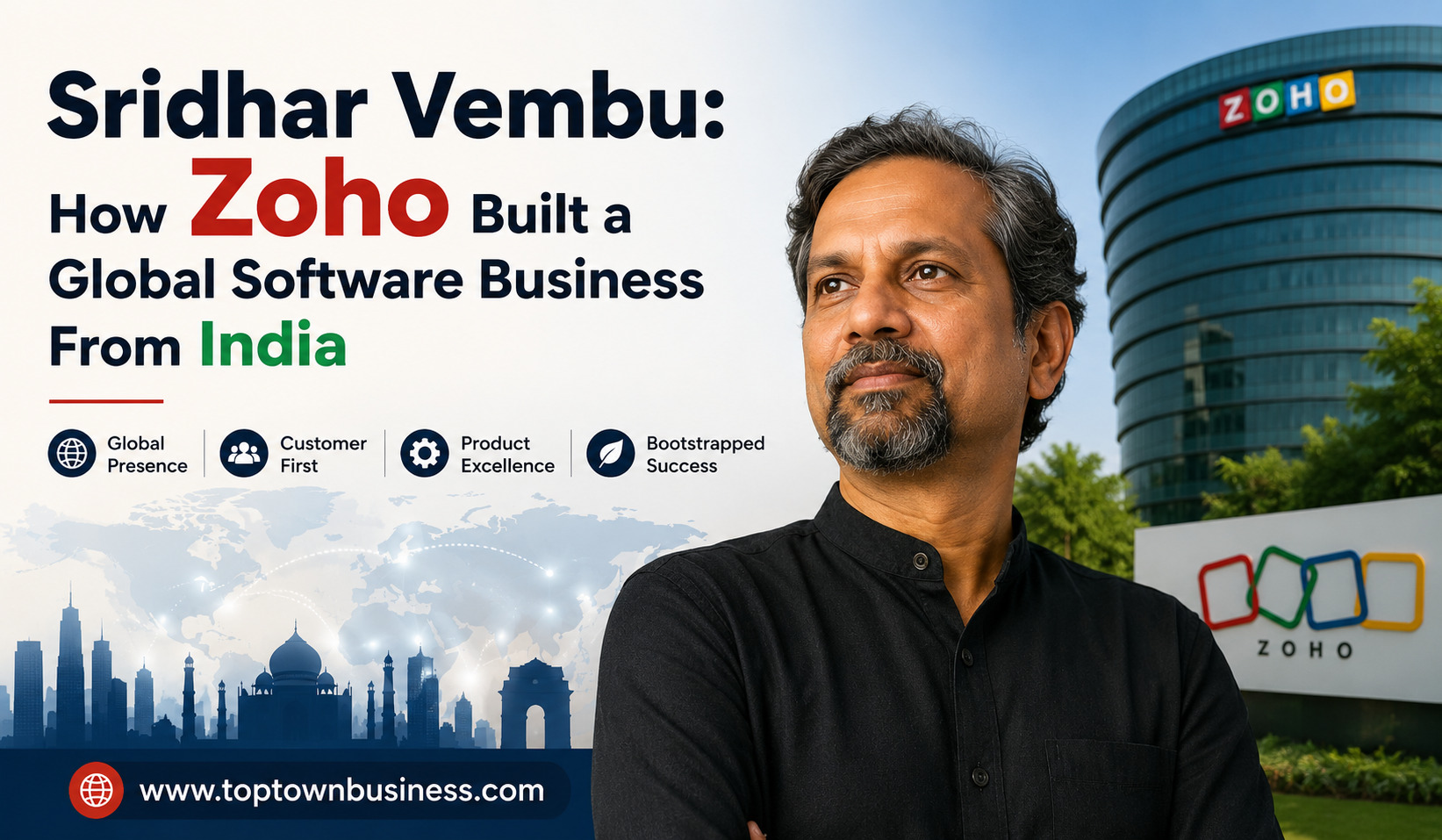
India’s startup success stories are often associated with venture capital, rapid fundraising, billion-dollar valuations, and aggressive expansion. But Sridhar Vembu and Zoho followed a very different path.
Instead of depending on large amounts of outside funding, Zoho built its business gradually, invested heavily in technology, and focused on serving customers around the world. What started in the 1990s as a small software company eventually became a global business software company with products used across international markets.
The story of how Zoho built a global software business from India is therefore more than an entrepreneur success story. It is an example of how a company can compete with much larger technology corporations through product development, patience, customer focus, and a long-term approach to business.
Who Is Sridhar Vembu?
Sridhar Vembu is the co-founder of Zoho Corporation and one of the most distinctive entrepreneurs in India’s technology industry.
Unlike many startup founders who built consumer internet companies, Vembu focused on business software. His ambition was not simply to create another Indian technology services company. He wanted to build products that could compete in global markets.
That required a different mindset.
Instead of treating India mainly as a source of engineering talent for overseas companies, Vembu believed Indian teams could create technology products for customers around the world.
That philosophy became one of the foundations of Zoho’s journey.
The Beginning: AdventNet
Zoho’s story goes back to the mid-1990s, when the company began as AdventNet.
According to Vembu’s account of the company’s history, the business started with operations in both India and the United States. The Indian side focused heavily on product development and research, while the US operation handled sales and customer relationships.
The company’s early focus was on software for the telecommunications and networking industry.
At that time, building a global software company from India was far from straightforward. India’s technology industry was becoming known for IT services, but creating and selling proprietary software products globally was a much harder challenge.
AdventNet nevertheless continued investing in engineering and product development.
The company generated revenue, reinvested much of it into research and development, and gradually developed its own technology capabilities.
Surviving the Dot-Com and Telecom Crash
One of the biggest tests came around the beginning of the 2000s.
The dot-com and telecom sectors experienced a major downturn, and companies connected to those industries faced enormous pressure. AdventNet was heavily exposed to telecommunications, meaning its existing market was suddenly becoming much less attractive.
Instead of simply waiting for the market to recover, Vembu decided that the company needed to reinvent itself.
This became a critical turning point.
The company began developing new businesses, including ManageEngine, focused on IT management software, and eventually Zoho’s cloud software business. Vembu has described this reinvention as a response to the realization that the telecom market might not return to its earlier strength.
This ability to adapt became one of Zoho’s defining characteristics.
The Birth of Zoho
The Zoho brand emerged as the company moved toward cloud-based business applications.
Rather than concentrating on one software product, Zoho developed a broad collection of applications designed to help businesses manage different parts of their operations.
These products addressed areas such as customer relationship management, finance, email, collaboration, human resources, analytics, and productivity.
The larger vision was to create an integrated technology ecosystem for businesses.
This approach gave Zoho an opportunity to compete in a market dominated by much larger companies.
Instead of trying to win through massive advertising budgets, Zoho focused heavily on building software and gradually expanding its customer base.
Why Zoho Chose a Different Business Model
One of the most unusual aspects of Zoho’s journey is its approach to funding.
Zoho has remained privately held and has emphasized that it was built without venture capital. The company has repeatedly described itself as bootstrapped and profitable, allowing it to make decisions without the pressure of external investors seeking a particular exit or valuation.
This strategy gave Vembu and his team greater control over the company’s direction.
For many startups, raising capital can accelerate expansion. But investment can also create expectations around growth, market share, valuations, and eventual exits.
Zoho chose a different path.
The company focused on generating revenue from customers and reinvesting in its products. Vembu has argued that this approach gives the company greater freedom to make long-term decisions rather than optimizing primarily for short-term investor expectations.
Building Products Instead of Chasing Trends
Zoho’s growth has been strongly connected to its emphasis on research and development.
The company’s philosophy is that software should be developed patiently and continuously improved. Zoho describes software development as a form of craftsmanship, emphasizing small teams, iteration, and long-term product quality.
This philosophy helped the company compete in categories where global giants already had strong positions.
Zoho did not need to become the largest company in every category. Instead, it aimed to provide useful products at competitive prices and earn a sustainable share of the market.
That approach was visible even when Zoho faced competitors such as Microsoft and Google. Vembu argued that a smaller company could build a profitable business by serving customers well without necessarily having to “win” the entire market.
How Zoho Became Global From India
One of Zoho’s most important achievements is its international orientation.
The company was not built exclusively around the Indian market. From its early years, it maintained a connection between Indian product development and international sales.
This allowed Zoho to operate with a global mindset while maintaining substantial roots in India.
The model also demonstrated the potential of India’s engineering talent.
Instead of simply providing outsourced development services to foreign companies, Zoho used Indian teams to create its own intellectual property and sell products internationally.
That distinction is important.
Zoho’s story represents a shift from “India as a technology service provider” to “India as a technology product creator.”
Investing in People Through Zoho Schools
Another distinctive part of Vembu’s approach is his emphasis on developing talent internally.
Zoho created the Zoho Schools of Learning, which provide an alternative pathway into technology careers for young people who may not have traditional university qualifications. The program emphasizes practical skills and allows students to learn while receiving financial support.
This approach addresses a problem faced by many technology companies: finding skilled employees.
Instead of relying entirely on conventional academic qualifications, Zoho created a system for identifying promising young people and training them internally.
The strategy also reflects Vembu’s broader belief that talent can be developed rather than simply purchased from the existing job market.
Why Rural India Matters to Zoho
Zoho has also experimented with building offices and creating employment opportunities outside India’s biggest technology hubs.
This is unusual in an industry that has traditionally concentrated heavily around cities such as Bengaluru, Hyderabad, Chennai, Pune, and Mumbai.
The company has argued that cloud technology can make it possible to distribute high-value technology jobs more widely.
For Zoho, this is not simply a social initiative. It is also connected to its approach to talent, company culture, and long-term development.
The idea is simple: talented people do not necessarily have to move to major cities to build global software.
A Global Challenger in Business Software
Today, Zoho competes in several software categories against some of the world’s largest technology companies.
Its portfolio has expanded into a broad ecosystem of business applications, while the company has continued investing in its own technology infrastructure.
Zoho has also emphasized vertical integration, including building and managing its own data-center infrastructure rather than depending entirely on public cloud providers. The company says this approach allows it to control more of its technology stack and focus on performance, security, and cost.
This is another example of Vembu’s long-term philosophy.
Rather than outsourcing every component that can be purchased externally, Zoho has chosen to develop important capabilities internally when it believes doing so creates strategic value.
What Entrepreneurs Can Learn From Sridhar Vembu
Sridhar Vembu’s journey offers several lessons for entrepreneurs.
First, you do not always need venture capital to build a large technology company. Zoho demonstrates that customer revenue can be used to finance growth when the business model and spending discipline support it.
Second, long-term thinking can be a competitive advantage. Zoho did not attempt to become successful overnight. It spent years developing products, technologies, and talent.
Third, Indian companies can build products for global customers from India. Zoho’s journey challenges the idea that world-class software companies must be headquartered in Silicon Valley or depend on massive funding.
Finally, adaptability matters. When the telecom market collapsed, Vembu did not simply defend the old business. The company used the crisis as an opportunity to reinvent itself and enter new software categories.
The Future of Zoho
The global software industry is becoming increasingly competitive, with artificial intelligence, cloud computing, automation, cybersecurity, and changing workplace models reshaping the market.
For Zoho, the opportunity is to continue expanding its software ecosystem while maintaining the principles that helped build the company.
Its long-term independence remains one of its biggest differentiators.
As businesses increasingly look for alternatives to expensive and complicated enterprise software, Zoho’s focus on integrated products, competitive pricing, privacy, and customer relationships could continue to create opportunities.
The bigger question is whether the company can maintain its distinctive culture as it grows internationally.
Conclusion
Sridhar Vembu’s Zoho story is one of India’s most important technology-business journeys. Starting from a small software company in the 1990s, the organization survived industry crashes, reinvented itself, developed a large portfolio of business applications, and built a global customer base.
What makes Zoho particularly interesting is not just its size. It is the way the company was built.
Instead of relying heavily on venture capital or chasing short-term valuations, Zoho focused on customers, products, research and development, internal talent, and financial independence. The company’s own history emphasizes that it has remained bootstrapped and privately held while investing heavily in technology and people.
For Indian entrepreneurs, the lesson is powerful: a global technology company does not necessarily have to be born in Silicon Valley. It can be built from India, one product, one customer, and one long-term decision at a time.