
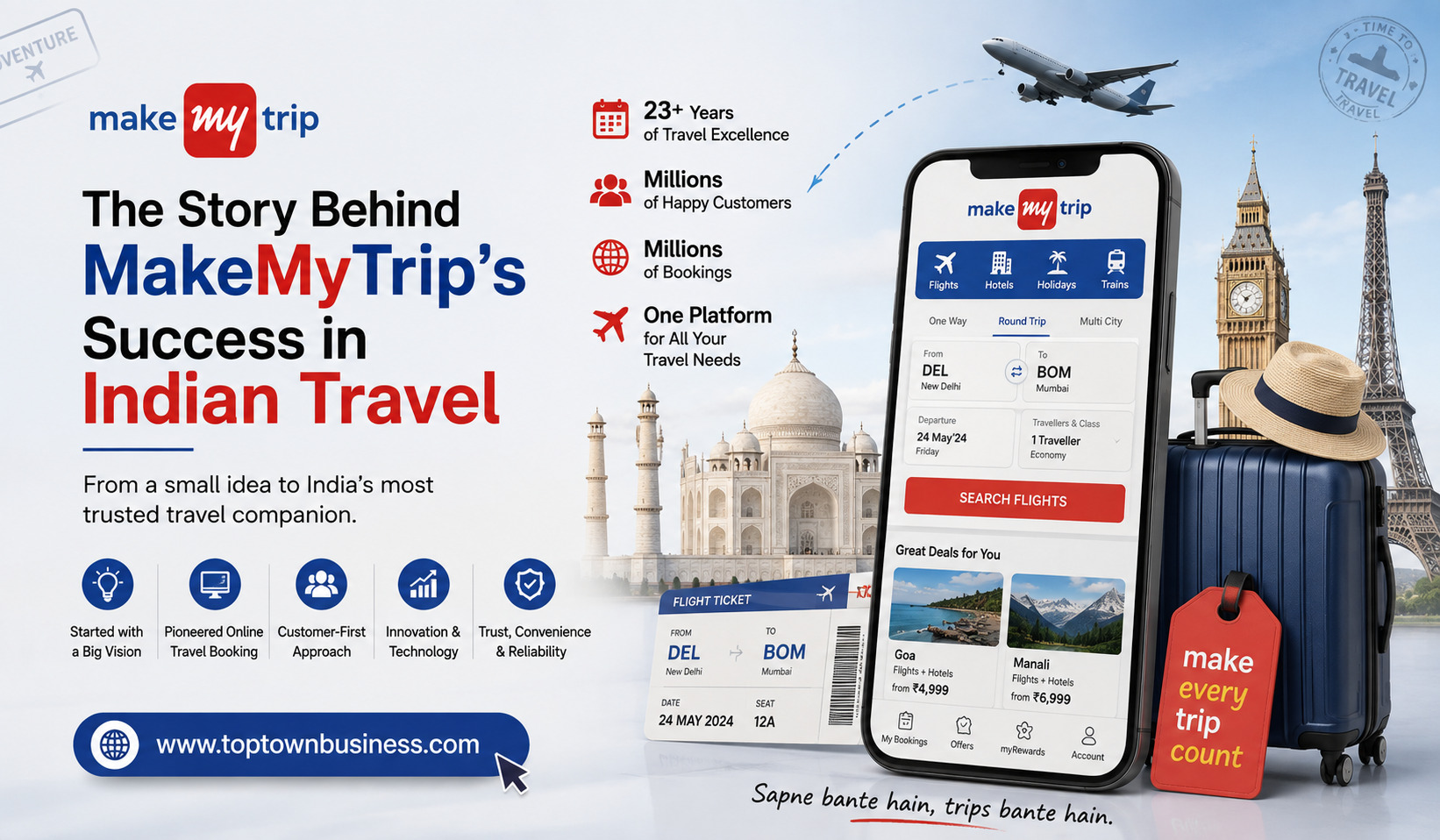
MakeMyTrip is one of the most recognizable names in India’s online travel industry. From booking flights and hotels to arranging buses, trains, holiday packages and other travel services, the platform has become a familiar part of the travel-planning process for millions of Indians.
But MakeMyTrip’s rise was far from easy. The company was founded in 2000, at a time when India’s internet ecosystem was still in its early stages and online shopping was nowhere near mainstream. It survived the dot-com crash, changed its target market, entered India at the right moment and eventually helped reshape how Indians booked travel.
The story of MakeMyTrip is therefore not simply about an online booking website. It is a story of timing, persistence, technology and understanding how consumer behavior was changing.
How MakeMyTrip Started
MakeMyTrip was founded by Deep Kalra in 2000. The original business was not focused primarily on Indian consumers. During its first five years, the company targeted the non-resident Indian market in the United States, particularly people looking for flights between the US and India.
This was a practical decision.
At the beginning of the 2000s, India’s internet penetration was low, credit-card usage was limited and many consumers were still uncomfortable making financial transactions online. Targeting Indians living in the US gave MakeMyTrip access to customers who were already more familiar with online commerce.
The company launched its Indian website in September 2005. This decision eventually became one of the most important turning points in its history.
Surviving the Dot-Com Crash
MakeMyTrip was born during the excitement surrounding the early internet boom. But the optimism surrounding internet businesses did not last.
The dot-com crash created enormous difficulties for technology companies around the world. MakeMyTrip also faced a difficult period, compounded by events such as the September 11 attacks and the SARS outbreak, which affected international travel demand.
The company had to survive without the easy access to capital that many internet startups had initially expected.
This period became an important test of the business.
Instead of abandoning the idea, the company continued operating and eventually found a path toward sustainable growth. The ability to survive when the broader technology market was struggling became one of MakeMyTrip’s defining characteristics.
For a startup operating in a new industry, staying alive long enough for the market to develop can sometimes be as important as having the right idea.
Why India Became the Big Opportunity
The real transformation began when MakeMyTrip entered the Indian market.
Several changes were taking place at the same time. Internet access was becoming more common, consumers were becoming increasingly comfortable with digital services and India’s aviation market was beginning to change.
The emergence of low-cost airlines was particularly important.
Affordable air travel created a much larger potential customer base, while online booking made it easier for travelers to compare fares and purchase tickets without depending entirely on traditional travel agents.
Deep Kalra later highlighted the importance of low-cost airlines and the increasing acceptance of online transactions in India’s travel market.
MakeMyTrip recognized that these changes could work together.
Instead of simply creating another travel website, it attempted to make online travel booking more convenient, transparent and accessible.
Making Travel Booking Easier
Before online travel platforms became popular, consumers often depended heavily on travel agents to arrange flights and holidays.
This process could involve phone calls, visits to offices and limited visibility into available options.
MakeMyTrip changed the experience by bringing travel information and booking options onto one digital platform.
Customers could search for flights, compare options and complete bookings without necessarily visiting a travel agent.
Over time, the company expanded beyond flights into hotels, holiday packages, buses, trains, cars and other travel-related services. Its current platform also includes activities and experiences and several ancillary travel services.
This expansion was strategically important because travel is not a single-product market.
Someone booking a flight may also need a hotel. A family planning a holiday may require transportation and activities. A business traveler may need accommodation and ground transport.
By offering more parts of the journey, MakeMyTrip could increase the number of reasons customers had to return to its platform.
Building Trust in Online Travel
Technology alone was not enough.
MakeMyTrip had to convince people that booking travel online was safe and reliable.
Trust was particularly important in the early years because online commerce was unfamiliar to many Indian consumers. A customer paying for a flight online needed confidence that the booking would actually be confirmed and that support would be available if something went wrong.
The company therefore emphasized reliability, customer support and transparency as important elements of its brand. MakeMyTrip describes its mission as empowering travelers with easy and instant bookings combined with broad choices, technology and customer support.
As more people successfully booked flights and hotels online, consumer confidence grew.
This created a powerful cycle: more bookings generated greater familiarity with online travel, which encouraged more consumers to try digital booking.
The Importance of the 2010 IPO
Another major milestone came in 2010 when MakeMyTrip went public on the Nasdaq.
The company completed its initial public offering in August 2010, offering 5.75 million ordinary shares at $14 per share.
The listing became a landmark moment for the company and India’s emerging internet sector.
MakeMyTrip’s first day of trading attracted enormous attention, with the stock closing sharply higher. The successful IPO also gave the company greater visibility and access to capital for future expansion.
For an Indian internet company that had started a decade earlier during the early dot-com era, reaching the public markets was a remarkable achievement.
It also demonstrated that an online business could survive the difficult early years and eventually build a commercially valuable consumer brand.
Expanding Through Acquisitions
MakeMyTrip did not rely entirely on organic growth.
One of its most important strategic moves came through its combination with the Ibibo Group, which included brands such as Goibibo and redBus. The merger was completed in 2017.
This significantly strengthened MakeMyTrip’s position in India’s online travel market.
Goibibo added another major digital travel brand, while redBus gave the group a strong presence in online bus-ticketing.
The strategy was logical because India’s travel market includes multiple transportation and accommodation segments. Combining complementary platforms allowed the company to serve more travelers and cover more parts of the travel journey.
MakeMyTrip subsequently continued expanding into additional areas, including corporate travel, travel-agent services, foreign exchange and ground transportation.
The Shift to Mobile
Another major change in India’s travel industry was the rapid growth of smartphones.
As consumers moved from desktop computers to mobile devices, travel companies had to make booking possible from anywhere.
MakeMyTrip launched native mobile applications for iOS and Android in 2015.
This was more than a technological upgrade.
Mobile apps allowed the company to remain connected to travelers throughout the entire journey. Customers could search for trips, check bookings and manage travel plans while away from home.
The rise of affordable smartphones and mobile internet therefore created another growth opportunity for the company.
Building a Travel Ecosystem
MakeMyTrip’s long-term strategy has been to become more than a flight-booking website.
Its platforms now cover air tickets, hotels and holiday packages, bus tickets, rail tickets, car hire, activities and other travel-related services. The company operates through MakeMyTrip as well as brands including Goibibo and redBus.
It has also developed services aimed at businesses and travel partners.
For example, myBiz focuses on corporate travel, while myPartner is designed for travel agents. The company has also expanded into markets such as the UAE.
This ecosystem approach helps reduce dependence on one particular travel category.
If airline bookings slow down, hotel bookings or bus travel may provide other opportunities. If consumers travel domestically, the company can also serve their international travel requirements.
Data and Technology as a Competitive Advantage
Modern travel booking involves enormous amounts of information.
Prices change constantly, hotel availability can vary by the minute and travelers expect personalized recommendations. This makes technology a central part of the business.
MakeMyTrip has increasingly invested in artificial intelligence and machine-learning-led features. Its goal is to use technology to improve discovery, personalization and the overall booking experience.
Technology also allows the company to process large volumes of transactions and understand customer behavior.
The more customers use a platform, the more information the company can potentially use to improve its products and services.
That creates an advantage that can become stronger as the business grows.
MakeMyTrip’s Scale Today
The scale of MakeMyTrip’s business illustrates how dramatically India’s travel industry has changed.
For fiscal 2025, the company reported 58.7 million flight segments, 37.0 million hotel and package room nights and 106.5 million travelled bus tickets through its platforms. The company also estimated that nearly one in three domestic air passengers in India booked their air ticket through its platforms during that fiscal year.
These figures show how far the company has moved from its early days of serving a relatively small US-India travel market.
Its growth has also benefited from broader changes in India, including rising smartphone usage, increasing internet penetration, greater travel connectivity and the expansion of the middle class.
What Makes MakeMyTrip Successful?
The success of MakeMyTrip can be traced to several factors.
First, the company entered the Indian online travel market at an important moment. It was already operating when India’s internet and aviation markets began expanding rapidly.
Second, it focused on solving a real consumer problem: making travel booking easier and more transparent.
Third, the company expanded beyond a single service. Flights became the starting point, but hotels, buses, trains, holiday packages and other services eventually created a broader ecosystem.
Fourth, strategic acquisitions strengthened the company’s market position. The Goibibo and redBus combination was particularly significant.
Finally, MakeMyTrip continued adapting to technological changes, moving from websites to mobile apps and increasingly incorporating AI and machine learning into its services.
Lessons Entrepreneurs Can Learn From MakeMyTrip
MakeMyTrip’s journey offers an important lesson about timing.
When the company was founded in 2000, India’s online travel market was nowhere near the size it is today. The founders had to survive long enough for the ecosystem around them to mature.
The company also demonstrates why entrepreneurs should remain close to customer problems. Travel booking was complicated, fragmented and heavily dependent on offline agents. Simplifying that process created genuine value.
Another lesson is the importance of adapting.
MakeMyTrip started with a relatively focused travel proposition but eventually expanded across flights, hotels, buses, trains, holidays and other services. It also adapted to mobile technology and changing consumer behavior.
Conclusion
The story behind MakeMyTrip’s success is ultimately a story of persistence and timing.
Founded by Deep Kalra in 2000, the company survived the collapse of the early internet boom, spent its initial years serving the US-India travel market and entered India in 2005. As low-cost airlines, smartphones, internet access and consumer confidence transformed Indian travel, MakeMyTrip was positioned to benefit from those changes.
Its Nasdaq listing, expansion into hotels and transportation, combination with Goibibo and redBus, mobile-first strategy and continued investment in technology helped turn it into one of India’s leading travel platforms.
More than two decades after its founding, MakeMyTrip’s journey shows how a startup can grow by identifying a changing consumer habit early, surviving difficult periods and continuously adapting its business model to the market around it.